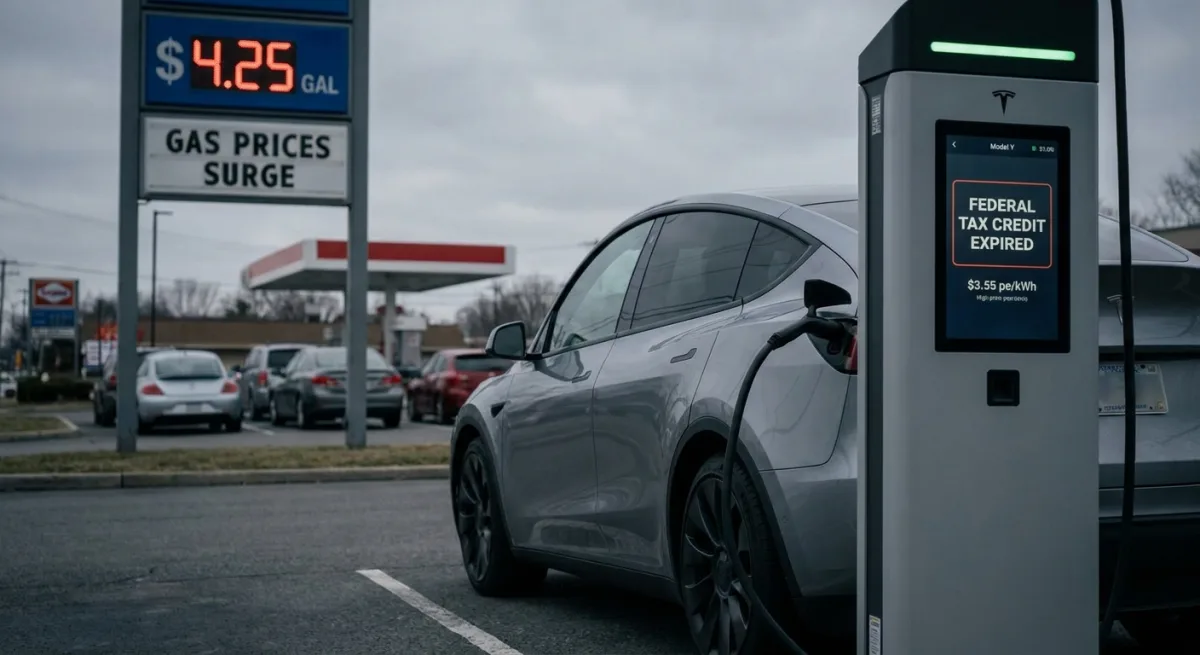
US petrol prices surging past $4 per gallon has pushed consumer interest in electric vehicles to new highs, yet actual sales are plummeting. Following the expiration of the $7,500 federal tax credit, the overall US EV market contracted by a staggering 28% in the first quarter of 2026. This massive drop leaves automakers scrambling to convert curiosity into actual purchases.
Tesla delivered 358,023 vehicles in Q1 2026, missing Wall Street estimates by 7,600 units despite a 6% year-over-year increase against a weak comparison quarter. The company also reported a production surplus of roughly 50,000 units, hinting at either softening demand or a deliberate inventory buildup ahead of the anticipated Model Y Juniper refresh. While Edmunds data shows EV consideration hitting a 2026 peak of 23.8%, affordability remains the ultimate barrier for everyday buyers.
The Tax Credit Void vs. Geopolitical Fuel Spikes
The disconnect between high interest and low sales stems from a single policy shift: the expiration of the $7,500 federal EV tax credit and the $4,000 used EV credit on September 30, 2025. Without this financial cushion, total new EV sales in the US fell to between 212,600 and 216,400 units in Q1 2026. The January market alone saw a brutal 41% year-over-year nosedive.
Meanwhile, the spike in petrol prices - driven by military action against Iran and disruptions in the Strait of Hormuz - has pushed Brent crude to $118 per barrel. Middle Eastern and Asian refineries cut runs by approximately 6 million barrels per day, driving up costs at the pump. While this geopolitical crisis creates a temporary tailwind for EV interest, it is clearly not enough to trigger a buying spree without government incentives.
Tesla's Market Share Illusion
Tesla currently holds between 54% and 58% of the US EV market, up from 46% for the full year of 2025. However, this growth is a byproduct of a shrinking market rather than a massive sales surge. Competitors are bleeding heavily; Ford saw its EV sales collapse by 70% year-over-year, while Chevrolet dropped 55% in January alone. Hyundai even slashed the price of its Ioniq 5 by roughly $10,000 just to move inventory.
Rivian emerged as a rare exception in the sector, boosting deliveries by 20% to 10,365 units. Even in California, traditionally an EV stronghold, Tesla's share of all new vehicle sales dropped from 9.2% to 7.7% as registrations fell 24%. Hybrids are rapidly displacing pure EVs in the state, proving that Tesla's challenges are not just global, but deeply domestic.
Strategic Pricing Reversals and Capital Expenditure
Abandoning the aggressive price cuts of previous years, Tesla's average selling price rose to $45,343 in Q1 2026. Leasing costs have also spiked significantly, with Model 3 payments jumping 67% to $499 per month and Model Y leases rising 39% to $549. This pivot prioritizes profit margins over sheer volume, a risky move that relies heavily on sustained high gas prices to justify the premium.
Furthermore, Tesla has committed to a massive $25 billion capital expenditure plan for 2026, which is $5 billion above prior guidance. This budget will fund six factory ramps, Optimus robot production, AI compute infrastructure, and a new chip fabrication facility in Austin. Because the company expects to be free-cash-flow negative for the rest of the year, this spending requires sustained revenue driven by unpredictable geopolitical fuel spikes.
Winning by Losing Less
Tesla's current position in the US market is less about overwhelming success and more about surviving a brutal industry contraction better than legacy automakers. The 28% drop in overall US EV sales proves that consumer goodwill and high gas prices cannot replace hard financial incentives. If crude oil prices stabilize and drop back toward $70 a barrel, the temporary tailwind driving current EV curiosity will vanish, exposing the raw affordability crisis underneath.
Building a $25 billion expansion strategy while relying on conflict-driven fuel spikes is a massive gamble. While the recent approval of Tesla's Full Self-Driving software in Europe offers a unique competitive edge, the domestic reality is stark. Tesla is winning the US market simply by losing less ground than Ford and GM, signaling that the broader EV transition is facing its most severe reality check to date.