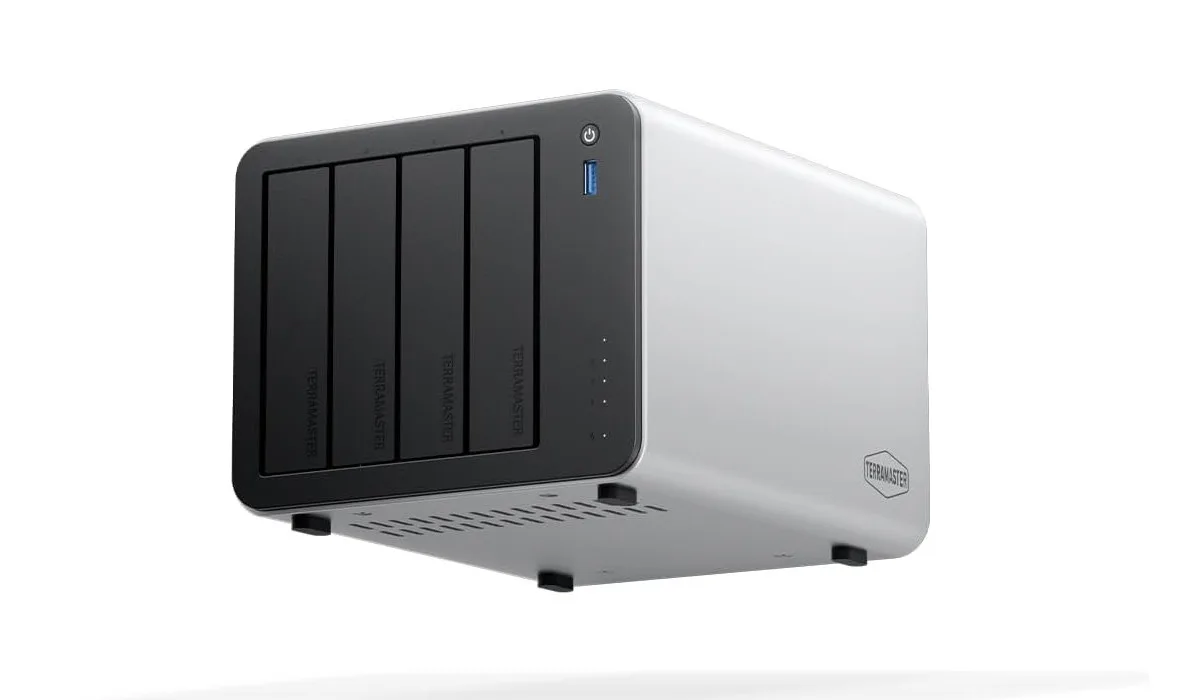
TerraMaster has officially launched the F4-425 Pro 4+3 Hybrid NAS, upgrading its high-performance storage lineup with Intel’s latest octa-core processors. Designed primarily for small teams and power users demanding high-speed local storage, this new model pairs massive capacity with dual 5GbE networking to eliminate data transfer bottlenecks. The system is available in two distinct processing tiers, allowing buyers to choose between an Intel Core i3-N305 or the newer Core 3 N350 chip.
The "4+3" moniker refers to the unit's hybrid storage architecture. It features four SATA bays capable of holding up to 132TB of traditional HDD or SSD storage (32TB per drive), alongside three M.2 2280 NVMe SSD slots that support an additional 24TB (8TB per drive). This setup allows users to leverage high-capacity hard drives for bulk storage while utilizing the NVMe slots for high-speed caching or dedicated fast-access volumes.
Hardware Specifications and Processing Power
The core difference between the two available models lies in their processing efficiency and memory allocation. The base model utilizes the Intel Core i3-N305 "Alder Lake-N" processor (15W TDP) paired with 8GB of DDR5 memory. The premium tier steps up to the Intel Core 3 N350 "Twin Lake" processor (7W TDP) and doubles the memory to 16GB of DDR5. Both systems support RAM expansion up to 32GB.
Connectivity is robust across both variants. The NAS includes two 5GbE RJ45 ports that support link aggregation via SMB Multichannel, effectively doubling the bandwidth for compatible networks. Peripheral expansion is handled by three USB 3.2 Type-A ports (10 Gbps) and one USB 3.2 Type-C port (10 Gbps). An HDMI 2.1 port is also present, though it is strictly reserved for terminal access rather than media playback.
New Features in TOS 7
The F4-425 Pro ships with TerraMaster's latest operating system, TOS 7, which is built on the Linux 6.12 kernel. This update introduces several actionable features designed to streamline workflow and data management for professional environments.
- OpenClaw AI Integration: Supports natural language control, allowing users to execute complex searches and commands using conversational prompts.
- Enhanced Search Engine: TerraMaster claims a 120% improvement in search accuracy and a 10x increase in query speed for faster file retrieval.
- Smart ISO Mounting: Users can now mount and access ISO files directly with a simple double-click, bypassing the need for third-party extraction tools.
- Advanced Network Controls: Introduces per-port bandwidth limits and a unified recycle bin to better manage shared team resources.
The Efficiency Equation for Always-On Storage
While Intel's naming convention shift from Alder Lake-N to Twin Lake might suggest a massive generational leap, the Core 3 N350 is essentially a refined refresh of the i3-N305 with marginally higher clock speeds. However, the real story here is the thermal design power (TDP). The N350 achieves its performance at just 7W, less than half the 15W draw of the i3-N305. For a device designed to run 24/7, this drastic reduction in power consumption - combined with the jump from 8GB to 16GB of RAM - makes the $110 price difference easily justifiable for businesses running multiple Docker containers or heavy AI workloads.
Pricing strategy also plays a major role in the F4-425 Pro's rollout. TerraMaster is currently offering the NAS on its direct storefront for $559.99 (i3-N305) and $669.99 (N350) as part of a time-limited 20% promotion. Meanwhile, standard retail pricing on Amazon sits significantly higher at $699.99 and $799.99, respectively. For a typical household, the older F4-425 Plus (Intel N150) at $519.99 remains a more practical buy, but for small studios needing 5GbE speeds and AI-driven file retrieval, the N350 Pro model hits a very compelling sweet spot.