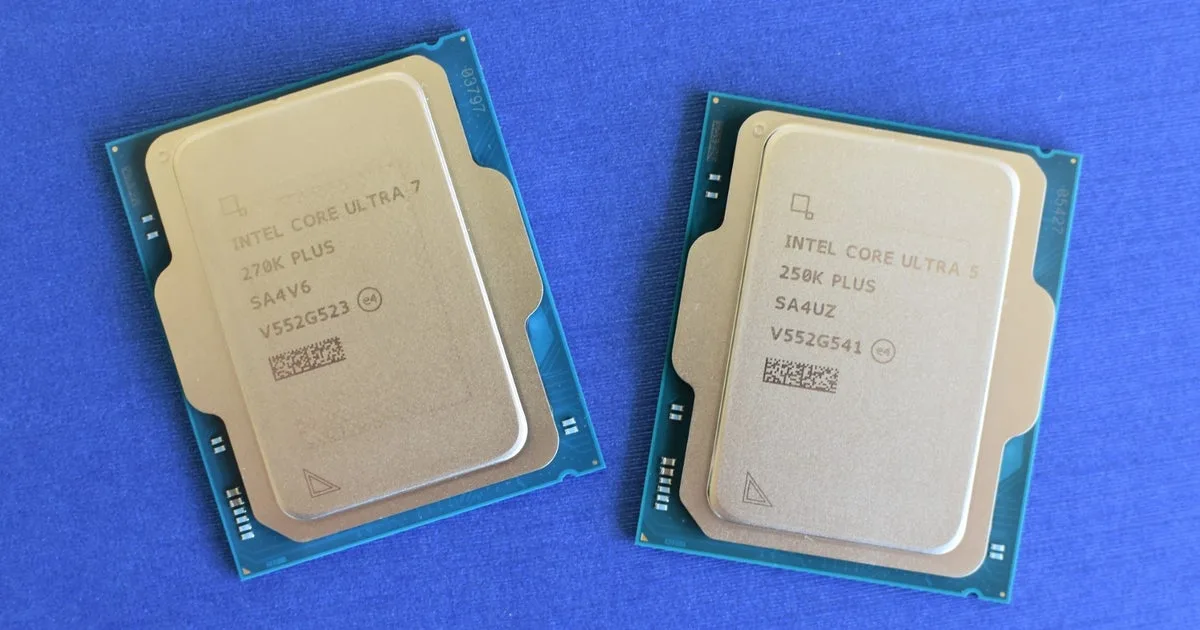
The Intel Core Ultra 7 270K Plus and its mainstream sibling, the Core Ultra 5 250K Plus, have officially arrived as Intel's latest attempt to refine the Arrow Lake architecture. Aimed primarily at PC builders, multitaskers, and budget-conscious creators, these Arrow Lake Refresh processors deliver exceptional thermal efficiency and aggressive pricing. For consumers weighing a platform upgrade, these chips offer a compelling productivity bargain, even if they ultimately fail to dethrone AMD in pure gaming performance. This release signals a transitional phase for Intel, prioritizing multitasking stability and cooler temperatures over brute-force frame rates.
To address the latency issues that plagued the original Core Ultra 200S family, Intel has implemented sensible architectural adjustments rather than simply pushing clock speeds to dangerous thermal limits. The flagship Core Ultra 7 270K Plus maintains a 5.5GHz maximum boost clock, identical to the older Core Ultra 7 265K. Meanwhile, the Core Ultra 5 250K Plus sees a minor bump to 5.3GHz, up from the 5.2GHz found on the Core Ultra 5 245K. Both processors also benefit from the addition of four extra Efficiency cores (E-cores) compared to their pre-Refresh counterparts, significantly boosting multithreaded workloads without drawing excessive power.
Architectural Tweaks and Binary Optimization
The most significant under-the-hood change is a 900MHz speed boost to the die-to-die (D2D) frequency across both new processors. This directly targets the latency penalty introduced when Intel split its once-unified memory and compute controllers into separate tiles. By accelerating how quickly these disparate components communicate, Intel aims to claw back the gaming performance lost during the transition away from monolithic chip designs. While this approach is highly power-efficient, the real-world gaming gains remain somewhat muted against heavy competition.
These processors are also the first to utilize the Intel Binary Optimization Tool, a new feature integrated into the Intel Application Optimization app. This software is designed to increase instructions per clock (IPC) in specific titles, allowing the CPU to process more data per cycle without raising physical clock speeds. However, its current utility is limited by a small supported roster of just over a dozen games at launch. In testing, enabling the tool in Cyberpunk 2077 pushed the Core Ultra 7 270K Plus from 233fps to 243fps, while the Core Ultra 5 250K Plus climbed from 224fps to 233fps - a modest 4% improvement in both scenarios.
Gaming Benchmarks and Thermal Efficiency
Despite Intel's internal claims regarding gaming supremacy, benchmark results paint a sobering picture for the Arrow Lake Refresh. In Total War: Warhammer III, the Core Ultra 5 250K Plus fails to match the older Core i5-14600K, and both new chips run roughly 10% slower in F1 2024 compared to previous generations. The processors do secure narrow victories in Cyberpunk 2077 and Returnal, where the Core Ultra 7 270K Plus manages to edge past the former flagship Core i9-14900K. However, neither chip comes close to challenging the dominance of the AMD Ryzen 7 9800X3D in pure gaming workloads.
Where the Core Ultra 200S Plus series truly shines is in thermal management and aggressive market pricing. During intense gaming sessions, the Core Ultra 7 270K Plus peaked at just 76°C, while the Core Ultra 5 250K Plus ran at an icy 68°C - a massive improvement over the Core i9-14900K, which notoriously hit the 100°C danger zone. In Cinebench productivity tests, the 270K Plus maxed out at a safe 90°C, and the 250K Plus at 74°C, both running cooler than the Ryzen 7 9800X3D's 88°C peak. Priced at just $300 for the 270K Plus and $200 for the 250K Plus, these chips are roughly $100 cheaper than their original Arrow Lake equivalents, making them highly attractive for budget-conscious workstation builds.
My Take
Intel's strategy with the Arrow Lake Refresh is a fascinating pivot from the brute-force tactics of the 13th and 14th generations. By pricing the Core Ultra 7 270K Plus at $300 - nearly $200 cheaper than the Ryzen 7 9800X3D - Intel is effectively conceding the ultra-enthusiast gaming crown to AMD in exchange for dominating the mid-range productivity market. The addition of four E-cores and the remarkable thermal efficiency make the $200 Core Ultra 5 250K Plus an absolute steal for video editors and multitaskers who want a quiet, cool-running system without investing in premium liquid cooling.
However, for dedicated gamers, the 900MHz D2D frequency boost simply isn't enough to overcome the latency inherent in Intel's current tiled architecture. The fact that these chips are tied to the LGA 1851 socket, which is expected to be retired soon, makes an immediate upgrade difficult to justify for anyone already on a 13th or 14th Gen platform. If your primary goal is pushing maximum frame rates, the smartest move is to wait for Intel's upcoming Nova Lake architecture later this year, which is rumored to introduce Big Last-Level Cache (BLLC) to finally rival AMD's 3D V-Cache technology head-on.