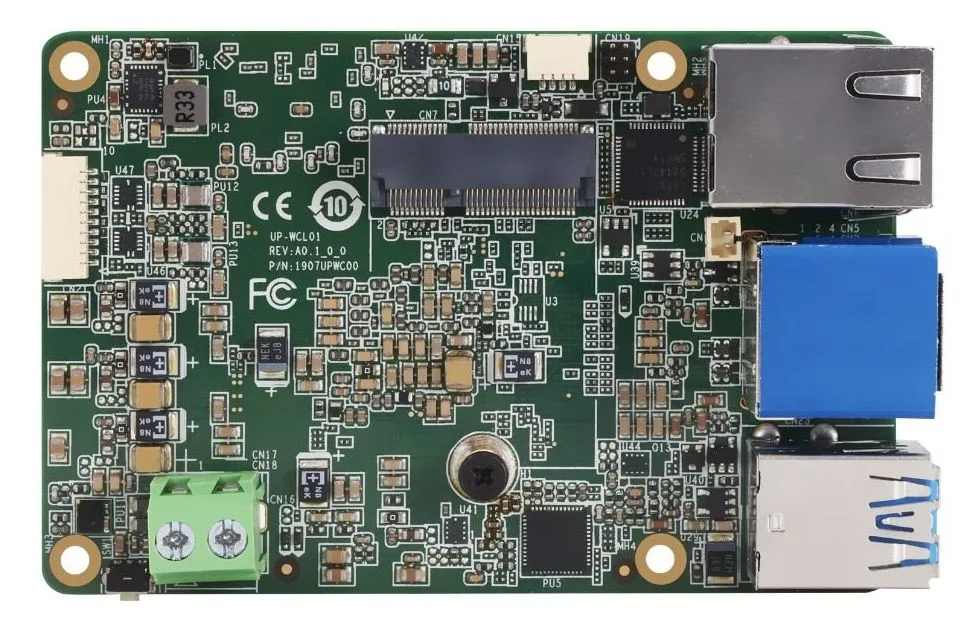
The AAEON UP WCL is a credit card-sized single-board computer that packs Intel's new Wildcat Lake architecture into a footprint identical to the Raspberry Pi Model B. Designed for edge computing developers and power users who need native x86 compatibility, this board supports Windows 11 and Ubuntu out of the box. Unlike typical Arm-based hobbyist boards, it scales up to an Intel Core 7 processor, offering a massive leap in single-core performance over the Raspberry Pi 5's BCM2712 chip.
While it lacks built-in Wi-Fi and Bluetooth, the UP WCL compensates with an M.2 2230 slot for custom wireless cards and a 2.5 GbE Ethernet port for high-speed wired networking. The board supports up to 24GB of onboard LPDDR5 memory and up to 256GB of UFS storage, making it highly capable for data-intensive local workloads.
Performance will vary significantly based on the chosen processor tier. AAEON plans to offer three distinct Intel Wildcat Lake configurations:
| CPU Model | Cores | P-Core Max Freq | GPU Cores | GPU Max Freq | GPU TOPS | NPU TOPS |
|---|---|---|---|---|---|---|
| Core 7 350 | 6 (2P + 4LP-E) | 4.8 GHz | 2 | 2.6 GHz | 21 | 17 |
| Core 5 320 | 6 (2P + 4LP-E) | 4.6 GHz | 2 | 2.5 GHz | 20 | 16 |
| Core 3 304 | 5 (1P + 4LP-E) | 4.3 GHz | 1 | 2.3 GHz | 2.3 | 15 |
Beyond the silicon, the 85 x 56mm board includes a robust I/O selection tailored for industrial and maker applications. Features include:
- 1 x HDMI 2.1 port
- 3 x USB 3.2 Gen 2 Type-A ports
- 1 x 12V/5A DC power input
- 1 x 10-pin header (GPIO, SPI, IWC, PWM, USB 2.0, UART)
- RTC battery support
- TPM support for enhanced security
The UP Nexus WCL Expansion
For projects requiring more expansion, AAEON is also launching the UP Nexus WCL. This larger 101.6 x 101.6mm mainboard supports up to 48GB of RAM, dual 2.5 GbE LAN ports, an M.2 2242/2280 slot, and a 40-pin GPIO header. Both boards will also be available as complete mini PCs, dubbed the UP WCL Edge and UP Nexus WCL Edge, featuring dedicated enclosures. Mass production for the entire lineup is slated for the third quarter of 2026.
The Hidden Cost of x86 Miniaturization
While the AAEON UP WCL offers an impressive amount of compute power in a Raspberry Pi form factor, its 30 to 36-watt typical power consumption completely changes the deployment equation. A standard Raspberry Pi 5 peaks around 12 watts under heavy load, allowing for passive cooling or minimal fan setups. Pushing 36 watts through an 85 x 56mm board will require aggressive active cooling solutions, making it less ideal for silent, low-profile home server projects.
However, for industrial edge AI applications, this power draw is a fair trade-off. The inclusion of dedicated NPU TOPS (up to 17 on the Core 7) and native Windows 11 support means enterprise developers can deploy complex machine learning models without rewriting their x86 software stack for Arm. It is not a Raspberry Pi killer; rather, it is a specialized industrial tool wearing a hobbyist disguise.