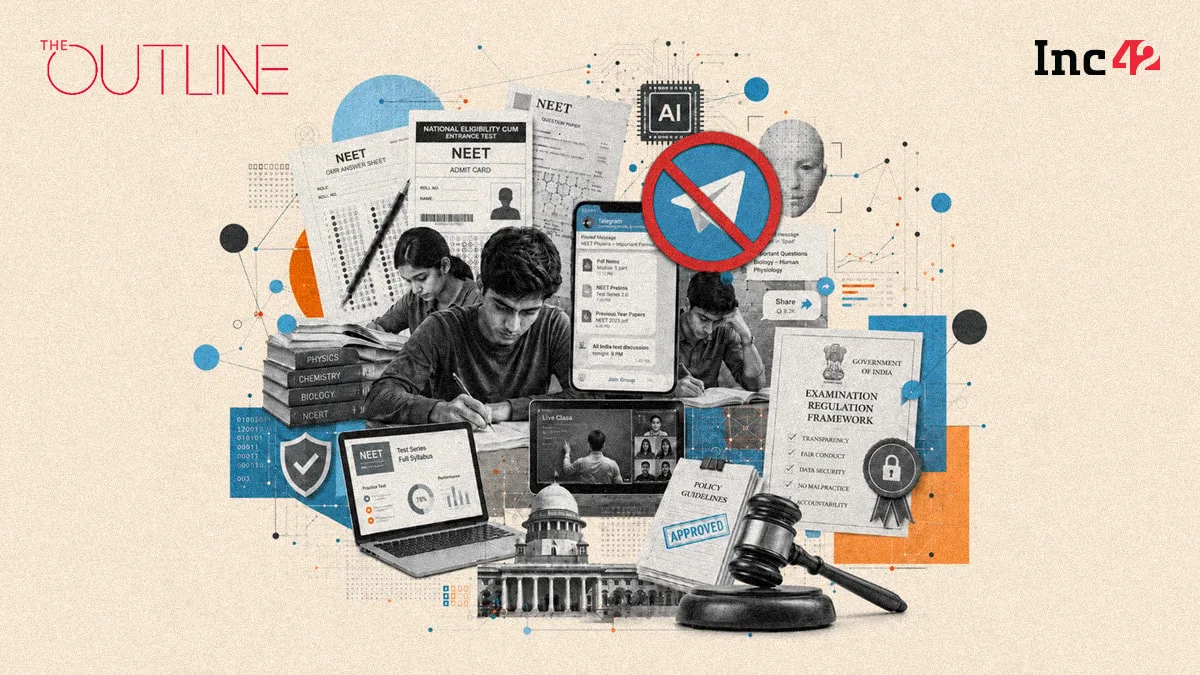
The temporary Telegram ban in India has left millions of students and educators scrambling, exposing a massive technological void in the country's education system. Following the catastrophic NEET-UG paper leaks that disrupted the lives of over 2.2 million medical aspirants, the government invoked Section 69A of the Information Technology Act to block the messaging app, likening its channels to the dark web. As the Delhi High Court declined to interfere with the blocking orders, Telegram remains inaccessible in India until at least June 22, forcing the nation to question whether targeting a communication platform can actually cure a systemic crisis of integrity.
The drastic measure has severely divided the legal, cybersecurity, and policy communities. For some, the ban represents a necessary exercise of state leverage against uncooperative tech giants. Rahul Rai, cofounder of the law firm Axiom5, noted that while leaking is the core wrongful conduct and Telegram is merely a means of dissemination, the government's hands are tied. "If the government has secured evidence of the paper being tossed around by a set of masked IDs and seeks their identities, what can the Indian government do when an app like Telegram just simply refuses to cooperate?" Rai explained.
Why the Government Dropped the Hammer on Telegram
Proponents of the ban argue that temporary restrictions create necessary friction, reduce immediate dissemination risks, and establish accountability expectations for intermediaries. Sohini Mandal, founder of Nilaya Legal, argued that because the platform-wide ban is for a very short period, it meets the test of proportionality as the least restrictive mechanism available to prevent student extortion. However, digital rights advocates and education experts warn that treating the symptom ignores the disease.
Maheshwer Peri, founder of Careers360, called the move extremely short-term and myopic, warning that organized fraud networks are highly fluid. "You need to plug the loophole, which is the leak, not the distribution," Peri argued. Tech policy adviser Pranesh Prakash echoed this sentiment, pointing out that many Telegram channels actually scam students with fake, backdated leaks. He suggested the government should instead follow the money trails of these scammers using the multiple layers of KYC built into the UPI payment system.
In the future, if a government wants to shut down an app before an election or during a protest, it will rely on this precedent. The 'temporary' framing makes it more concerning because that is precisely what makes it so easy to invoke.
- Anirudh Rastogi, Founder, Ikigai Law
The collateral damage of the ban is already immense. Millions of lawful exam aspirants have lost access to legitimate study resources, and teachers who conduct quizzes and catch-ups on Telegram have been cut off due to the actions of a few malicious actors. This disruption comes at a critical time, with students facing immense psychological pressure and several tragic reports of suicide in the aftermath of the exam's cancellation.
The Edtech Void: Chasing VC Funds Over Infrastructure
Beyond the immediate legal battle, the NEET crisis is a damning indictment of the Indian edtech ecosystem. While the education ministry flounders to figure out a solution, edtech companies remain busy running high-margin coaching classes. Despite billions of dollars poured into India's booming educational technology sector over the past decade, the ecosystem has entirely failed to tackle the root causes of examination fraud.
Investors in India are overwhelmingly driven by the pursuit of rapid, outsized returns. This effectively pushes founders toward consumer-facing applications, SaaS models, or test-prep platforms, while they shy away from arduous, infrastructural B2G (business-to-government) problems. Solving the vulnerabilities related to NEET, CUET, and JEE involves painful, long-haul engagement cycles with lethargic government departments, fragmented state-level authorities, and cautious policymakers.
A senior faculty member at PhysicsWallah noted that platforms like Telegram have democratized learning, helping teachers reach students in Tier II and III cities who previously lacked access to immediate resources. However, the executive acknowledged that long-term solutions are desperately needed, including stronger security measures and greater accountability at every level, rather than relying on temporary app restrictions.
SNECS and the Future of AI-Secured Exams
The recurrence of paper leaks is not a question of technological capacity, but of intent. Clear examples of structural redesign already exist, such as the Secure National Examination Conduction System (SNECS) proposed by Dr. Santosh Ramrao Butle. Dr. Butle, who has direct operational experience managing hybrid-mode examinations for hundreds of thousands of students, designed SNECS to eliminate the physical handling of test papers.
Under the SNECS paradigm, no question paper exists in a readable physical or digital format anywhere in the country until precisely 30 to 60 minutes before the exam begins. An AI system automatically selects questions from a massive, secure repository. The final paper is locked in high-grade encryption that requires simultaneous authorization from multiple independent institutions to unlock, and is printed directly at the examination centers. Coupled with stringent biometric verification, systems like SNECS illustrate the true potential of applied technology.
Despite being submitted as a formal policy proposal to the National Testing Agency and the Ministry of Education, SNECS has not been considered for national-level implementation. The fact that such blockchain-secured frameworks remain largely conceptual highlights a severe lethargy in modernizing India's educational infrastructure.
The Reactive Trap of Digital Censorship
Banning Telegram to stop exam leaks is the digital equivalent of playing whack-a-mole with a blindfold on. If the scammers migrate to WhatsApp, Signal, or decentralized platforms tomorrow, the government's current logic dictates that those must be banned next. Relying on Section 69A of the IT Act for "temporary" platform-wide bans sets a dangerously low threshold for digital censorship, establishing a playbook that could easily be weaponized during political protests or elections under the guise of maintaining public order.
More importantly, this crisis exposes a fundamental market failure in India's $10 billion edtech sector. The industry has optimized for rapid venture capital returns through B2C test prep, completely abandoning the B2G infrastructure required to actually administer those tests safely. Until the Indian government actively incentivizes deeptech solutions like SNECS through lucrative public-private partnerships, human hands will continue to touch physical exam papers. As long as that analog vulnerability exists, 2.2 million students will remain at the mercy of the highest bidder, and no amount of app banning will secure their future.