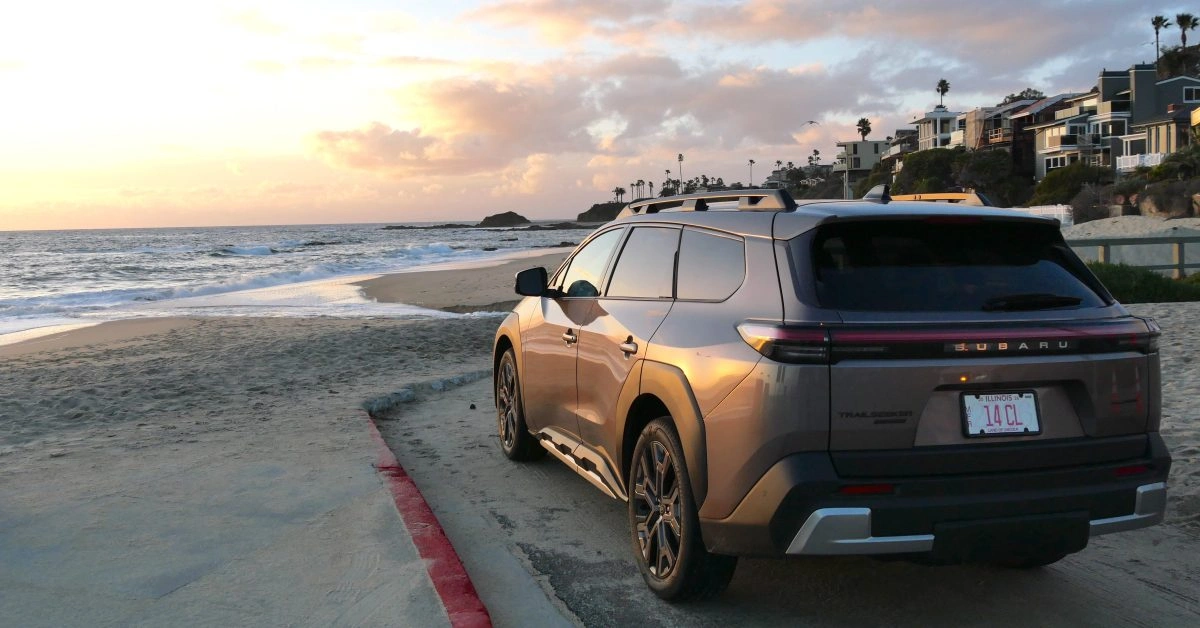
The highly anticipated Subaru Trailseeker EV review is finally here, marking a significant milestone for the Japanese automaker as it introduces a direct electric replacement for the beloved Outback. Designed specifically for outdoor enthusiasts and loyal brand followers looking to transition to electric mobility, this new rugged SUV aims to prove that zero-emission driving does not require sacrificing trail-ready capability. By delivering the most powerful production vehicle in the company's history, Subaru is giving prospective buyers a compelling reason to upgrade, ensuring that their next adventure vehicle can handle both steep muddy inclines and rapid highway merging with equal confidence.
To demonstrate these capabilities, Subaru hosted a first drive event in Southern California following a day of heavy rain. The muddy, mist-covered terrain provided an ideal testing ground for the vehicle's off-road prowess. The Trailseeker handled the challenging conditions effortlessly, largely thanks to the integration of X-MODE. This advanced traction and braking system, activated via a dedicated button next to the shifter, optimizes the all-wheel-drive performance specifically for snow, mud, and steep hills. Even for novice off-road drivers, the system proved highly confidence-inspiring, easily managing standing water and slick mud that would typically challenge a standard road car.
Record-Breaking Performance and Engineering
Beneath the rugged exterior lies a powertrain that shatters previous brand records. The Trailseeker delivers a staggering 375 horsepower, officially making it the most powerful car Subaru has ever manufactured. This output comfortably eclipses the 341 horsepower generated by the legendary rally-racing WRX STI. Consequently, the electric SUV sprints from 0 to 60 mph in just 4.4 seconds, securing its title as the quickest Subaru to date. Drivers can tailor this performance using three distinct drive modes: Eco, Normal, and Power. While Eco mode remains highly responsive for daily commuting, switching to Normal or Power unlocks a significantly more aggressive throttle response. Notably, the throttle mapping is linear and immediate, avoiding the artificial delays or smoothing effects that plague some competing electric vehicles.
From an engineering and manufacturing standpoint, the Trailseeker represents a nuanced evolution of the ongoing partnership between Subaru and Toyota. While the smaller, entry-level Uncharted EV is manufactured in Toyota facilities, the Trailseeker is proudly built at Subaru's own factory in Gunma, Japan. Toyota will release its own version of this platform, dubbed the Woodland. Structurally, the Trailseeker shares its front-end architecture with the existing Solterra EV up to the C-pillar. However, behind the C-pillar, the Trailseeker extends an additional 6 inches to maximize cargo space and passenger comfort, fulfilling its role as a true Outback successor.
Dimensions and Driving Dynamics
The physical footprint of the Trailseeker clearly distinguishes it from its smaller sibling, the Uncharted. The new flagship is 13 inches longer, 2 inches taller, and carries an additional 100 to 300 pounds depending on the specific trim level. This added bulk naturally makes the vehicle less tossable on winding canyon roads compared to the lighter Uncharted. However, the low center of gravity inherent to its battery placement ensures it still feels remarkably stable and engaging to drive for a mid-size SUV.
Despite the impressive acceleration and off-road tech, the regenerative braking system leaves room for improvement. Drivers can adjust the regeneration levels using convenient paddles mounted on the steering wheel. Unfortunately, even at its maximum setting, the regenerative braking is not strong enough to enable true one-pedal driving. This conservative approach requires drivers to rely on the physical brake pedal more frequently than they might in rival electric SUVs, which could be a slight disappointment for EV veterans accustomed to maximum energy recuperation.
| Specification | Subaru Trailseeker EV |
|---|---|
| Horsepower | 375 hp |
| 0-60 mph Time | 4.4 seconds |
| Manufacturing Location | Gunma, Japan |
| Length vs Uncharted EV | +13 inches |
| Height vs Uncharted EV | +2 inches |
| Weight vs Uncharted EV | +100 to 300 lbs |
Frequently Asked Questions
Does the Subaru Trailseeker support one-pedal driving?
No, while it features adjustable regenerative braking via steering wheel paddles, the maximum setting is not strong enough to bring the vehicle to a complete stop without using the brake pedal.
How does the Trailseeker compare to the Subaru Solterra?
The two vehicles are nearly identical from the front bumper to the C-pillar. However, the Trailseeker adds 6 inches of length to the rear, providing significantly more cargo space to serve as a proper Outback replacement.
Where is the new Trailseeker manufactured?
Unlike the smaller Uncharted EV which is built by Toyota, the Trailseeker is manufactured at Subaru's own assembly plant in Gunma, Japan.
My Take
The 2026 Subaru Trailseeker EV is exactly the vehicle the brand needed to retain its fiercely loyal customer base in the electric era. By pushing the powertrain to 375 horsepower and achieving a 4.4-second 0-60 mph time, Subaru has effectively silenced any concerns that an electric Outback replacement would lack highway passing power or trail-climbing grunt. Building the vehicle in their Gunma factory rather than outsourcing it entirely to Toyota also signals a strategic desire to maintain strict quality control over their flagship models. However, the reluctance to implement true one-pedal driving highlights a lingering conservatism among legacy Japanese automakers. They are clearly prioritizing a familiar, gas-car-like transition for their current owners over embracing EV-native driving dynamics. While this might alienate hardcore EV enthusiasts, it is a calculated and likely successful strategy to convert traditional Outback drivers who want rugged capability without the learning curve of aggressive regenerative braking.
This article was written by AI from reporting by electrek.co.