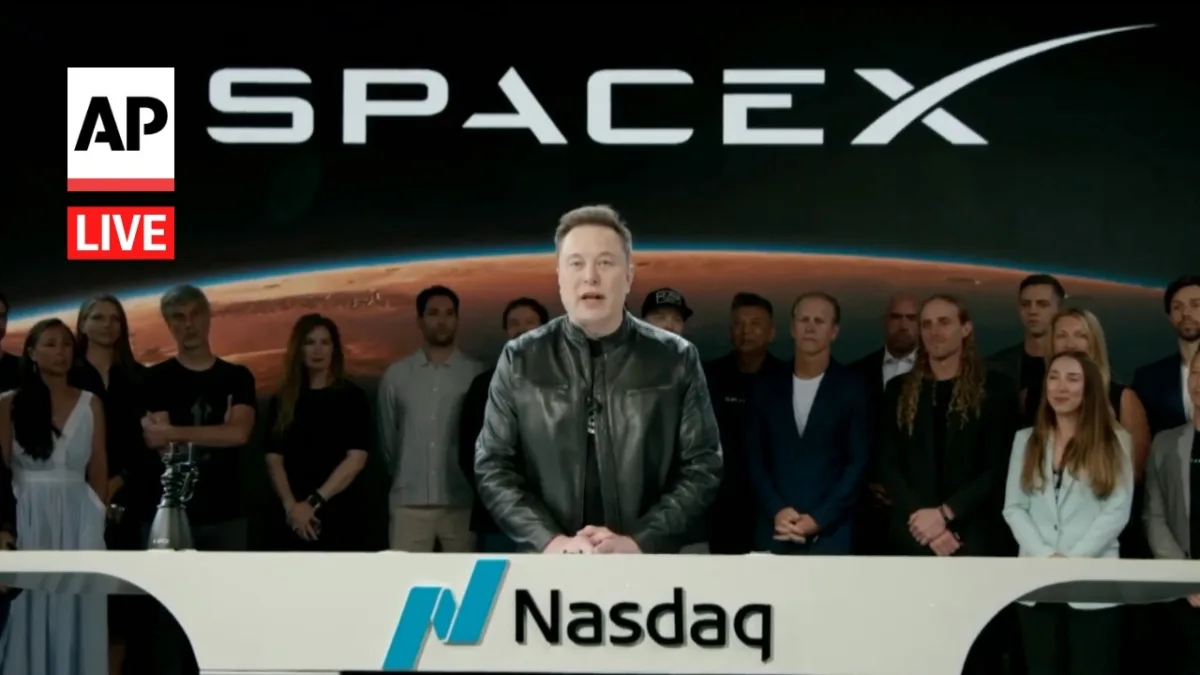
Elon Musk has officially taken SpaceX public at a staggering $1.75 trillion valuation, sparking a frenzy among retail investors desperate to replicate the historic gains of Tesla's early days. However, the financial mechanics behind this highly anticipated initial public offering (IPO) reveal a vastly different landscape. When Tesla debuted in 2010, it carried a microscopic $1.7 billion valuation, giving early backers the "Musk premium" essentially for free. Today, SpaceX is priced roughly one thousand times higher, meaning the explosive potential for a thousand-fold return is mathematically impossible.
The premium, the hype, and the future performance of three separate revolutionary industries have already been aggressively priced into the offering. This leaves public investors to bear the immense structural risks of a mature, gargantuan enterprise while chasing the rapidly diminishing returns of a valuation that peaked before the opening bell even finished ringing.
The Illusion of the "Musk Premium"
Despite the overwhelming market hype, the underlying financials present a stark reality. Last year, SpaceX recorded a massive net loss of $4.94 billion on $18.67 billion in revenue. Buying into a $1.75 trillion mega-cap stock with the expectation of small-cap growth is a classic cognitive error, driven by the behavioral trap known as the lottery effect.
According to historical data compiled by finance researchers like Jay Ritter at the University of Florida over four decades, unprofitable companies going public consistently underperform the broader market by an average of 30 percent over the subsequent three years. Believing that the personal charisma of a singular founder can rewrite the laws of corporate finance at this scale ignores the reality that Tesla made its early backers rich because of its modest starting valuation, not simply because of the man at the helm.
Engineered Scarcity and Lockup Loopholes
The architecture of the SpaceX IPO appears designed to manufacture demand rather than discover fair value. Underwriters have floated an incredibly tiny slice of the company - just 4 percent, representing roughly $75 billion of stock. This microscopic float is pitted against insatiable global demand and forced buying from massive passive index funds, triggered by the company's rapid ten-day inclusion in the MSCI index. Furthermore, the retail allocation was quietly slashed from an initial target of 30 percent down to the low 20s to accommodate institutional giants.
Adding to the risk is a highly unusual, tiered lockup structure. Instead of the traditional 180-day cliff, insiders can begin selling off tranches immediately following the first public earnings report, with Elon Musk himself exempt from several key restrictions. This playbook mirrors the 2019 listing of Saudi Aramco, which floated just 1.5 percent at a $1.7 trillion valuation and now trades well below its IPO price. Similarly, Snowflake's explosive 2020 debut left opening-day buyers waiting half a decade just to break even.
The Valuation Reality Check
At $135 per share, SpaceX trades at an eye-watering 94 times trailing revenue. To justify this multiple, traditional discounted cash flow models must assume the aerospace giant will eventually generate over a trillion dollars in revenue and hundreds of billions in pure profit. For context, Amazon generates approximately $740 billion in revenue, while Alphabet nets about $130 billion in annual profits. SpaceX is currently priced to comfortably eclipse both tech behemoths.
Wall Street bulls justify this by pointing to hyper-growth scenarios where Starlink becomes a software-as-a-service monopoly, Starship achieves weekly commercial flights, and the recently integrated xAI dominates orbital cloud computing. However, analysts remain deeply skeptical of xAI's ability to compete with OpenAI and Google using untested space-based infrastructure. Independent analysts at Morningstar estimate the actual fair value of the business is closer to $780 billion, or roughly $63 a share.
Absolute Control Without Guardrails
Corporate governance presents another massive risk for public shareholders. SpaceX has structured its listing so that Elon Musk retains an absolute 85 percent of the total voting power through super-voting Class B shares. This means public investors are buying an economic interest with absolutely zero say in how the company is run.
Unlike other tech giants where founder control is balanced by shareholder recourse, SpaceX offers no activist path, no potential for a proxy fight, and no realistic way to influence the board of directors. If capital is suddenly redirected from satellite telecommunications to fund speculative projects at xAI, X, or Neuralink, shareholders have no voice. The governance discount typically applied to such concentrated power structures is entirely absent here.
The Passive Index Strategy
Navigating the SpaceX IPO does not require succumbing to the fear of missing out. Because of its massive $1.75 trillion scale, the moment SpaceX enters primary global indices, anyone holding a standard S&P 500 fund or a total-market ETF will automatically gain diversified exposure to the aerospace giant. You do not need to take on concentrated, high-risk positions at a historic premium.
The most rational strategy is to let the initial theatrical dust settle. Wait for the cold, hard numbers of the first few earnings reports and observe how the market digests the influx of secondary shares once the insider lockups expire. A short-term upward pop driven by artificial scarcity does not validate a flawed starting price. At this valuation, retail investors are no longer funding a disruptive startup; they are merely subsidizing a grand dream at the absolute peak of its pricing power.