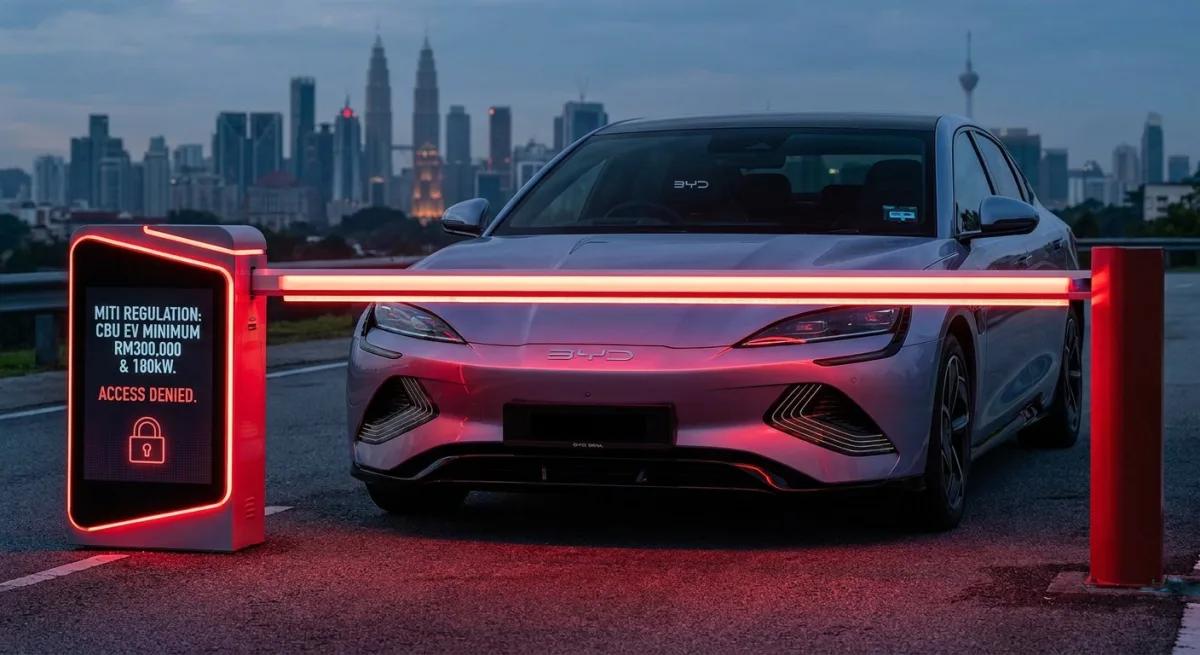
The Malaysian electric vehicle market is facing a massive regulatory shakeup that could eliminate affordable imported models overnight. A controversial new MITI CBU EV ruling mandates strict price and power minimums, threatening to wipe out the entire local lineups of major brands like BYD, Toyota, and Mini by July 2026. The Ministry of Investment, Trade, and Industry (MITI) has officially dictated that fully-imported (CBU) electric vehicles must now meet a minimum Cost, Insurance, and Freight (CIF) value of RM200,000.
Industry estimates suggest that this RM200,000 CIF baseline will realistically translate into a final retail selling price exceeding RM300,000 once all taxes and logistical costs are factored in. Furthermore, the policy introduces a strict performance floor, requiring all imported EVs to produce a minimum power output of 180kW (241hp). Automakers were only informed of these sweeping changes on April 30, 2026, leaving them with a mere two-month window to overhaul their entire market strategies before the July 1 enforcement date.
The Complete List of Banned Sub-180kW Models
The new power output requirement alone will decimate the entry-level and mid-range EV segments. Any fully-imported vehicle producing less than 180kW will be barred from the market, regardless of its pricing structure. This effectively removes the most popular daily drivers currently available to Malaysian consumers.
| Power Output | Affected EV Models |
|---|---|
| 70kW (94hp) | BYD Dolphin Standard, Dongfeng Box |
| 95kW (127hp) | BYD Seal 6 Dynamic |
| 100kW (134hp) | iCaur V23 2WD |
| 105kW (141hp) | GWM Ora Good Cat Ultra |
| 110kW (148hp) | Nissan Leaf 2nd Gen FL |
| 120kW (161hp) | BYD M6 Standard, Dongfeng Vigo |
| 126kW (169hp) | GWM Ora Good Cat GT |
| 128kW (172hp) | Toyota Urban Cruiser |
| 130kW (174hp) | BYD Atto 2, Weststar Maxus T90 EV |
| 135kW (181hp) | iCaur 03 2WD |
| 140kW (188hp) | Mercedes EQA 250 AMG Line |
| 150kW (201hp) | BMW iX1 eDrive20 / eDrive 20L, BYD Atto 3 Ultra, BYD Dolphin Extended, BYD M6 Extended, GAC Aion Y Plus Premium / Elite, GWM Ora 07 Long Range Ultra, Honda e:N1, Mercedes-Benz EQV 300, MG4 Luxury |
| 155kW (208hp) | iCaur V23 iWD |
| 160kW (215hp) | BYD Seal 6 Premium, Mini Cooper SE, Mini Aceman SE, Leapmotor B10 Life / Design, Leapmotor C10 |
| 167kW (224hp) | Toyota bZ4X |
High-Power EVs Priced Out of the Market
Even if a vehicle meets the 180kW performance threshold, it must still clear the RM300,000 retail price barrier. This dual-requirement strategy means that several high-performance but aggressively priced EVs will also be eliminated from showrooms. If automakers do not transition these specific models to local assembly (CKD), they will disappear from the Malaysian market entirely.
- BMW: i4 eDrive35, iX2 xDrive30, iX3 Final Edition
- BYD: Seal Premium, Seal Performance, Sealion 7 Premium, Sealion 7 Performance
- Dongfeng: 007 Premium, 007 Prime
- Mini: JCW Aceman E, JCW E, Countryman SE All4
- Smart: #1 Pro, #1 Premium, #1 Brabus, #3 Pro, #3 Premium, #3 Brabus, #5 Premium, #5 Brabus
- Weststar Maxus: MIFA 9 Luxury, MIFA 9 Premium
- XPeng: G6 Facelift, G6 RWD Standard Range, G6 RWD Long Range, G6 AWD Performance, G6 AWD Black Edition, X9 Standard Range, X9 Long Range Pro
- Zeekr: 7X RWD Standard, 7X RWD Long Range, 7X AWD Performance, X Premium, X Flagship AWD
- Other Affected Models: Denza D9 Advanced FWD, GWM Ora 07 Performance, iCaur 03 iWD, JAC T9 BEV 4x4, Leapmotor C10 Plus, Mercedes CLA 250+ AMG Line, MG4 XPower, Toyota Hilux BEV
The Tesla Dilemma and CKD Pressures
The status of Tesla remains a significant gray area under the new regulations. Because the American automaker entered Malaysia through the special BEV Global Leaders programme rather than the traditional Franchise AP route, it is currently unclear if the MITI mandate applies to them. If it does, the popular Tesla Model Y Juniper and the rest of their sub-RM300,000 lineup will be wiped out, as all local Tesla units are fully imported.
Transitioning to local assembly seems highly unlikely for Tesla. The company currently supplies the Malaysian market from its Giga Shanghai factory, which boasts an annual production capacity of over 950,000 vehicles. In stark contrast, Malaysia saw only 7,282 Tesla registrations in 2025. Establishing a dedicated CKD facility for a market that consumes less than 1 percent of Giga Shanghai's output simply does not align with standard automotive financial models.
The Local Assembly Gamble
This aggressive policy shift by MITI is a high-stakes gamble designed to force foreign automakers to invest heavily in Malaysian manufacturing infrastructure. By effectively banning affordable imports, the government is sending a clear message: if you want to sell high-volume EVs in Malaysia, you must build them here. However, the execution of this strategy carries severe short-term risks for the country's green energy transition.
Giving automakers a mere two-month notice to establish complex CKD operations is logistically impossible. As a result, brands like BYD, Dongfeng, GWM, iCaur, Leapmotor, Mini, Smart, Toyota, and Weststar Maxus are facing the immediate loss of their entire BEV lineups this July. By removing sub-RM300,000 options from the market, MITI risks stalling mainstream EV adoption entirely, transforming electric vehicles back into luxury status symbols rather than accessible daily drivers for the average consumer.