The creation of microscopic optical tornadoes is set to solve one of the biggest hardware bottlenecks in quantum communication. By forcing light to twist like a miniature whirlwind inside a simple liquid crystal, researchers have unlocked a highly scalable way to build complex photonic devices without relying on expensive nanostructures. This breakthrough points to a new era of miniature light sources that can easily integrate into next-generation optical networks.
This development is critical for quantum engineers, photonics researchers, and telecom developers looking to scale advanced optical systems. Instead of fabricating massive, complex experimental rigs, developers can now use self-organizing materials to trap and manipulate light. This drastically lowers the barrier to entry for building stable quantum hardware, enabling faster processing and more secure data transmission.
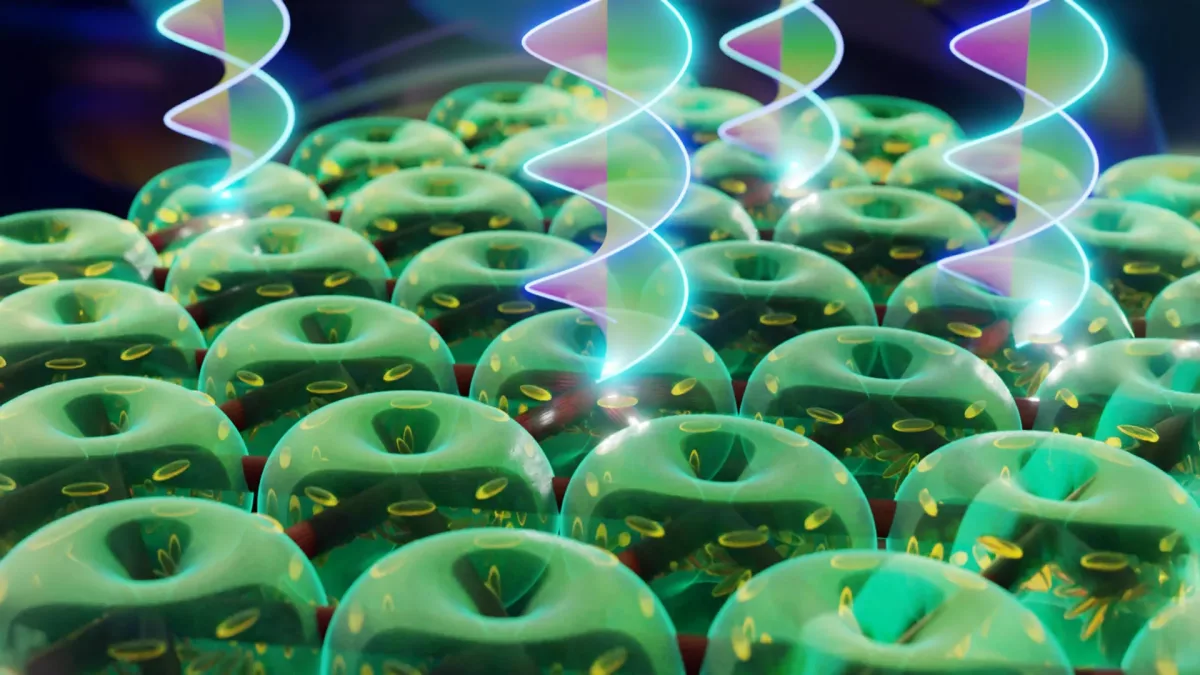
Traditionally, generating structured light states - where the light wave twists and its polarization rotates - required intricate and costly setups. This new method leverages liquid crystals, similar to those found in everyday displays, to create microscopic defects known as torons. These doughnut-shaped structures act as highly efficient traps for light, mimicking the way a magnetic field bends the trajectory of electrons.
How Liquid Crystal Torons Trap Light
The research team from the University of Warsaw, the Military University of Technology, and CNRS utilized the unique properties of liquid crystals to manipulate photons. Because liquid crystal molecules maintain a fixed orientation while flowing like a liquid, they can form tightly twisted spirals. When these spirals close into a ring, they form torons.
When placed inside an optical microcavity made of mirrors, these torons create a synthetic magnetic field. Dr. Piotr Kapuściński explains that spatially variable birefringence causes the light to bend, much like electrons moving in cyclotron orbits. This allows the system to trap the light efficiently, with the trap's size and properties fully controllable via external electric voltage.
Achieving Ground-State Stability
The most significant technical leap in this study, published in the journal Science Advances, is achieving these stable light vortices in the ground state. In standard photonic systems, light carrying orbital angular momentum only appears in highly excited, unstable states. Reaching the lowest-energy ground state makes the system inherently stable and minimizes energy loss.
When the researchers introduced a laser dye into the microcavity, the resulting light not only rotated but behaved like a coherent laser beam. Prof. Dmitry Solnyshkov noted that this setup makes photons behave similarly to quarks, the charged particles that make up protons. This opens entirely new avenues for both fundamental physics research and practical engineering applications.
The Shift Toward Self-Organizing Photonics
The transition from rigid nanostructures to self-organizing liquid crystals represents a massive paradigm shift for optical computing. By proving that complex light manipulation can occur in the stable ground state using accessible materials, this research directly challenges the assumption that quantum hardware must be inherently massive and expensive. It proves that sophisticated quantum states can be achieved with simpler, smarter material engineering.
As the demand for high-bandwidth optical communication grows, the ability to easily generate and control these optical tornadoes will likely accelerate the commercialization of quantum networks. Relying on the same foundational materials used in modern displays means the manufacturing pipeline for these new photonic devices could scale much faster than traditional silicon-based quantum alternatives.