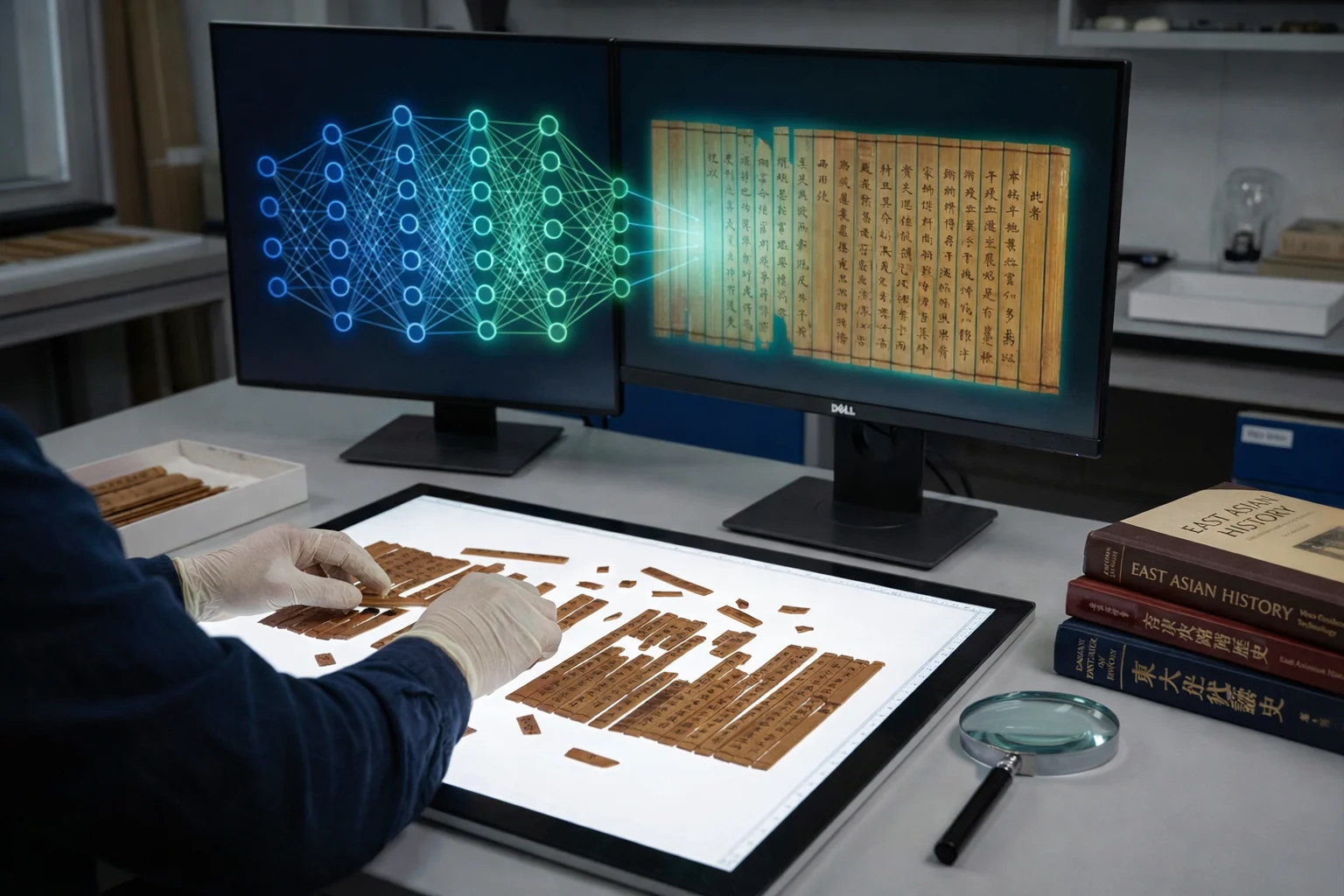
The WisePanda deep learning framework is revolutionizing archaeological restoration by using physics-driven artificial intelligence to reconstruct fragmented ancient bamboo slips. Designed for researchers, historians, and computer scientists, this breakthrough eliminates the painstaking manual effort traditionally required to piece together thousands of irregular artifacts. By automating the matching process, the tool enables historians to decode ancient East Asian texts with unprecedented speed and accuracy.
Bamboo slips served as a primary medium for recording early civilizations in East Asia. Over millennia, these crucial historical documents have deteriorated and fractured into thousands of disorganized pieces. Previously, archaeologists relied on manual sorting or basic curve-matching algorithms, which struggled with the complex, irregular degradation patterns of organic materials.
The Physics Behind the WisePanda Framework
Unlike standard generative AI models that require massive datasets of manually paired samples, the WisePanda system takes a physics-driven approach. The framework analyzes the physical properties of bamboo, specifically focusing on fracture mechanics and material deterioration over time.
Using this mechanical data, the framework automatically generates synthetic training data that perfectly mimics how bamboo splinters and degrades. This allows the matching network to train itself on highly accurate physical simulations rather than relying on scarce real-world paired examples.
The results demonstrate a statistically significant increase in matching accuracy when compared to both traditional curve matching and modern generative methods. The system outputs ranked suggestions for archaeologists, drastically accelerating the rejoining process. Researchers have made the complete framework, including the physics engine and deep learning pipelines, publicly available on Code Ocean.
Frequently Asked Questions
What is the WisePanda deep learning framework?
It is a specialized artificial intelligence tool designed to digitally rejoin fragmented ancient bamboo slips using physics-based fracture simulations.
How does it overcome the lack of training data?
By simulating the physical deterioration and fracture mechanics of bamboo, the system generates its own synthetic training data, bypassing the need for manually paired artifact samples.
My Take
The introduction of the WisePanda framework represents a critical shift in how we approach digital heritage preservation. By integrating the actual physics of material fracture into a deep learning model, the researchers have elegantly solved the data scarcity problem that plagues niche archaeological AI applications. The fact that this method yields a statistically significant accuracy boost over standard generative AI proves that domain-specific physical constraints are often more valuable than raw computing power. As this physics-driven machine learning paradigm matures, we can expect it to be adapted for other fragile mediums, such as shattered pottery or degraded papyrus, fundamentally accelerating our recovery of lost human history.
This article was written by AI from reporting by nature.com.