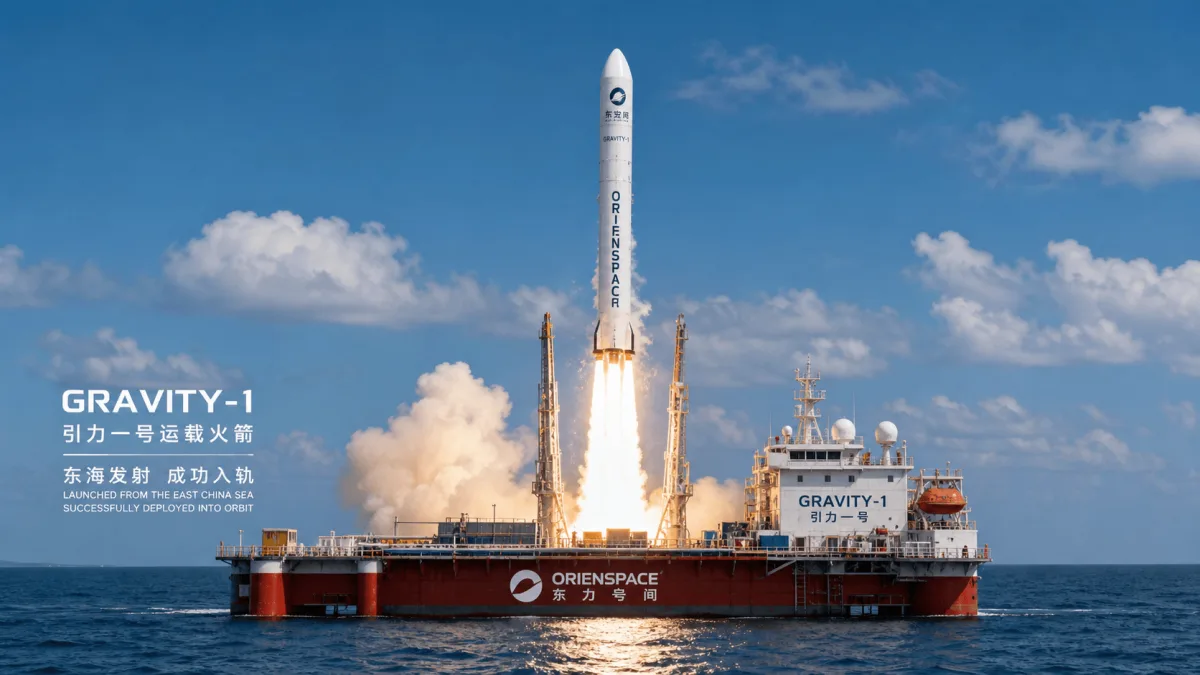
Orienspace has successfully executed the first deep-sea launch of its Gravity-1 rocket, deploying nine satellites and one payload experiment into a predetermined orbit. The mission, conducted on July 22, 2026, lifted off from the Dongfang Space Port vessel approximately 170 kilometers east of Shanghai in the East China Sea. This milestone marks a critical transition for the Gravity-1 program, moving it from the demonstration phase into scaled commercial operations.
For the global telecommunications and commercial aerospace sectors, this launch proves the viability of offshore platforms for rapid, high-capacity satellite internet deployment. The sea voyage exposed the rocket to harsh salt spray and humidity over several days, requiring enhanced environmental protection for sensitive components. Despite these technical hurdles, Orienspace plans three additional commercial batch launches in 2026, including a large-scale satellite internet constellation deployment mission for which the hardware is already prepared.
Payload Diversity and Strategic Offshore Advantages
The Gravity-1 payload manifest demonstrated significant versatility across multiple commercial sectors. The Dongpo 13, 14, and 17 through 20 satellites provide lightweight, rapid-response earth observation with all-weather wide-area coverage. Meanwhile, the Xiguang 2-01 and Tianyi 49 satellites are tailored for quantitative remote sensing, targeting mining, agriculture, and urban planning. The mission also carried the Lilac 3, which conducts thermal and attitude control experiments, alongside the Neptune payload test featuring a modular design for flexible solar array compatibility.
Orienspace deliberately chose the technically demanding deep-sea launch route to secure four distinct strategic advantages over traditional land-based or coastal facilities:
- First-Stage Safety: Offshore launches eliminate the risk to populated areas downrange during the initial ascent.
- Debris Management: Mobile launch positions allow for precise control over where spent stages and debris impact the ocean.
- Recovery Prerequisite: Mastering offshore launch and landing is a mandatory step toward the future recovery and reuse of liquid rockets.
- Southward Trajectory: Deploying a low-orbit satellite internet constellation requires a direct southward launch capability, which China's four existing land-based sites cannot safely provide.
The Transition to Gravity-2 and Capital Expansion
Currently holding the title of the world's largest solid-fuel launch vehicle, Gravity-1 is setting the stage for the company's next-generation hardware. Orienspace is already conducting pre-flight ground testing for the Gravity-2 reusable liquid rocket. Powered by the self-developed JD-2 liquid oxygen-kerosene engine, which has completed multiple full-system tests, Gravity-2 is targeting its first flight readiness by Q4 2026.
The upcoming Gravity-2 will offer a payload capacity of 21.5 metric tons to low Earth orbit (LEO) and 15 metric tons to a 500-kilometer sun-synchronous orbit. This capacity places it among the largest private Chinese liquid launch vehicles, directly targeting the lucrative low-orbit constellation deployment market. To fund this rapid expansion, Orienspace confirmed two financing rounds this year and is planning a shareholding system reform in 2026 ahead of a potential capital markets listing.
The Offshore Bottleneck Solution for LEO Broadband
The success of the Gravity-1 deep-sea launch is less about the rocket itself and more about solving a critical geographic bottleneck for satellite internet. Inland launch sites inherently restrict launch azimuths to avoid dropping spent stages on populated areas, severely limiting the ability to achieve the specific orbital inclinations required for global broadband coverage. By proving that a mobile sea platform can reliably launch heavy payloads southward, Orienspace has unlocked a scalable deployment path.
Furthermore, the aggressive timeline for the Gravity-2 reusable rocket indicates a direct strategic pivot toward competing with established global LEO networks. Delivering 21.5 metric tons to LEO is a massive leap in capacity that shifts the economics of satellite internet deployment. If Orienspace can successfully close the loop on offshore recovery by late 2026, it will drastically lower the cost per kilogram to orbit, positioning the company as a primary infrastructure provider for the next generation of space-based telecommunications.