To prevent catastrophic urban failures, Run With It Synthetics is building hyper-realistic digital twins of entire cities to simulate disasters before a single life is at risk. As climate change and infrastructure vulnerabilities accelerate, urban planners, utility companies, and government agencies are increasingly flying blind into unprecedented crises. This Alberta-based tech company provides a critical solution: using advanced artificial intelligence to model potential futures across metrics as diverse as disaster response, climate resiliency, and public health.
The demand for this level of predictive analysis is surging. According to a June 2026 report by Grand View Research, the global marketplace for strategic forecasting has reached $49.5 billion and is projected to explode to $328.5 billion by 2033. This growth is fueled by a widening cohort of industries - from energy to healthcare - desperate to future-proof their systems against variables that have no historical precedent.
The HoloDeck: Building Synthetic Realities
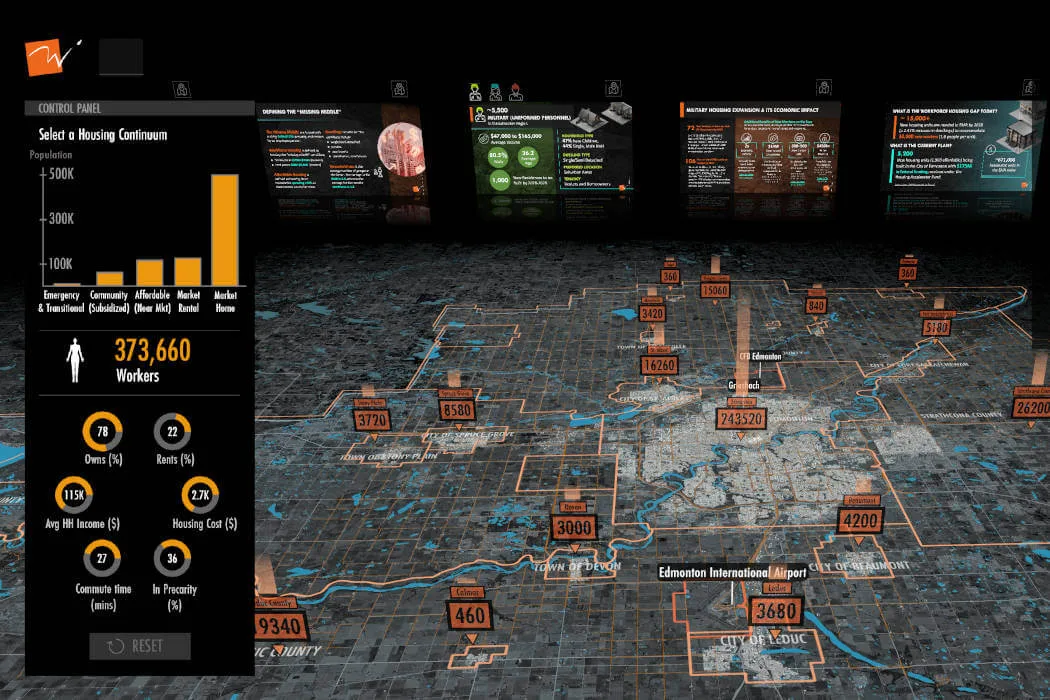
The foundation of the company's predictive power lies in its proprietary HoloDeck platform. The system marries generative and agentic AI with a high-fidelity, six-dimensional GIS-based map. This allows the company to replicate real-world infrastructure down to demographically accurate, AI-powered "people" complete with behavioral patterns, psychologies, and health predispositions.
The platform's capabilities were famously demonstrated during a 2019 keynote, where the company simulated a 6.7-magnitude earthquake tearing through Santa Clara, California. The simulation played out on a 180-foot screen, showing splintered gas lines and rogue sparks igniting fires across a city populated by 100,000 agentic AI citizens. The scenario was simulated, but the data-driven outcomes provided real, actionable insights for emergency responders.
Following that debut, the Electric Power Research Institute (EPRI) tapped the company to run a "black sky" scenario - a prolonged regional power grid failure in Phoenix, Arizona, during a summer heatwave. However, the sudden onset of the global pandemic forced a massive pivot in the simulation's parameters.
We had to become epidemiologists; we had to use, translate, and attribute COVID-19 to these synthetic populations.
- Myrna Bittner, Run With It Synthetics
"All of a sudden, the energy behaviour changed like it's never changed before, overnight," co-founder Myrna Bittner explained. By integrating consumer data from the Smart Energy Consumer Collaborative (SECC), the platform was able to quantify exactly when public trust in utility providers would collapse and when household happiness levels would plunge during a locked-down blackout.
From Missed Chat Booms to Global Forecasting
The technology powering these massive simulations has roots stretching back to the 1990s. Decades before AI data centers dominated the tech landscape, Myrna and Dean Bittner were bootstrapping Bittco Solutions, developing early groupware called Co-motion. While they admittedly missed the "chat boom" by underestimating their own messaging feature, their work caught the attention of Australian engineer Graham Dawson.
Dawson funded their pivot into NeuralVR Technologies, tasking the duo with creating synthetic intelligence environments for complex systems where real-world failure would be catastrophic. Because computing power was severely limited at the time, the team developed highly efficient neural networks and 3D visualization techniques that required minimal hardware - intellectual property that eventually formed the backbone of Run With It Synthetics when it formally launched in 2014.
Expanding Beyond Disasters: Health and Climate
Today, the 30-person company has expanded its scope far beyond earthquakes and blackouts. Recent projects include modeling wildfire egress routes in Alberta, quantifying the healthcare impacts of expanding telehealth to rural communities, and projecting Calgary's energy demands out to the year 2050. The team has even crafted synthetic twins of both Canada and Earth.
This momentum has led to significant new partnerships. Last month, the company joined forces with the University of Waterloo's FamilyPsycle Lab to launch the Synthetic Waterloo Intelligent Futures Technology (SWIFT) hub, applying predictive modeling to mental health and population wellbeing. Additionally, the company was recently selected as one of nine startups in the MaRS Adaptech Accelerator for the 2026-2027 cohort, focusing heavily on climate change resilience.
The Geopolitics of Predictive AI
Despite attracting high-profile US clients like NASA, FEMA, and the Department of Homeland Security, the company recently made a calculated decision to pull out of US defense contracts. "There was a bit of a sense of endangerment," Dean Bittner noted, pointing to the threat of sudden business disruption as US federal agencies undergo dramatic, unpredictable shifts.
This strategic withdrawal highlights a growing trend in the North American tech sector: the rising value of domestic tech sovereignty. By pivoting away from the volatile US defense sector, the company is insulating itself from geopolitical whiplash while positioning its AI as a foundational tool for Canadian nation-building. Myrna Bittner emphasized this domestic focus, noting that "defence isn't just about equipment; it's about people, infrastructure, communities, [and] economic capacity."
In an era where a single election cycle can erase billions in federal climate contracts, relying on stable, domestic partnerships isn't just an ethical stance - it is a highly effective risk mitigation strategy. As the strategic forecasting market races toward $328 billion, companies that prioritize stable governance and ethical deployment will likely outlast those chasing volatile defense dollars.