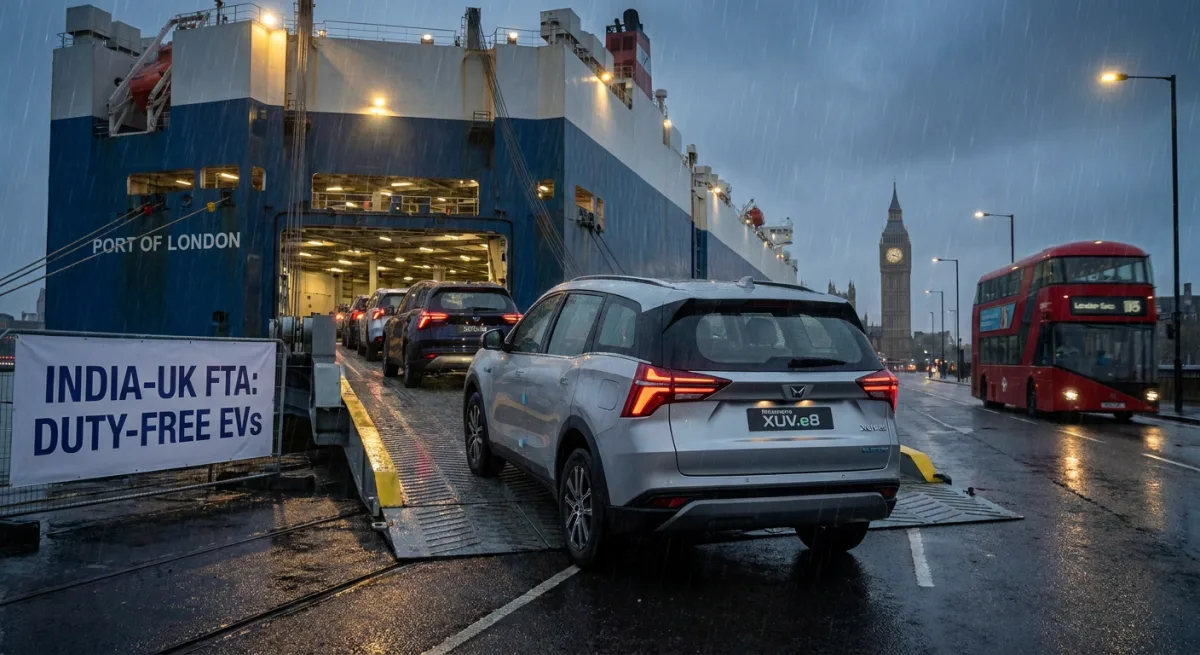
Indian automakers are preparing to significantly expand their footprint in the UK electric vehicle market following a landmark free trade agreement. The India-UK Comprehensive Economic and Trade Agreement, expected to take effect on July 15, establishes a phased, duty-free pathway for India-made clean vehicles. This legislative shift fundamentally alters the export strategy for automotive giants like Maruti Suzuki, Mahindra & Mahindra, and Tata Motors.
This development is critical for UK consumers seeking affordable EV options and automotive investors tracking global supply chain shifts. By lowering import barriers, the agreement paves the way for lower-cost electric SUVs to enter a market where high upfront prices remain a primary barrier to mass adoption.
The Phased Quota System Explained
The trade deal does not open the floodgates immediately; instead, it relies on a carefully calibrated quota system that begins in the sixth year of the agreement. At that point, India will receive a total duty-free quota of 17,600 units annually for electric, hybrid, and hydrogen passenger vehicles. The framework strictly categorizes these vehicles by price to protect domestic luxury manufacturing.
The initial sixth-year quota is broken down into three specific pricing tiers:
- Under GBP 20,000: 6,800 units allocated for budget-friendly models.
- GBP 20,000 to GBP 40,000: 6,800 units allocated for mid-range vehicles.
- GBP 40,000 to GBP 80,000: 4,000 units allocated for premium models.
Vehicles priced above GBP 80,000 are explicitly excluded from any duty concessions. Over time, the total export allowance will gradually scale up, reaching a permanent cap of 88,000 units by the 15th year. At this mature stage, the two lower-priced segments will each allow 34,000 units, while the premium tier will cap at 20,000 units.
Automaker Strategies and Early Moves
For Indian manufacturers, the UK represents a natural and highly lucrative export destination due to its right-hand-drive standard and rapidly growing demand for zero-emission vehicles. Velusamy R, President of Automotive Business at Mahindra & Mahindra, noted that the UK is a prime target for their upcoming models. "We will evaluate as part of a calibrated global expansion of our electric SUV portfolio," he explained, adding that the company is currently studying the market opportunity before finalizing distribution plans.
Maruti Suzuki is already ahead of the curve, utilizing its existing manufacturing infrastructure to supply European markets. The company views the new trade agreement as a massive boost to its "Make in India for the world" strategy.
We have already started exporting eVITARA to Europe, with about 36,000 units already exported within nine months of the launch, and the UK being the top market.
- Rahul Bharti, Senior Executive Officer of Corporate Affairs, Maruti Suzuki
Meanwhile, a spokesperson for Tata Motors Passenger Vehicles described the quota-based framework as a vital tool for supporting the long-term competitiveness of India's domestic industry. The phased approach allows these companies to align their upcoming EV platforms with strict UK safety and environmental regulations before larger volumes are permitted.
The Affordability Bridge the UK Desperately Needs
The strategic timing of this trade agreement cannot be overstated. Currently, the UK electric vehicle market is caught in a tug-of-war between expensive European legacy models and a rapidly expanding influx of aggressive Chinese imports from brands like BYD and MG. Indian EVs offer a crucial third pillar: affordable, right-hand-drive vehicles from a geopolitically friendly trade partner.
By capping the highest volume of duty-free exports in the sub-£40,000 categories, the agreement directly targets the most stagnant segment of the UK auto market - the budget-conscious everyday driver. For India, this is a golden opportunity to prove its manufacturing prowess on a global stage and counter China's dominance in the EV supply chain. If Maruti Suzuki and Tata Motors can deliver reliable electric SUVs at the £20,000 mark, they won't just be participating in the UK market; they will fundamentally disrupt its pricing structure.