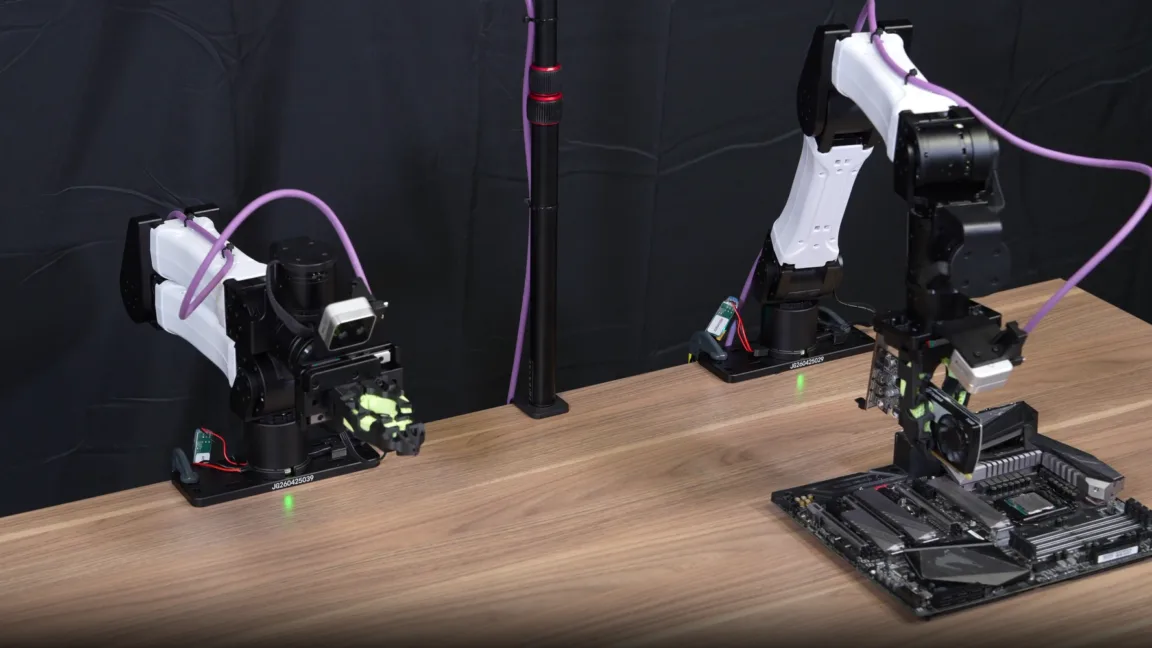
Training robotic arms to perform delicate tasks like installing GPUs into thin motherboard sockets or cutting zip ties traditionally requires hundreds of hours of human oversight. NVIDIA’s new ENPIRE framework changes this by allowing AI coding agents to autonomously train robots overnight. Developed by the NVIDIA GEAR (Generalist Embodied Agent Research) lab in collaboration with Carnegie Mellon University and UC Berkeley, this agent harness wraps around AI models to provide memory, context, constraints, and feedback loops.
According to a LinkedIn post by Jim Fan, director of AI at NVIDIA, the system allows the lab to self-improve tirelessly while researchers simply read the morning reports. Because NVIDIA plans to open-source the framework, developers will soon be able to host their own self-running robot labs at home.
Prerequisites for an Autonomous Robot Lab
- Physical robotic arms and a dedicated testing environment.
- Sufficient compute resources to run the agent harness.
- API access to advanced AI coding agents (tested with OpenAI’s Codex with GPT-5.5, Anthropic’s Claude Code with Opus 4.7, and Moonshot AI’s Kimi Code with Kimi K2.6).
- A generous token budget to sustain continuous overnight training cycles.
How to Automate Training with the ENPIRE Framework
- Deploy the ENPIRE agent harness around your chosen AI models. This provides the necessary software wrapper that grants the AI coding agents memory, context, and operational constraints.
- Configure the automatic reset and verification module. This ensures the agents can independently reset the physical workspace and verify task completion without human intervention.
- Refine the policies guiding robotic behavior through algorithmic testing. This enables the AI teams to independently develop approaches and retain changes that raise the overall success rate.
- Evaluate the refined policies across multiple physical robots simultaneously. This allows the system to run real-world experiments in parallel, drastically accelerating the training regimen.
- Address operational failures by analyzing system logs and ingesting data. This empowers the AI to debug the training infrastructure, rewrite algorithm code, and even process external research papers to overcome physical limitations.
The Hardware Bottleneck Shifts
By open-sourcing the ENPIRE framework, NVIDIA is effectively democratizing advanced robotics R&D. Startups and independent researchers will soon be able to achieve autonomous training cycles that previously required massive institutional budgets and dedicated engineering teams. When AI coding agents can independently figure out the physics of inserting a GPU into a motherboard, the software barrier to entry collapses.
This development fundamentally shifts the bottleneck in robotics from software training to hardware durability. If AI agents are running continuous, parallel experiments overnight, the physical robotic arms will experience unprecedented wear and tear. Future advancements will likely need to focus on building cheaper, more resilient robot joints to keep up with the tireless pace of AI-driven self-improvement.