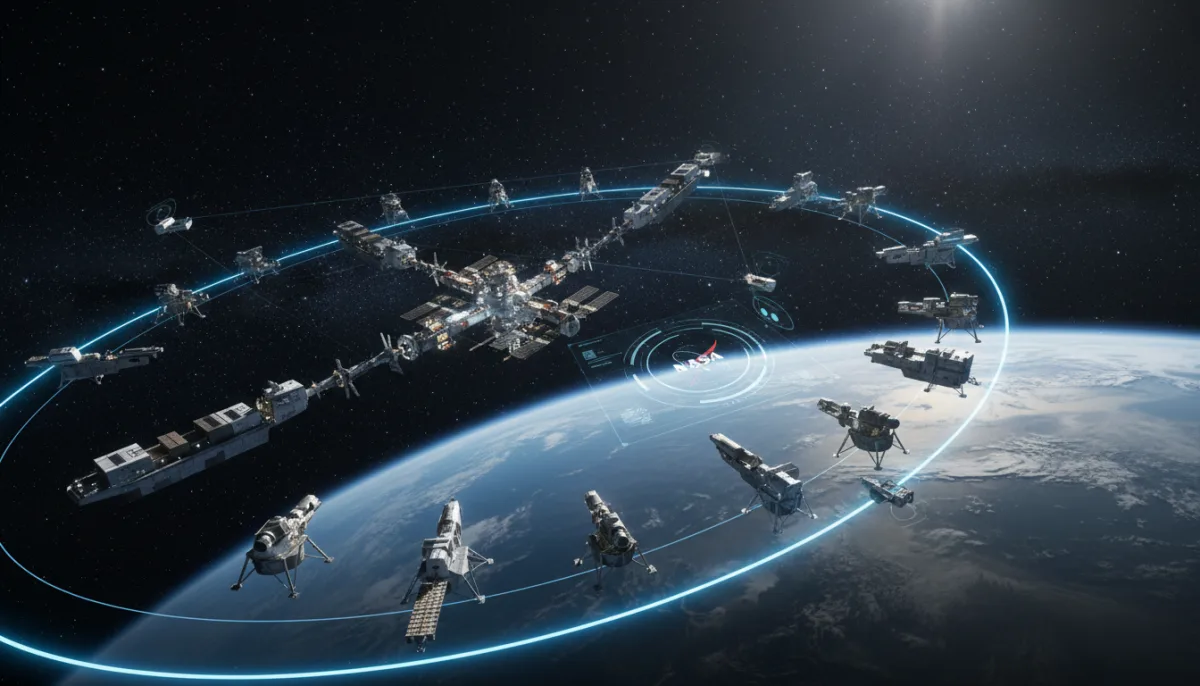
As NASA prepares to launch humanity’s first lunar spaceport, a critical challenge has emerged: preventing spacecraft from colliding in the complex gravitational web between Earth and the Moon. To solve this, engineers are developing a specialized NASA Gateway traffic control system to manage the influx of Orion capsules, cargo ships, and lunar landers. Unlike terrestrial airports, this orbital hub will have no physical runways or taxiways, relying entirely on precise mathematical trajectories.
Within the next two decades, the Gateway station will serve as the primary staging point for astronauts traveling into deep space. However, managing multiple vehicles moving through the same orbital environment requires unprecedented coordination. Engineers from Texas A&M University, NASA’s Johnson Space Center, and Purdue University have published new algorithms in Acta Astronautica to establish the orbital "rules of the road" for this challenging region.
Navigating the Near Rectilinear Halo Orbit
The gravitational environment around the Moon dictates a unique path for the spaceport. Gateway will operate in a Near Rectilinear Halo Orbit (NRHO), a highly elongated trajectory that provides an uninterrupted line of sight to Earth for communications. This specific orbit requires minimal propellant to maintain, making it ideal for long-term lunar infrastructure.
The trajectory brings the station within 1,000 miles of the Moon’s north pole before swinging it nearly 40,000 miles beyond the lunar south pole. While a single station can easily maintain this course with occasional thruster burns, the environment becomes hazardous when multiple uncrewed cargo vehicles and large lunar landers attempt to dock or depart simultaneously.
The future of lunar exploration depends as much on the traffic management as it does on the rocket science.
- Dr. Diane Davis, Texas A&M University
To prevent collisions, researchers ran thousands of computer simulations incorporating realistic navigation errors and imperfect thruster performance. They determined that modest increases in station-keeping maneuvers could keep spacecraft substantially closer to their planned positions, preserving valuable fuel while ensuring crew safety.
The 'String of Pearls' Formation
A central concept in this new traffic system is "loitering," which requires a spacecraft to carefully maintain its position relative to a specific orbit while waiting for a docking port to clear. Because there is no fixed surface in space, every vehicle remains in constant motion, requiring a delicate balance between safe separation and fuel efficiency.
"Every spacecraft is constantly moving," Dr. Davis explained. "It’s a Goldilocks zone of keeping 'parked' vehicles far enough from each other to be safe, but close enough to their destination so that resources are used efficiently."
Instead of allowing visiting vehicles to wait independently, the researchers propose organizing lunar traffic into a "string of pearls" formation. Spacecraft would arrange themselves naturally along the lunar orbit, maintaining their loitering positions relative to Gateway. This enables a closer formation and drastically reduces the risk of vehicles drifting dangerously close together.
The Hidden Cost of Lunar Congestion
The development of a cislunar traffic control system highlights a fundamental vulnerability in the Artemis program's architecture: the unforgiving economics of deep-space propellant. On Earth, commercial aircraft can circle an airport for hours using relatively cheap and abundant jet fuel. In the vacuum nearly 240,000 miles from Earth, every single thruster burn consumes irreplaceable resources.
If the proposed "string of pearls" formation fails to maintain stability, or if navigation errors force spacecraft into excessive corrective maneuvers, missions could be aborted simply due to fuel starvation. This research proves that astrodynamics - not just heavy-lift rockets - will be the ultimate bottleneck for commercial lunar scalability. As private companies eventually join NASA in cislunar space, these mathematical traffic rules will likely evolve into strict international space laws, dictating exactly who gets priority access to the Moon's most valuable orbital real estate.
This article was written by AI from reporting by scitechdaily.com.