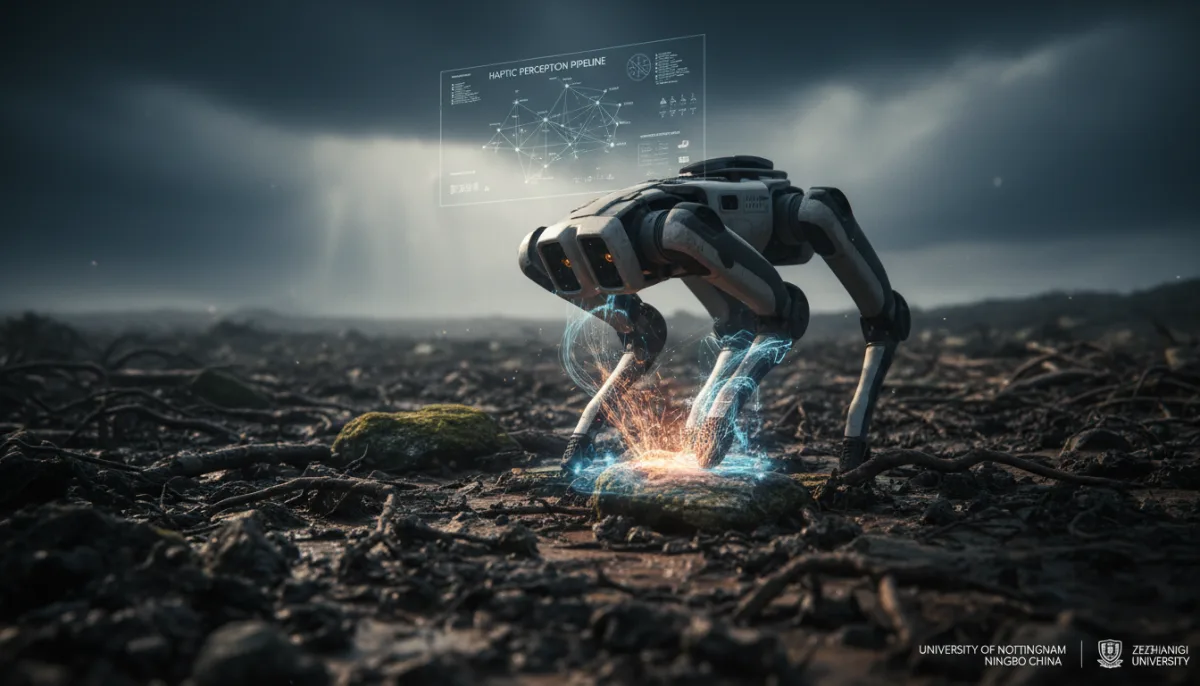
Legged robots navigating unstructured terrain face a critical vulnerability: they often cannot accurately perceive the ground beneath their feet in real time. A newly published survey in the Artificial Intelligence Review systematically breaks down how legged robot contact sensing and artificial intelligence are bridging this gap. By analyzing how haptic feedback provides early, trustworthy evidence of traction limits, the research outlines a path to solving the unpredictable foot-ground contact problem.
For robotics engineers and AI control system developers, this synthesis provides a definitive roadmap for integrating haptic feedback into locomotion pipelines. Historically, robots relied heavily on vision, which frequently fails in tall grass, mud, or poor lighting. Implementing robust contact sensing enables safer and more resilient deployments in real-world missions, such as disaster recovery or off-road autonomous exploration, where a single misstep can cause a catastrophic fall.
Three Channels of Haptic Perception
The research categorizes sensory input into three distinct channels to manage real deployment constraints. First, interface fields capture pressure, shear, and contact geometry directly at the foot. This provides the most immediate data regarding the physical interaction between the robot and the terrain.
Second, near-foot wrenches and vibro-acoustic transients detect immediate force changes and vibrations upon impact. Finally, proprioceptive inference uses joint and body dynamics to deduce contact states without relying on dedicated foot sensors. This third channel is particularly valuable for maintaining operational health under long-term deployment where external sensors might suffer durability issues.
Translating Sensation into Action
Gathering sensory data is only half the battle; the survey details how this evidence translates into controller-facing targets. These targets include identifying specific contact events, measuring the realized interaction state, and updating feasibility envelopes under uncertainty. The researchers highlight how these inputs feed into model-based, hybrid, and policy-centric control pipelines.
To ensure safety during these operations, the data is consumed by advanced safety overlays. Techniques such as feasibility-aware optimization, uncertainty-aware constraint tightening, and barrier-based run-time filters act as safeguards. These filters process the haptic data in real time to prevent the robot from executing commands that would lead to a loss of balance.
Rigorous Evidence Stratification
To build this comprehensive framework, the research team from the University of Nottingham Ningbo China and Zhejiang University employed a PRISMA-informed methodology. Starting with 966 records across major databases like IEEE Xplore and Scopus, they distilled the literature down to a core corpus of 261 studies.
Crucially, the survey codes the gathered evidence by validation maturity. The authors carefully distinguish between high-fidelity simulations, hardware-bench tests, and actual real-robot field deployments. This stratification ensures that developers understand which sensing representations yield task-sufficient products under strict latency and bandwidth constraints.
The Shift Toward Active Haptic Exploration
The most significant takeaway from this comprehensive review is the inevitable pivot toward morphology-sensing co-design. While the robotics industry has heavily indexed on visual AI for navigation, the reality is that vision is easily occluded. By treating each footfall as an action-conditioned update over latent terrain variables, future legged robots will not just react to slips - they will actively probe the ground.
Just as a human tests a loose rock before shifting their full weight, the next generation of quadrupedal and bipedal systems will use active haptic exploration to guarantee stability before committing to a step. This fundamentally shifts the control paradigm from reactive recovery to proactive terrain assessment, marking a critical evolution in how autonomous systems interact with the physical world.
This article was written by AI from reporting by link.springer.com.