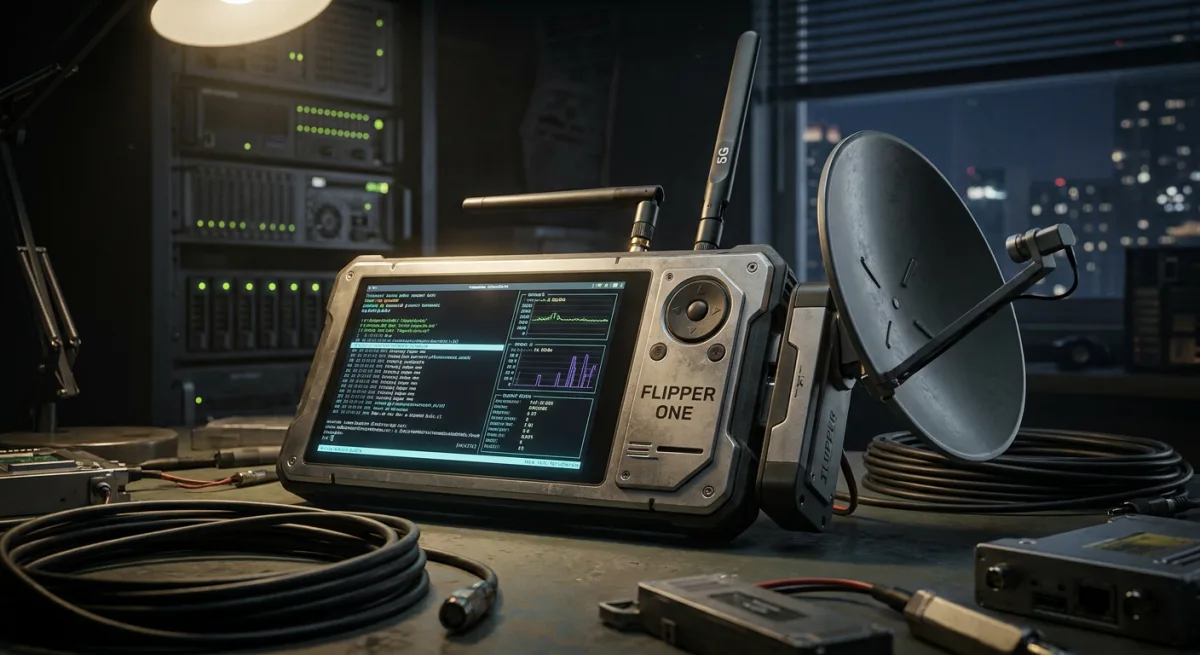
The creators of the viral Flipper Zero are developing a highly customizable, full-blown Linux computer called the Flipper One. Designed for security researchers and developers, this new cyberdeck shifts focus from short-range spoofing to long-range IP-based networks, including 5G and satellite connectivity. The company insists this is not a direct successor to the Zero, but rather a significantly more capable platform built for complex network environments.
Moving away from the limited short-range capabilities like RFID and NFC, the Flipper One is built to connect to any IP-based network. It supports widespread protocols such as 5G, Wi-Fi, Ethernet, and even NTN satellite connectivity. Under the hood, the device utilizes a co-processor architecture to balance heavy computing with efficient hardware management. The primary engine is a Rockchip RK3576 SoC featuring an 8-core CPU, a Mali-G52 GPU, and a dedicated NPU for running small on-device AI models, paired with 8GB of RAM.
Complementing the main SoC is a dual-core Raspberry Pi RP2350 microcontroller equipped with 16MB of flash memory. This secondary chip manages the display, buttons, touchpad, LEDs, and power subsystem, and is powerful enough to operate the device independently. The company is also encouraging modular attachments via standard GPIO connectors and plans to release 3D models so users can customize the physical build to their exact requirements.
How Developers Can Contribute to the OS
On the software side, the company is pitching the Flipper One as the most open and best-documented ARM computer available. The ultimate goal is to ship the device with full mainline Linux kernel support, eliminating the need for vendor-specific patches. This means users could theoretically apply updates directly from the kernel archive maintained by Linus Torvalds, ensuring the hardware always supports the latest software.
Because achieving true mainline kernel support is notoriously difficult in practice, the Flipper team is actively seeking community collaboration. Developers can access the newly announced Developer Portal, which serves as a comprehensive wiki for the device's hardware, software, and design schematics. By contributing to this open Debian-based OS, the community can help shape the final product and overcome potential compute bottlenecks before its official release.
The Evolution from Toy to Serious Cyberdeck
The transition from the Flipper Zero to the Flipper One represents a massive shift in the company's hardware strategy. While the Zero was often treated as a viral novelty for physical access testing, the Flipper One is positioning itself as a legitimate, IP-focused cyberdeck. By integrating a Rockchip SoC with a Raspberry Pi microcontroller, the device bridges the gap between a standard Linux computer and a dedicated hardware hacking tool.
However, the promise of full mainline Linux kernel support is an ambitious target that many ARM manufacturers fail to maintain long-term. If the Flipper team can actually deliver a device that updates directly from the mainline archive without relying on proprietary vendor blobs, it could set a new standard for open-source hardware. The success of this project will heavily depend on whether the developer community rallies behind their newly launched portal to build a truly independent platform.