The first direct observation of a hybridization-wave electronic order has been achieved in a van der Waals Kondo lattice, validating a long-standing theoretical prediction in quantum physics. A team of researchers, including Lu Cao and Yuhang Jiang, successfully visualized this elusive quantum state within the layered transition metal dichalcogenide 6R-TaS2. This breakthrough provides condensed matter physicists and materials scientists with a verified platform to explore and control complex hybridization-driven quantum phases.
Kondo lattice systems are complex environments where localized magnetic moments coherently hybridize with itinerant electrons. This interaction typically gives rise to a rich landscape of emergent quantum phenomena. Within this theoretical framework, scientists have long proposed that the hybridization strength itself could act as a spatially modulated order parameter. However, capturing direct experimental evidence of this resulting "hybridization wave" has remained an outstanding challenge in the field of strongly correlated electrons.
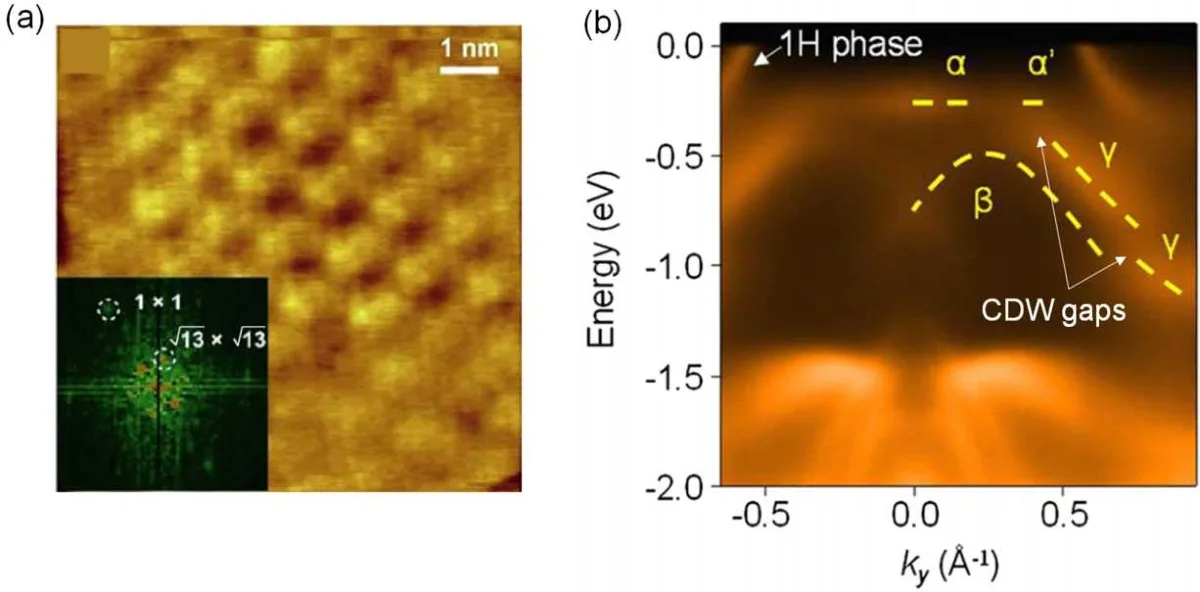
To overcome this hurdle, the research team utilized scanning tunneling microscopy and spectroscopy (STM/STS) to examine 6R-TaS2. This specific material is a naturally occurring heterostructure composed of alternating 1T-TaS2 and 1H-TaS2 layers. By probing the material at the atomic level, the researchers successfully identified the hybridization gap within the 1T layer. This critical observation demonstrated the establishment of a coherent Kondo lattice within the van der Waals material.
Breaking Symmetries in the Star-of-David Superlattice
The most significant discovery emerged when the team analyzed the spatial characteristics of the hybridization gap. They found that the gap presents a uniaxial unit-cell doubling modulation. This specific modulation breaks both the translational and rotational symmetries of the underlying Star-of-David superlattice.
Crucially, the researchers confirmed that this unit-cell doubling is not caused by structural topography. Because the physical structure remains unchanged, this modulation constitutes the first real-space visualization of the hybridization-wave order. Furthermore, the data revealed that this hybridization wave correlates with an energy-dependent nematic order. Because both orders share the exact same periodicity and orientation, the findings highlight deeply intertwined electronic instabilities within the material.
This discovery holds profound implications for the future of quantum materials engineering. By proving that layer-engineered van der Waals materials can host these advanced states, researchers now have a versatile toolkit for developing next-generation quantum devices. For further academic details, the full study is available via arXiv:2603.12720 and can be tracked on Google Scholar.
My Take
The direct visualization of a hybridization wave in 6R-TaS2 is a monumental step forward for condensed matter physics. What makes this study particularly impactful is the use of a naturally occurring heterostructure rather than an artificially synthesized lattice. By leveraging the alternating 1T and 1H layers of 6R-TaS2, the team bypassed the immense technical difficulties usually associated with engineering coherent Kondo lattices from scratch. This strongly suggests that the broader family of transition metal dichalcogenides holds untapped potential for hosting intertwined electronic instabilities. As researchers continue to map these nematic orders, we can expect a rapid acceleration in the development of tunable quantum materials designed for advanced computing architectures.
Frequently Asked Questions
What is a Kondo lattice?
A Kondo lattice is a quantum system where localized magnetic moments interact and hybridize coherently with freely moving (itinerant) electrons, leading to unique electronic behaviors and emergent quantum phenomena.
What material was used to observe the hybridization wave?
Researchers used 6R-TaS2, which is a layered transition metal dichalcogenide. It acts as a natural heterostructure made of alternating 1T-TaS2 and 1H-TaS2 layers.
How did scientists visualize this quantum state?
The team utilized scanning tunneling microscopy and spectroscopy (STM/STS) to observe the hybridization gap and its uniaxial unit-cell doubling modulation at the atomic level.