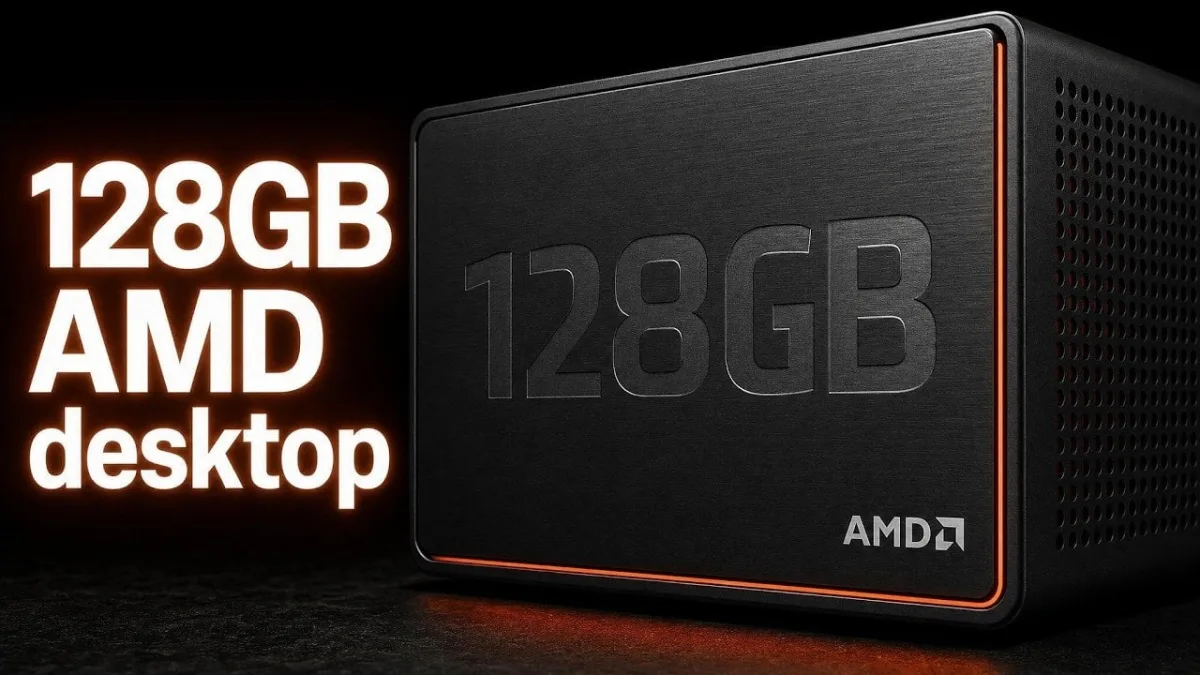
Developers looking to run massive local AI workloads without relying on expensive cloud subscriptions have a new hardware option. The AMD Ryzen AI Halo developer box is a $4,000 compact mini PC that leverages 128GB of unified LPDDR5X memory to process models with up to 200 billion parameters entirely offline. Weighing just 1.2kg and powered by a single USB-C cable, the system prioritizes extreme memory capacity over raw computational speed.
Unlike traditional AI workstations that rely on massive, power-hungry discrete GPUs, this developer box utilizes an integrated compute architecture. The standout feature is its LPDDR5X memory operating at 8,000 MT/s, which allows the system to dynamically allocate up to 96GB as VRAM. According to testing by The Stack, this massive memory pool makes the device highly capable for specific memory-heavy AI tasks.
Optimized for Language, Bottlenecked by Video
The AMD Ryzen AI Halo is explicitly designed for workloads where memory capacity is the primary bottleneck. It delivers competitive token generation speeds for conversational AI inference and provides enough overhead for fine-tuning large language models (LLMs). By eliminating the VRAM constraints typical of standard consumer hardware, developers can process memory-intensive datasets locally.
However, the reliance on an integrated GPU introduces severe performance limitations for high-throughput tasks. The system achieves only 60% of its theoretical peak performance, making it poorly suited for compute-intensive applications like image or video generation. Users requiring sustained computational power or CUDA-based workflows will find the hardware lacking compared to traditional setups.
Software Ecosystem and Community Reliance
While the hardware specifications are robust, the software ecosystem supporting the Ryzen AI Halo remains a significant hurdle. The platform currently suffers from limited official support for fine-tuning workloads and frequent driver regressions that can disrupt development pipelines. Furthermore, performance benchmarks remain inconsistent due to variability in the software stack.
To bypass these limitations, early adopters are heavily reliant on community-developed tools and custom configurations. The system natively supports both Windows and Linux, offering flexibility, but the lack of a seamless, out-of-the-box experience means it is currently best suited for experienced developers comfortable with troubleshooting.
The VRAM Advantage in the Local AI Market
When compared to enterprise alternatives like the Nvidia DGX Spark, the AMD Ryzen AI Halo carves out a highly specific, yet vital, niche. In the current AI landscape, VRAM capacity is often a harder barrier to entry than raw compute speed. Acquiring 96GB of VRAM typically requires chaining multiple high-end discrete GPUs or renting expensive cloud instances.
By offering a unified memory architecture for $4,000, AMD is directly targeting researchers who need to load massive 200-billion parameter models but do not necessarily need them to run at lightning speed. It is a calculated trade-off: sacrificing the brute force of a discrete GPU to achieve unparalleled portability and memory depth in a 1.2kg chassis. If AMD can stabilize its software stack and reduce driver regressions, this memory-first approach could redefine budget-conscious AI development.