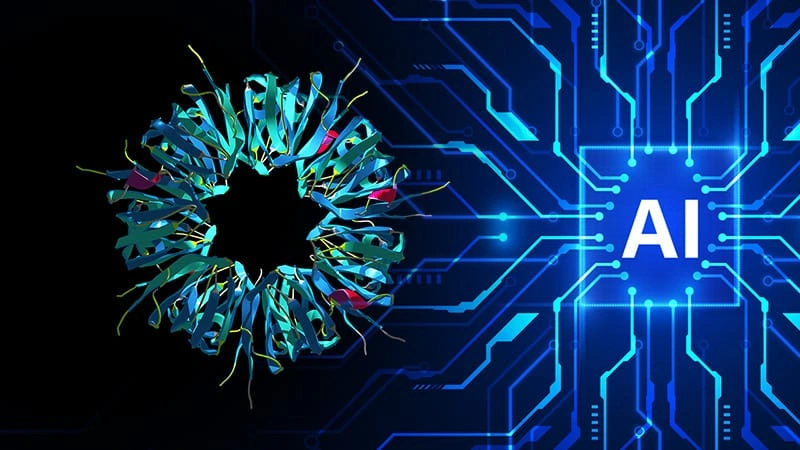
AI is rewriting the rules of cancer drug hunts, predicting druggable targets from protein 3D structures in a fraction of the time it once took.
Traditional oncological drug development drags on for years, burdened by sky-high costsoften exceeding $2 billion per drugand success rates hovering below 10%. Enter artificial intelligence, now laser-focused on 3D structures of proteins and compounds to identify 'druggable targets' with unprecedented speed. This breakthrough, detailed in a fresh Nature study, promises to compress discovery timelines from months to mere hours, targeting the very pockets where small molecules can bind and disrupt cancer pathways.
From AlphaFold Legacy to Target Precision
The foundation? Tools like AlphaFold2 and RoseTTAFold, Nobel-winning AI models that predict protein structures from amino acid sequences with near-atomic accuracy. Before these, labs relied on laborious X-ray crystallography or cryo-EM, solving structures for just a fraction of the proteome. Now, AlphaFold's database boasts over 200 million predictions, accessed by 2 million researchers worldwide.
In oncology, this means scanning tumor-related proteinslike kinases or receptorsfor hidden binding sites. The Nature paper highlights AI's role in 'virtual screening': feeding compound libraries into models that simulate docking, flagging hits that bind tightly without wet-lab trials[1 from provided]. Imagine an AI agent autonomously iterating: it pulls a protein sequence, generates its 3D fold via Evoformer modules (AlphaFold's neural network core), then probes for pockets using diffusion networks akin to image generators. This agent could chain to ligand design, outputting viable candidates overnight.
Technical Deep-Dive: The Architecture Powering Predictions
At its heart, AlphaFold2 employs a deep neural network trained on Protein Data Bank (PDB) structures, multiple sequence alignments (MSA), and physical priors. It outputs 'distograms'probability maps of residue distancesthen refines via structure modules into full 3D models. Newer evolutions like AlphaFold3 and Isomorphic Labs' IsoDDE extend this: they model protein-ligand complexes directly, doubling accuracy on binding benchmarks and spotting novel pockets from sequence alone.
Key innovation: pocket detection without ligands. IsoDDE identifies all potential binding sites on a protein, even undrugged ones, using geometry-aware networks. This beats physics-based docking (e.g., AutoDock) in speedminutes vs. daysand cost, while matching gold-standard affinities. For oncology, it's game-changing: proteins like KRAS mutants, once 'undruggable,' now yield pockets for covalent inhibitors.
Information Gain: Before vs. After AI
| Metric | Pre-AI Era | AI-Accelerated (AlphaFold+) |
|---|---|---|
| Structure Solution Time | Weeks-Months (experimental) | Minutes (prediction) |
| Proteome Coverage | <10% solved | 200M+ predictions |
| Drug Discovery Success Rate | <10% | Projected 2-3x faster hit ID |
| Compute Needs | High (clusters) | Low (ML inference) |
This table underscores the leap: AI doesn't just predict; it democratizes structure-based drug design (SBDD), impacting hit generation most profoundly.
Real-World Wins and Oncology Edge
Already, AlphaFold aids vaccine design, plastic-degrading enzymes, and antibiotic fixes. In cancer, it's visualizing nuclear pore complexes for targeted delivery or reengineering bacterial syringes for gene therapy. Isomorphic's engine flags first-in-class targets sans prior structures, unlocking mechanisms like allosteric modulation. Open-source like OpenFold ensures broad access, fueling non-profits and startups.
Challenges on the Horizon
Not flawless: models lag on dynamic conformations, post-translational mods, or multi-body complexes. Solvent, ions, and true ligand effects demand hybrid experimental validation. Yet, evolutionfrom AlphaFold2's MSA to AF3's diffusioncloses gaps rapidly.
The i10 Verdict
This isn't hype; it's the dawn of AI-native pharma. Picture agents designing bespoke oncology drugs end-to-end, slashing that $2B price tag. My take: within five years, 50% of new approvals trace to AI-predicted structures. Pharma giants ignoring this? They'll be relics. Dive inyour next breakthrough sequence awaits.
This article was written by AI from reporting by nature.com.