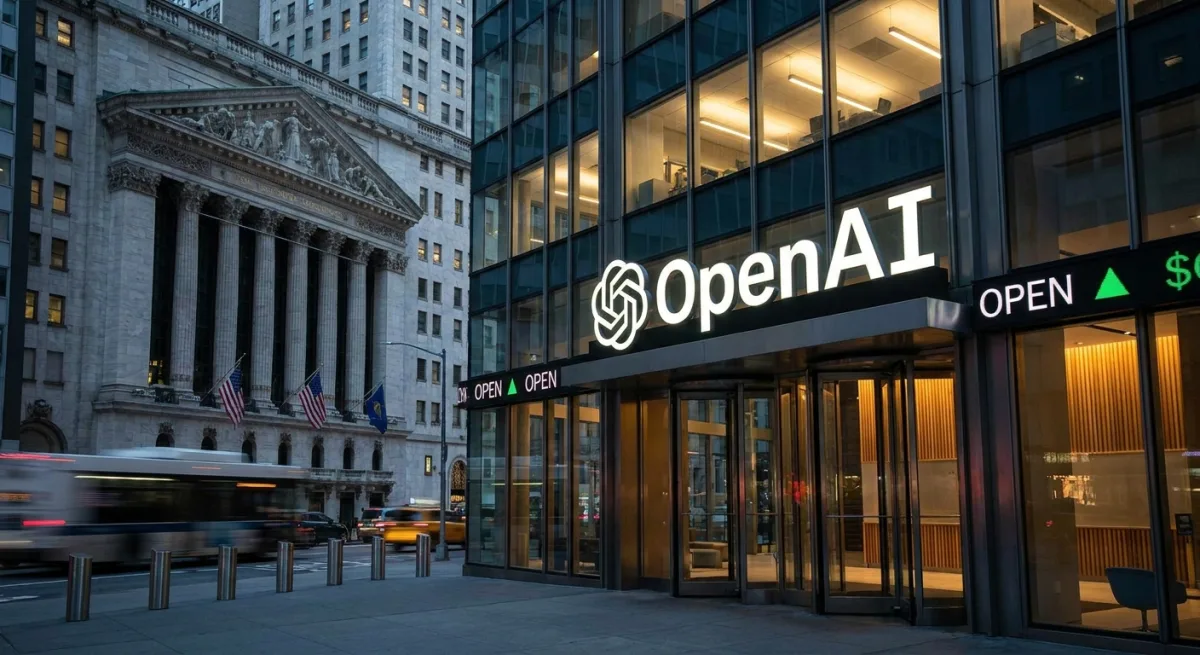
The highly anticipated OpenAI IPO filing has officially been submitted, marking a historic step that will transition the artificial intelligence pioneer from a venture-backed startup into a publicly traded giant. This monumental move, aimed at tech investors and financial analysts, will force the company to eventually open its books and face intense public market scrutiny. By taking this step, OpenAI is setting up a direct Wall Street showdown with its chief rival, Anthropic, which filed its own confidential paperwork just days earlier.
On Monday, OpenAI confidentially submitted its Form S-1 with the US Securities and Exchange Commission (SEC). This filing comes exactly one week after Anthropic submitted its own confidential S-1 on June 1, 2026. Because both filings are confidential, critical financial details - including executive compensation, business risks, and exact revenue figures - remain shielded from the public for now.
The Valuation Battle Behind the OpenAI IPO Filing
The race to the public markets highlights a dramatic valuation battle between the two AI pioneers. Following its most recent funding round, Anthropic is currently positioned as the world's most valuable startup, boasting a post-money valuation of $965 billion. This edge slightly surpasses OpenAI's latest post-money valuation, which sits at $852 billion.
However, OpenAI's path to the stock market has not been without internal friction. Reports indicate that Chief Financial Officer Sarah Friar has expressed reservations about a fast-tracked public debut. While CEO Sam Altman has pushed aggressively for the listing, Friar and other executives are reportedly concerned over missed revenue targets, slowing user growth, and astronomical infrastructure commitments.
These infrastructure costs are a massive point of contention. OpenAI initially projected a staggering $1.4 trillion spend on compute infrastructure, a figure that Altman seemed to become defensive about when questioned publicly. The company has since scaled back those projections, informing investors in February that it now plans to spend $600 billion on compute by 2030.
A Crowded June for Tech Debuts
The timing of the filing is also heavily influenced by broader market movements and ongoing legal battles. The announcement comes just weeks after the conclusion of the high-profile Musk v. Altman trial. Furthermore, it positions OpenAI's debut right alongside Elon Musk's SpaceX, which is preparing for its own massive IPO on June 12, 2026.
The SpaceX public debut is expected to raise $80 billion, making it the largest IPO in history. This creates a complex web of competition, especially since SpaceX recently acquired OpenAI's rival xAI and secured a massive partnership with Anthropic. Under that agreement, Anthropic will pay $15 billion annually to utilize SpaceX's advanced data centers.
The Trillion-Dollar AI CapEx Reckoning
The confidential filing represents far more than a routine corporate milestone; it is the beginning of a high-stakes reality check for the entire generative AI sector. For years, companies like OpenAI and Anthropic have operated in a venture capital bubble, burning billions of dollars on compute power with the promise of future artificial general intelligence (AGI). Public markets, however, are notoriously unforgiving of massive capital expenditures that do not translate immediately into robust quarterly earnings.
By entering the public sphere, OpenAI will no longer be able to hide its true cost-to-revenue ratio behind confidential S-1 updates. Wall Street investors will demand clear timelines for profitability, putting immense pressure on Sam Altman to justify the scaled-down yet still staggering $600 billion compute budget. If OpenAI cannot prove that its enterprise software and consumer subscriptions can offset these historic infrastructure costs, the public markets could trigger a severe valuation correction that ripples across the entire tech industry.
This article was written by AI from reporting by theverge.com.