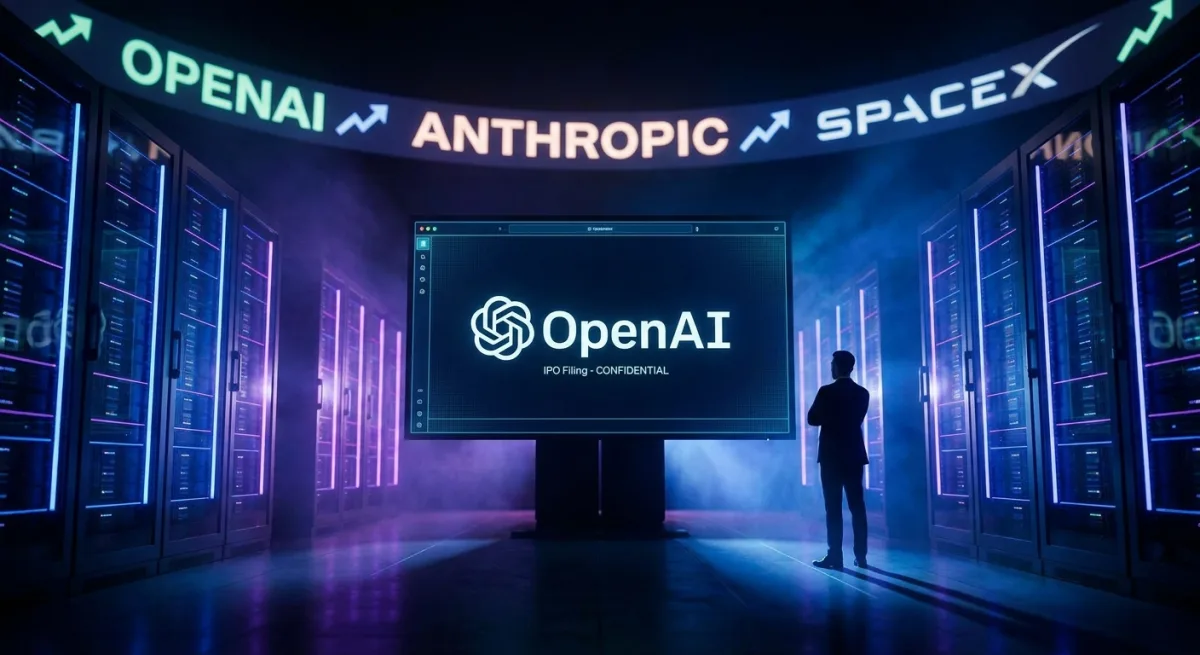
The highly anticipated OpenAI IPO is officially in motion, signaling a massive shift for investors looking to capitalize on the generative AI boom. The creator of ChatGPT has confidentially filed for a U.S. initial public offering, setting up a historic market debut that could value the company at up to $1 trillion. This move places OpenAI in a direct race with its chief rival, Anthropic, which filed for its own IPO just days earlier.
For tech professionals, enterprise buyers, and retail investors, this transition from a private startup to a public giant represents a massive shift in how AI development is funded and scrutinized. The decision to go public will force unprecedented transparency on OpenAI's massive compute costs, cloud partnerships, and path to profitability.
The confidential filing, first reported as targeting a September debut, positions OpenAI alongside other mega-cap tech giants preparing to test public market liquidity. Elon Musk's SpaceX is already leading the charge with a planned $75 billion offering at a $1.75 trillion valuation, while Anthropic recently filed after securing a $65 billion funding round that valued it at $965 billion.
"OpenAI is keeping options open as Anthropic edged ahead with its filing after a monster funding round," Michael Ashley Schulman, a partner at Cerity Partners, noted.
While OpenAI has not finalized its timeline, the company acknowledged the strategic shift. "It may be a while because there are things we want to do that are likely easier as a private company," OpenAI stated in an official release, hinting at the operational freedom they will lose under public market scrutiny.
Despite its massive scale, OpenAI's financial metrics reveal both explosive growth and staggering operational costs. In March, the company disclosed it was generating $2 billion in monthly revenue, growing four times faster than internet-era pioneers like Alphabet and Meta. This is a massive leap from the $1 billion in quarterly revenue recorded at the end of 2024.
However, the road to profitability remains long. OpenAI previously raised $110 billion at an $840 billion valuation from heavyweights like SoftBank, Amazon, and Nvidia. Yet, sources familiar with the matter indicate that OpenAI does not expect to turn a profit until 2030, largely due to the astronomical costs of training next-generation models.
This massive capital requirement is what drove OpenAI to renegotiate its historic $13 billion partnership with Microsoft. The revised agreement allows OpenAI to secure infrastructure and partnerships with rival cloud providers, including Amazon and Alphabet's Google, diversifying its technical stack.
What OpenAI does not want is for the public market capital to exhaust itself. Not only are SpaceX and Anthropic ahead of it in line to IPO, large public competitors could also raise tens of billions of dollars each in public market secondary issuances.
- Gil Luria, Managing Director, D.A. Davidson
The path to the OpenAI IPO was cleared of major obstacles following a crucial legal victory in May. A U.S. jury ruled against early backer Elon Musk, who had sued OpenAI for allegedly abandoning its original nonprofit mission. The unanimous verdict removed a significant cloud of uncertainty hanging over the company's valuation.
To appeal to public market investors, OpenAI is also restructuring. The company plans to transition from its complex nonprofit-controlled structure into a public benefit corporation (PBC). This change is designed to make it easier to attract billions in institutional capital while maintaining its mission-driven focus.
How to Prepare for the OpenAI IPO and Market Shift
The impending wave of AI IPOs will fundamentally alter the software and investment landscape. Here is how stakeholders should adapt:
- Monitor Enterprise Pricing: As OpenAI and Anthropic face public quarterly earnings pressure, expect a shift toward higher-margin enterprise contracts and potential price adjustments for API access.
- Evaluate Multi-Cloud Strategies: With OpenAI expanding its infrastructure beyond Microsoft Azure to Amazon and Google, developers should design platform-agnostic AI integrations.
- Assess Competitor Viability: Watch how Anthropic's developer-focused tools, like the coding assistant Claude Code (Claude Code) and its vulnerability-scanning model Mythos (Mythos), perform in the public eye compared to ChatGPT's consumer-heavy base of 900 million weekly active users.
The Reality Check of Public AI Valuations
The transition of OpenAI and Anthropic to the public markets will mark the end of the "hype era" and the beginning of strict financial accountability for generative AI. For years, these companies have operated on venture capital subsidies, training massive models with little regard for immediate margins. Once they are answerable to Wall Street, the narrative must shift from raw parameter counts to sustainable unit economics.
OpenAI's disclosure that it will not achieve profitability until 2030 is a ticking time bomb for public investors. While a $2 billion monthly revenue stream is incredibly impressive, the capital expenditures required to maintain leadership in the AI race are unprecedented. If public markets experience even a minor correction, or if "AI fatigue" sets in among institutional investors, these trillion-dollar valuations could face severe downward pressure.
Ultimately, this IPO wave will force a consolidation of the AI market. Smaller startups will find it increasingly difficult to compete for capital as public markets absorb hundreds of billions of dollars from dominant players. For enterprise buyers, this means betting on the right ecosystem now is more critical than ever, as the gap between the public AI giants and the rest of the industry is about to become an unbridgeable chasm.
This article was written by AI from reporting by economictimes.indiatimes.com.