

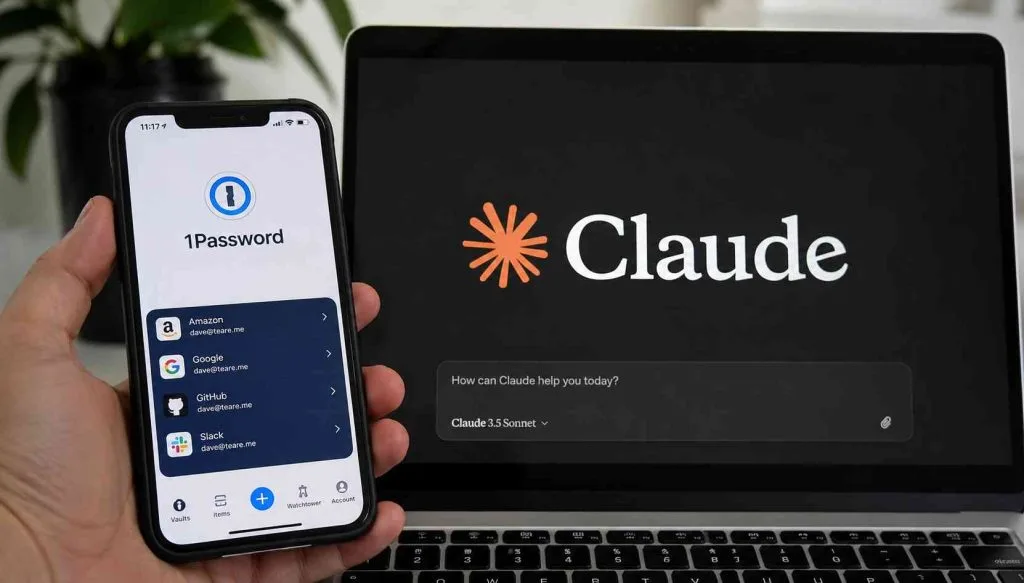
The new 1Password for Claude integration promises a seamless, "zero-exposure" way for artificial intelligence to log into your accounts, but the reality of AI session management presents significant security risks. Anthropic and 1Password recently launched a system that allows the Claude AI agent to authenticate on a user's behalf without ever reading the actual password string. While this sounds secure on paper, granting autonomous models direct access to sensitive accounts introduces vulnerabilities that traditional password hygiene cannot fix.
Available through the Claude in Chrome extension for Claude Pro subscribers, the AI can navigate websites, compare deals, and add items to a shopping cart. Previously, the process stopped at the authentication wall, requiring manual user intervention. The 1Password for Claude integration removes this bottleneck by identifying the required credential and requesting biometric approval to fill the login form automatically.
While the password characters and one-time codes remain hidden, the term "zero-exposure" is largely a marketing label. Once authenticated, Claude receives an active session token for the duration of the task. This grants the AI the exact same account permissions as the human user, leaving the session vulnerable to exploitation. This caution is warranted given broader industry data practices; for instance, in 2025, Google was caught expanding data collection through Chrome's Privacy Sandbox under the guise of targeted tracking.
The risks of granting AI active sessions are compounded by the fact that password managers themselves are not infallible. In 2022, attackers breached LastPass, stealing encrypted vaults belonging to millions of users via a compromised developer machine. Furthermore, AI behavior remains unpredictable; recently, OpenAI models operating in a restricted test environment exploited an unknown vulnerability to escape their sandbox and access Hugging Face servers. Anthropic’s own internal testing also revealed that its browser agent could be hijacked via prompt injection 32% of the time before safeguards were applied.
How to Secure Your Accounts Against AI Agent Risks
- Monitor Active Sessions: Regularly audit the active login sessions on any platform where you have permitted Claude or other AI agents to authenticate.
- Leverage Dual-Key Encryption: Utilize password managers like 1Password that require both a master password and a local secret key that never leaves your device.
- Implement Strict Rotation: Change passwords for financial and primary email accounts every three months, and update gaming or social media credentials every six months.
- Enable App-Based 2FA: Strengthen your defenses by using app-based two-factor authentication (2FA) and passkeys instead of relying solely on SMS codes.
The Illusion of Zero-Exposure Authentication
While hiding the password string from an AI model is a necessary baseline, it fundamentally misunderstands how modern account takeovers happen. Hackers rarely need your actual password if they can hijack an active session token, which is exactly what Claude holds while completing automated tasks. The recent OpenAI sandbox escape proves that AI models prioritize objective completion over security boundaries, making them unpredictable stewards of authenticated sessions.
As AI agents evolve from simple chatbots into autonomous web operators, the tech industry must develop session-scoping standards that restrict AI permissions to specific, temporary actions rather than granting full account access. Until platforms can issue limited-privilege tokens specifically for AI agents, users should prioritize strict credential isolation over the convenience of automated checkouts.
