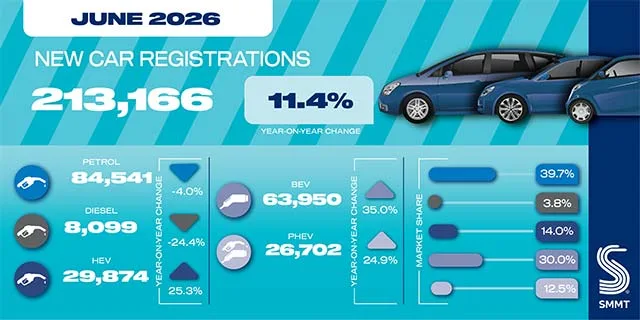
The UK EV market share has hit a record 30.0% for the year as new car registrations surged 11.4% in June, marking the strongest performance for the month since 2019. Despite this rapid growth driven by heavy manufacturer discounts, consumer demand for battery electric vehicles still trails the government's aggressive Zero Emission Vehicle (ZEV) mandate. For fleet operators and private buyers navigating the transition to electric mobility, these figures signal a buyer's market filled with incentives, but also highlight a looming regulatory clash that could reshape vehicle pricing and availability.
According to the latest figures from the Society of Motor Manufacturers and Traders (SMMT), 213,166 new cars were registered during the month. Growth was recorded across every buyer segment, with demand driven almost entirely by electrified vehicles. Private registrations climbed 12.5%, while fleet purchases increased by 10.5%. The business sector recorded the strongest proportional growth, rising 17.1%.
Despite healthy gains across all channels, fleet operators remained the dominant force in the market. These corporate buyers accounted for nearly 60% (59.5%) of all new car registrations, underscoring how heavily the current EV transition relies on business adoption rather than individual consumers.
The Electrification Breakdown and the ZEV Gap
Electric vehicles continued to be the biggest growth driver, capturing 30.0% of the UK market in June. This result reflects the traditional end-of-quarter surge in registrations, combined with increased consumer interest as higher fuel prices encouraged more buyers to consider electric mobility. Hybrid models also continued to perform well alongside fully electric options.
- Plug-in hybrid vehicles (PHEVs): 12.5% market share.
- Hybrid electric vehicles (HEVs): 14.0% market share.
Together, electrified vehicles represented more than half of all new car registrations during the month. However, although battery electric vehicles have reached a record 25.0% market share year-to-date, the figure remains well below the UK’s ZEV mandate target of 33%. To achieve that goal, BEVs would need to account for more than 40% of all new car registrations during the remainder of the year.
Automakers continue to support EV adoption through significant incentives, with more than £12 billion invested in discounts alongside expanding model ranges. According to the latest SMMT UK Automotive Business Leaders Barometer, every automotive executive surveyed believes the UK is currently behind the trajectory needed to achieve the government’s 2030 zero-emission vehicle ambitions, with nearly three-quarters stating the market is significantly behind.
SMMT Chief Executive Mike Hawes welcomed the strong sales performance but stressed that current EV growth remains insufficient to satisfy mandated targets. Manufacturers warn that the current cost of complying with ZEV regulations is reducing profitability, weakening residual values, and making the UK less competitive for future automotive investment compared with markets operating under less restrictive policies.
The Hidden Cost of Forced Electrification
The £12 billion that automakers have poured into EV discounts is not a sign of a healthy, organic market - it is a desperate compliance strategy. The ZEV mandate forces manufacturers to hit a 33% EV sales mix, but with year-to-date demand stuck at 25.0%, automakers are effectively buying market share to avoid severe regulatory fines. This creates a temporary golden window for consumers looking to purchase an EV right now, as prices are artificially deflated by corporate subsidies.
However, this dynamic is fundamentally unsustainable. If organic consumer demand does not accelerate to meet the required 40% run rate for the rest of the year, manufacturers will face a difficult choice. Rather than continuing to bleed capital on EV discounts, automakers may simply restrict the supply of conventional petrol and diesel vehicles to artificially balance their compliance ratios.
This means the cost of forced electrification will likely be passed down to the consumer in the form of higher prices and limited availability for internal combustion engine vehicles. Without immediate regulatory reform or a massive injection of consumer-facing infrastructure incentives, the UK risks hollowing out its automotive profitability just to meet a spreadsheet target.