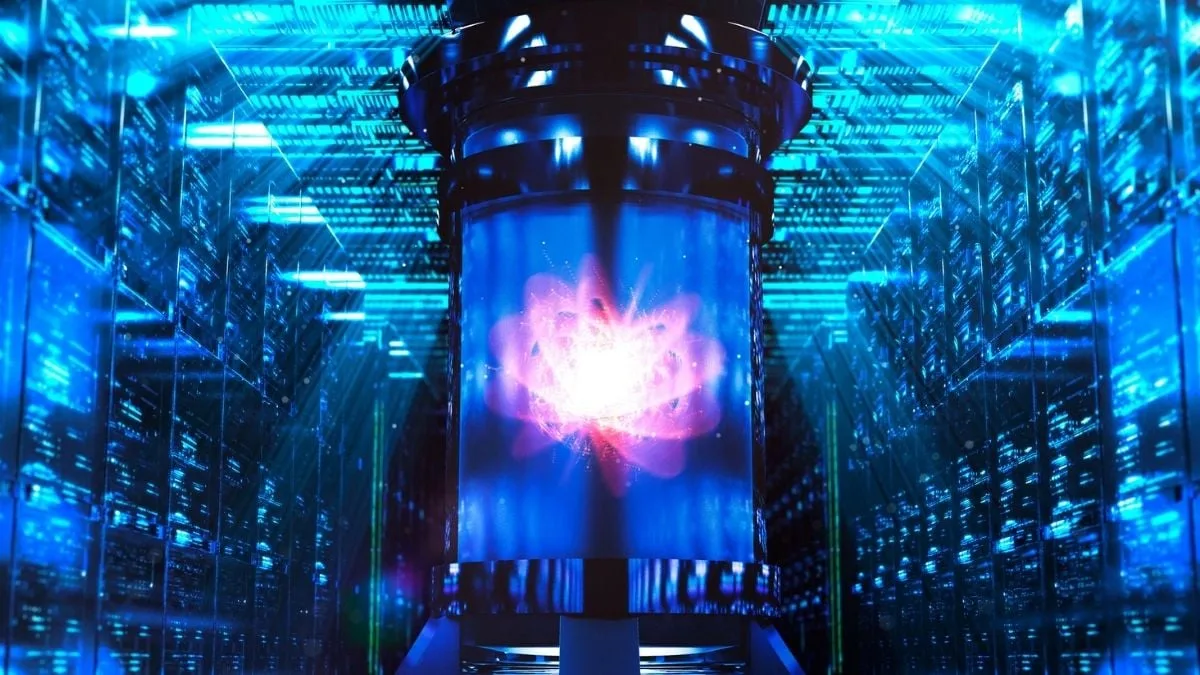
For the first time, physicists have successfully detected the elusive "ghost particles" emanating from shut-down nuclear reactors, unlocking a revolutionary method for non-intrusive nuclear monitoring. By measuring the residual antineutrino flux from dormant cores, researchers can now track radioactive decay and spent fuel without ever stepping foot inside the containment vessel. This breakthrough, achieved by the Double Chooz Collaboration and led by the Max Planck Institute for Nuclear Physics (MPIK), validates a theoretical emission that had never been practically measured.
Neutrinos and their antimatter counterparts, antineutrinos, are notoriously difficult to study. Because they lack an electric charge and possess near-nonexistent mass, they rarely interact with standard matter. However, these phantasmal particles are produced in unimaginable quantities during nuclear fission. While previous experiments easily tracked the massive flux from active power plants, capturing the faint signal from a dormant facility presented a monumental technical hurdle.
Tracking the Glow of Shut-Down Nuclear Reactors
The Double Chooz experiment, which operated from 2011 to 2017 in northern France, utilized two underground detectors positioned 400 meters and 1,050 meters away from the Chooz Nuclear Power Station. The primary goal was to observe how these particles change their "flavor" as they travel - a quantum phenomenon known as oscillation. However, the team also realized the detectors could be used to monitor the reactors even after the fission process was halted.
"Until now, reactor antineutrino experiments have mainly focused on operating reactors, where the antineutrino flux is much larger," Anthony Onillon, a physicist at MPIK and co-leader of the study, explained. He noted that detecting the tiny residual signal after shutdown required "exceptionally low backgrounds and careful analysis techniques" developed over several years.
Antineutrinos interact only extremely rarely with matter. However, when one interacts within the Double Chooz detector, a characteristic double-light signal is produced that can be distinguished from background events.
- Thierry Lasserre, Max Planck Institute for Nuclear Physics
Because physicists cannot see antineutrinos directly, they rely on a specific interaction known as inverse beta-decay (Inverse Beta-Decay). When an antineutrino passes through the detector's inner chamber, it occasionally collides with a proton inside a specialized liquid scintillator. This collision triggers a highly specific chain reaction that acts as a two-factor authentication for the particle's presence:
- First, the collision generates a neutron and a positron. The positron instantly annihilates with a nearby electron, creating an initial flash of light.
- Second, the newly created neutron is captured by gadolinium (Gadolinium), a rare-earth metal mixed into the scintillator, producing a secondary, delayed flash of light.
The Geopolitical Implications of Ghost Particles
During a 17.2-day observation window when both Chooz reactor cores were completely switched off, the research team recorded an excess of these specific light signatures. They measured 106 ±18 events, which aligned perfectly with the theoretical prediction of 88 ±7 events. To put the sensitivity of this achievement into perspective, this residual emission represents less than 1% of the antineutrino flux generated when the reactor is fully operational.
While the current iteration of this technology is primarily sensitive to large-scale changes in flux - meaning it might not immediately detect if a small handful of spent fuel assemblies were secretly removed - it serves as a critical proof-of-concept. The findings, published in the journal Physical Review Letters, lay the groundwork for next-generation detectors.
The Ultimate Tool for Nuclear Non-Proliferation
The ability to monitor shut-down nuclear reactors from hundreds of meters away fundamentally alters the landscape of global nuclear safeguards. Currently, international agencies like the IAEA rely on physical inspections, camera feeds, and on-site accounting to ensure that rogue states are not diverting spent nuclear fuel to extract plutonium for weapons programs. These traditional methods can be easily obstructed, delayed, or manipulated by uncooperative governments.
Antineutrino detection removes the need for physical access. Because these ghost particles pass effortlessly through concrete, steel, and earth, a monitoring station could theoretically be buried outside a facility's perimeter, providing an unhackable, real-time feed of the reactor's core composition and operational status. As detector technology scales and becomes more sensitive, this "eerie glow" will make it scientifically impossible to hide illicit nuclear activity, transforming a quirk of quantum physics into the ultimate geopolitical lie detector.
This article was written by AI from reporting by sciencealert.com.