Renewable energy systems often struggle with inefficient power conversion when stepping up low voltages from solar panels or wind turbines to grid-level requirements. A newly published study in Scientific Reports introduces a non-isolated high step-up DC-DC converter that achieves a massive voltage boost with a peak efficiency of 95.83%, addressing a critical bottleneck in green energy infrastructure.
This development is crucial for electrical engineers, grid operators, and renewable energy hardware designers. By minimizing energy loss during the step-up phase, this topology allows solar and wind farms to deliver more usable power to the grid without requiring bulky, expensive magnetic components. The design specifically targets the inefficiencies found in conventional quadratic converters.
The proposed architecture relies on the concept of high-order coupling. It integrates a secondary winding, a coupled inductor, a switched capacitor, and a voltage multiplier cell. Unlike traditional models, this new design achieves high voltage gain while significantly reducing the turns ratio and operating at a lower duty cycle. This directly translates to a more compact physical footprint and lower voltage stress across semiconductor devices, including both switches and diodes.
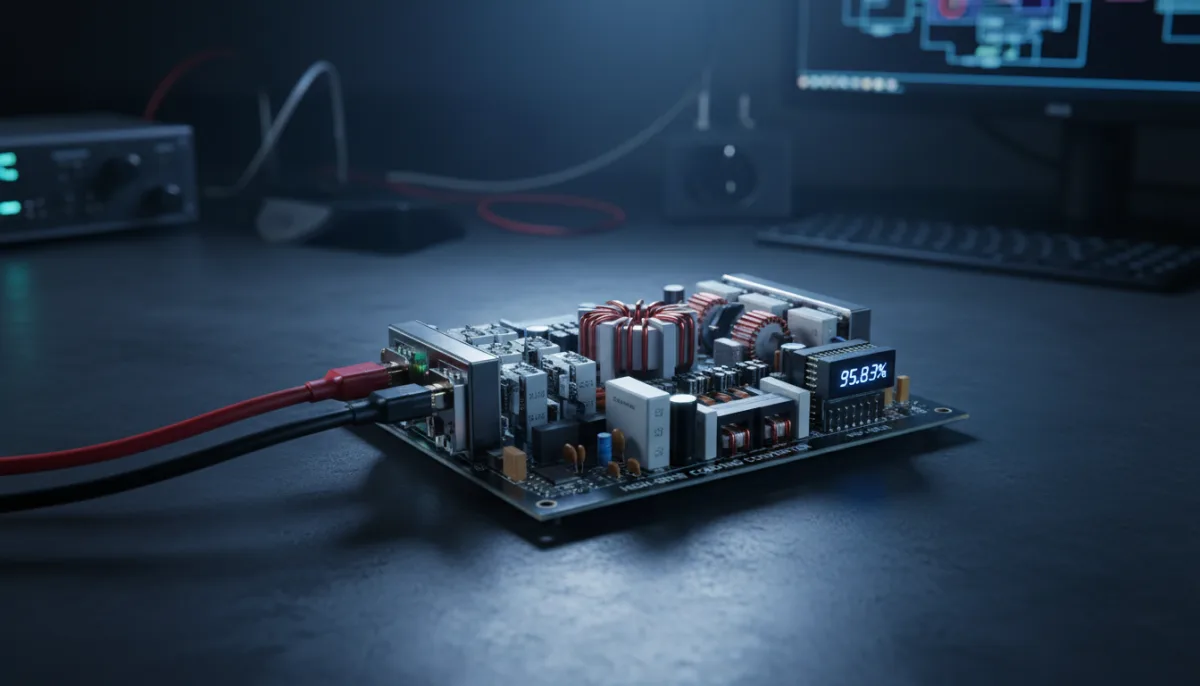
To validate the theoretical model, researchers Yin Chen, Minxin Lin, and Haibin Li built a laboratory prototype. The system successfully converted a 24V input into a 400V output, maintaining a common-ground configuration while hitting the 95.83% peak efficiency mark. The team also introduced a reduction-order method for the small-signal modeling of multi-winding cascaded converters, providing a new mathematical framework for future power electronics research.
The Efficiency Imperative in Grid Scaling
The transition to renewable energy is often framed around generation capacity, but the 95.83% efficiency achieved by this new high step-up DC-DC converter highlights the equally critical role of power electronics. Traditional converters suffer from high thermal losses and component stress when pushing low-voltage inputs to the 400V threshold required by many modern systems. This thermal waste directly cuts into the profitability and output of solar and wind installations.
By reducing the physical size of the magnetic components and lowering semiconductor stress, this cascaded high-order topology does not just save energy - it lowers the manufacturing and maintenance costs of the inverters themselves. If scaled commercially, this reduction-order modeling approach could accelerate the deployment of cheaper, more reliable micro-inverters for residential solar arrays and commercial wind farms, fundamentally improving the return on investment for green energy projects.