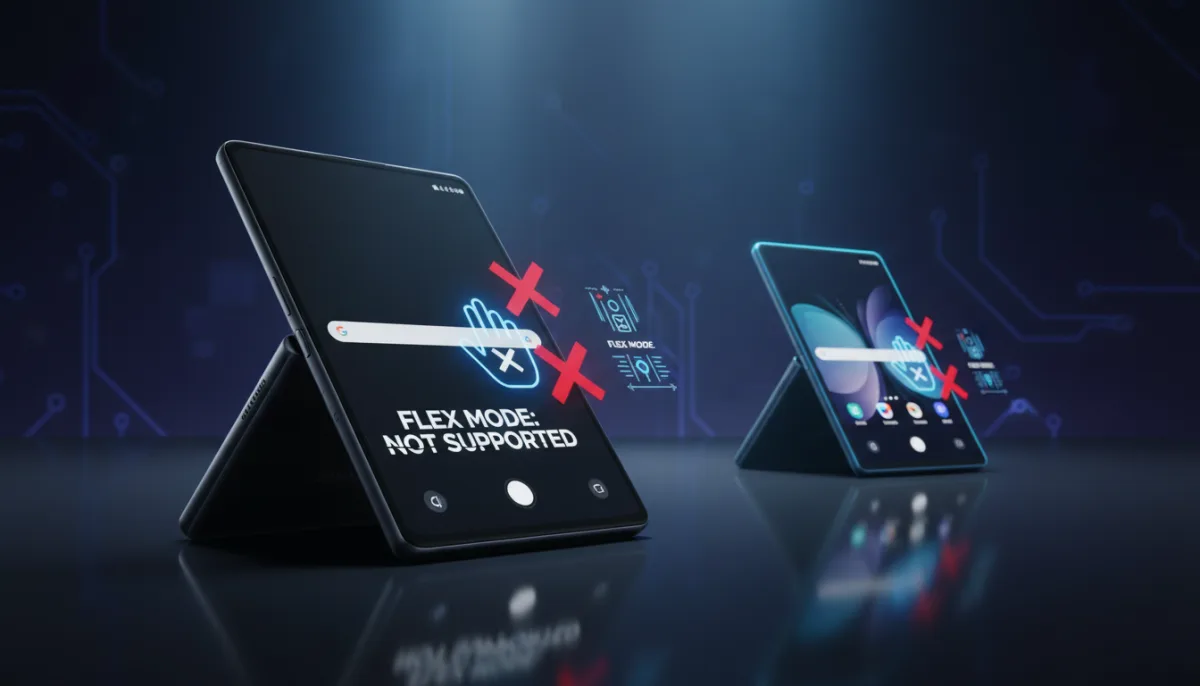
The Samsung Galaxy Z Fold 8 is a compact marvel, but it is missing a core software feature that defines the modern foldable experience: Flex Mode. While pre-orders for the new lineup are strong and the device serves excellently as a daily driver, the absence of this pivotal tool leaves a noticeable gap in its functionality. Users upgrading to the standard model will find that partially folding the screen does not trigger the adaptive interface they might expect.
Flex Mode automatically activates on most Samsung foldables when the device is partially opened between 75 and 115 degrees. It splits the main display into two distinct functional areas. For instance, in the camera app, the viewfinder shifts to the top half while the controls rest on the bottom. In the Gallery app, the bottom half transforms into a trackpad for precise photo editing.
However, on the Galaxy Z Fold 8, folding the display simply leaves a crease down the middle of the active app, with no handy interface repositioning. This stands in stark contrast to the Galaxy Z Fold 8 Ultra and the clamshell Galaxy Z Flip 8, both of which fully support the feature.
The Aspect Ratio Dilemma
The root cause of this omission appears to be the device's physical dimensions and weight distribution. The Galaxy Z Fold 8 features a 16:10 outer display and a 4:3 inner screen, which is fantastic for watching movies without heavy letterboxing. In contrast, the Galaxy Z Fold 8 Ultra utilizes a taller 21:9 outer display and a 1:1.11 inner screen.
Unfortunately, this new wider and shorter aspect ratio seems to be the standard model's undoing when it comes to holding a folded posture. Unlike the Ultra, the standard foldable cannot stay in a flexed position without slowly toppling over, opening, or closing. Since maintaining that bent shape is fundamental for the feature to work, the hardware limitation directly restricts the software capability.
Samsung Galaxy Z Fold 8 Specifications
| Specification | Detail |
|---|---|
| Processor | Qualcomm Snapdragon 8 Elite Gen 5 for Galaxy |
| RAM | 12GB / 16GB |
| Storage | 256GB / 512GB / 1TB |
| Battery | 4,800mAh |
| Operating System | Android 17 / One UI 9 |
| Front Cameras | 10MP main / 10MP cover |
| Starting Price | $1,900 at Samsung |
The Premium Price Without the Premium Posture
Paying upwards of $1,700 for a foldable phone sets a massive expectation for hardware and software synergy. Flex Mode is not just a gimmick; it is a unique utility that justifies the premium cost of a bending screen. Without it, the Galaxy Z Fold 8 feels trapped in a binary state - it is either a standard smartphone or a small tablet, completely missing the hybrid "laptop posture" that makes foldables so versatile for productivity and photography.
This hardware limitation makes the Galaxy Z Fold 8 Ultra look significantly more appealing for power users. If Samsung wants the standard Fold to stand on its own merits rather than just being the "cheaper" alternative, future iterations must solve this weight distribution issue. A foldable that cannot comfortably stay folded halfway is missing half the point of its own form factor.