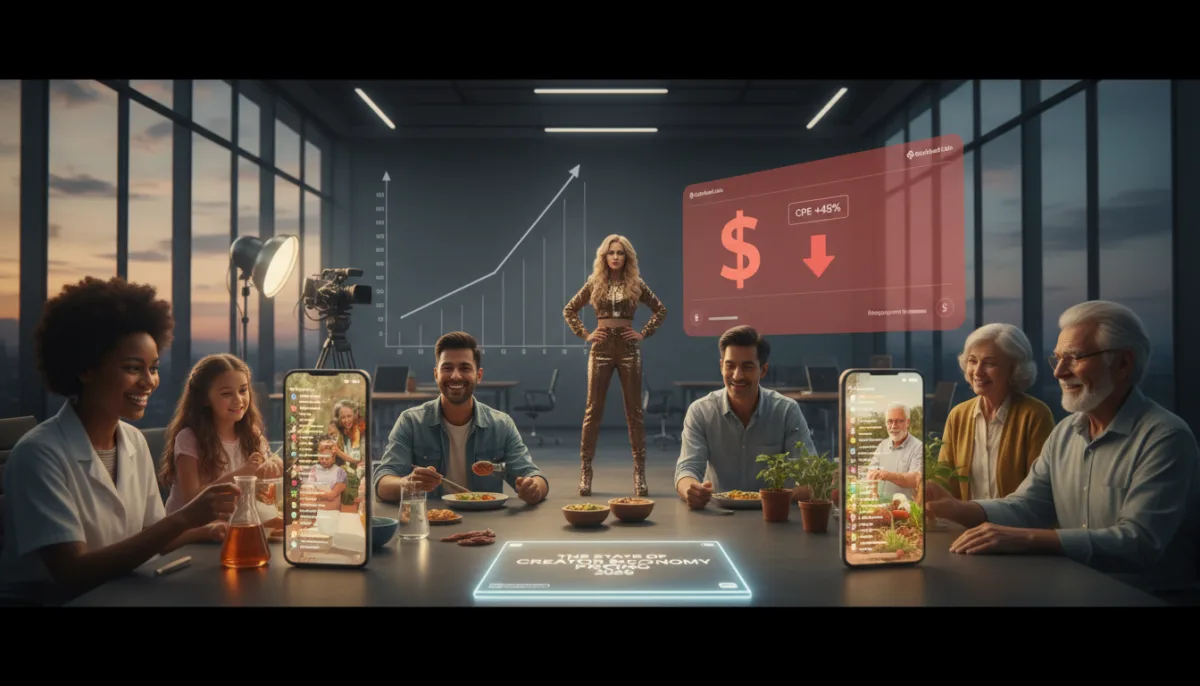
For years, brands have burned through marketing budgets by paying influencers based on vanity metrics like follower counts, often seeing dismal returns. A new framework released today aims to fix this disconnect by shifting the focus entirely to actual audience interaction. According to The State of Creator Economy Pricing 2026 report by SociaVault Labs, the industry is moving toward a Cost-Per-Engagement (CPE) model that exposes massive inefficiencies in how macro creators are priced.
The report introduces a cost-per-engagement index, specifically measuring the cost per 1,000 authentic engagements. This metric reframes influencer compensation around tangible value rather than a flat headline rate, answering the critical question of what a sponsored post is actually worth to a brand's bottom line.
Why Nano Creators Are Outperforming Macro Tiers
The data reveals a stark reality for mid-to-large influencers: a macro creator with 100,000 to 500,000 followers costs approximately 45 percent more per authentic engagement than a nano creator with under 10,000 followers. This discrepancy occurs because an influencer's asking price typically rises much faster than their engagement scales as their audience grows.
Furthermore, the platform matters just as much as the follower count. On a cost-per-engagement basis, TikTok creators consistently deliver engagement several times more efficiently than Instagram creators at comparable follower tiers.
Everyone anchors on the sticker price of a post, but that number says almost nothing about value. When the cost is divided by the engagement it actually earns, the advantage of smaller creators becomes measurable.
- Ola, Founder, SociaVault
2026 Market Projections and Compensation Shifts
Drawing from publicly available data and aggregated benchmarks, the report highlights several critical shifts in the broader market:
- The global influencer marketing market reached an estimated 32.55 billion dollars in 2025, within a broader creator economy valued near 250 billion dollars and projected to approach 480 billion dollars by 2027.
- A majority of multinational brands planned to increase influencer budgets in 2025, even as the average cost per individual collaboration softened amid a growing supply of creators.
- Per-post rates span from roughly 5 to 100 dollars for the smallest creators to 10,000 dollars or more for the largest, varying widely by platform, niche, and content format.
- Compensation is shifting away from flat fees toward performance-based models tied to measurable results.
The Niche Engagement Multiplier
Beyond follower counts, the specific content category heavily dictates pricing efficiency. The report introduces a "niche engagement multiplier," demonstrating that creators in high-engagement sectors like education and parenting generate substantially more engagement per follower than those in saturated categories like fashion. This multiplier is designed to help both brands and creators negotiate fairer pricing based on actual audience attention.
Emphasizing the need for clear data, Ola noted that "transparent methodology matters more than a big headline number," adding that the full report shows its math so anyone can verify the findings. The complete The State of Creator Economy Pricing 2026 report is available for free.
The Squeeze on the Influencer Middle Class
The 45 percent premium attached to macro creators signals a looming correction in the influencer economy. As brands transition from flat fees to performance-based compensation, the "middle class" of creators - those with large followings but passive audiences - will likely see their revenue streams shrink. Brands are realizing that stringing together ten highly engaged nano creators yields a better Return on Investment (ROI) than purchasing one expensive post from a macro influencer.
Furthermore, the stark efficiency gap between TikTok and Instagram suggests that algorithmic, content-first discovery is currently more valuable for brand integration than legacy follower graphs. If Instagram creators cannot close this cost-per-engagement gap, we will likely see a massive reallocation of brand budgets toward TikTok and YouTube Shorts, forcing Instagram-first creators to either lower their rates or pivot their content strategies entirely.