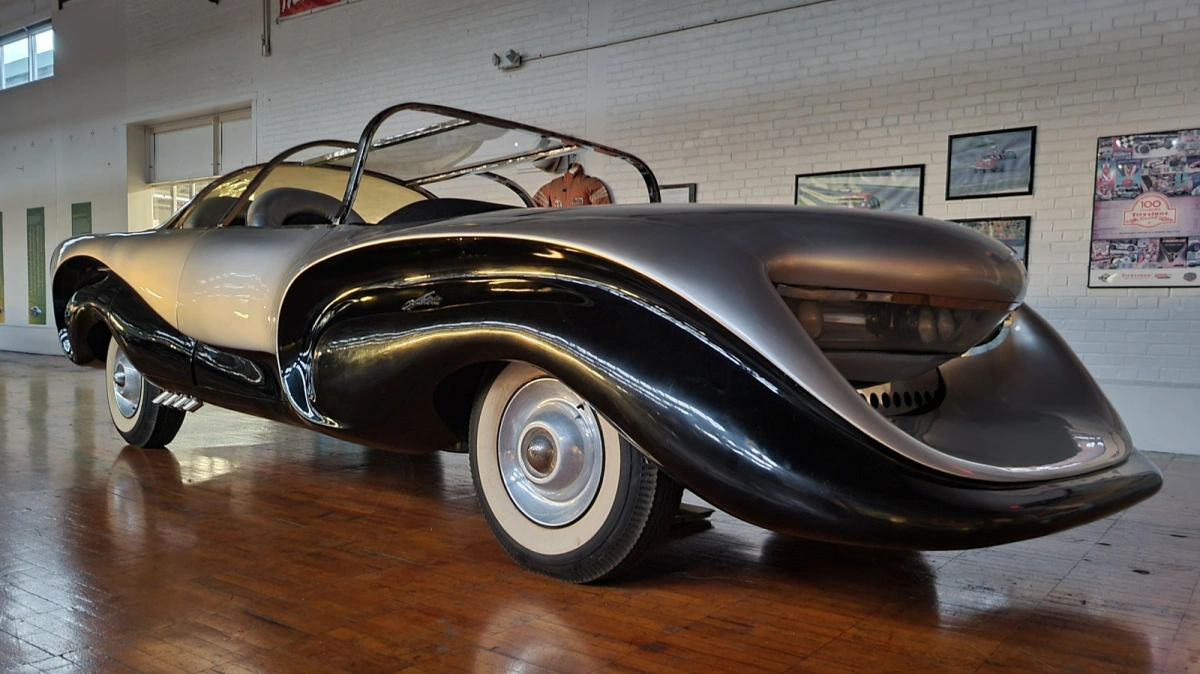
The 1957 Aurora Safety Car, a radical automotive concept designed by Catholic priest Alfred A. Juliano, is currently undergoing a comprehensive restoration at the Lane Motor Museum in Nashville. For automotive historians, restoration enthusiasts, and safety engineering professionals, this revival offers a rare glimpse into early, unconventional passenger protection strategies that predated modern industry standards. Understanding these early prototypes provides valuable context on the evolution of pedestrian and occupant safety mandates.
Built in a Connecticut horse stable in the mid-1950s using the remains of a wrecked 1954 Buick Roadmaster, the Aurora was an ambitious attempt to prioritize survival over traditional aesthetics. During an era when automotive safety was largely an afterthought, Juliano utilized his aerodynamics background from Yale to engineer a vehicle that fundamentally reimagined crash dynamics.
Radical Safety Engineering and Features
The vehicle's most polarizing feature was its convoluted full-fiberglass body, highlighted by a gaping, foam-stuffed front mouth designed to safely scoop up pedestrians rather than flattening them. To protect occupants, the car featured a bulging frontal windshield engineered to prevent head impacts during collisions. Furthermore, the structural shape of the vehicle was optimized to improve overall rigidity.
Juliano integrated a comprehensive suite of interior and exterior safety mechanisms. The Aurora included a spare tire mounted in front of the bumper for unseen impact protection, flush door handles, and seat belts - a feature that would not become an industry standard until Volvo introduced the three-point belt in 1959. Additional onboard safety technologies included a telescoping steering column, a padded dashboard, dual roll bars, and puncture-proof tires. Uniquely, the vehicle featured swiveling bucket seats at all four seating positions, allowing passengers to change their orientation to lessen the consequences of an imminent crash.
The Disastrous Debut and Legacy
Despite its innovative intentions, the Aurora was doomed by mechanical neglect and an exorbitant price tag of $15,000, equivalent to more than $176,767 today. Juliano originally hoped to premiere the vehicle at the 1956 Hartford Autorama but missed the deadline, aiming instead for a Manhattan debut the following fall. The journey from Connecticut was a disaster; the car broke down 15 times due to rust and water infiltrating the fuel line, causing Juliano to arrive eight hours late. The media focused entirely on the disastrous road trip rather than the groundbreaking safety technology.
Following the failed launch, the vehicle was abandoned in a Connecticut body shop, and Juliano eventually left the priesthood amid allegations of financial mismanagement regarding the car's funding. Decades later, British vintage-car expert Andy Saunders completed an 11-year restoration, though the car was subsequently damaged in a collision with a concrete traffic bollard. Today, the Lane Motor Museum is executing a comprehensive restoration, preparing the Aurora to join its collection of American safety cars alongside the Hudson-based Sir Vival car built by Walter Jerome.
Frequently Asked Questions
What was the primary purpose of the Aurora's unique front design?
The gaping, foam-stuffed front end was specifically engineered to safely scoop up pedestrians during a collision, preventing them from being run over or flattened by the vehicle.
Why did the Aurora Safety Car fail commercially?
The vehicle failed due to its polarizing aesthetics, an exorbitant $15,000 price tag, and severe mechanical unreliability, highlighted by 15 breakdowns during its initial trip to Manhattan.
My Take
The saga of the 1957 Aurora Safety Car illustrates a profound disconnect between visionary safety engineering and practical automotive execution. While Juliano's $15,000 prototype failed commercially due to mechanical neglect and a highly polarizing fiberglass body, its core concepts were undeniably ahead of their time. Features like padded dashboards, telescoping steering columns, and pedestrian-conscious front ends eventually became foundational elements of modern automotive safety regulations. The ongoing restoration at the Lane Motor Museum is not just about repairing a bizarre vintage car; it is about preserving a critical, tangible stepping stone in the evolution of automotive crash survivability.