

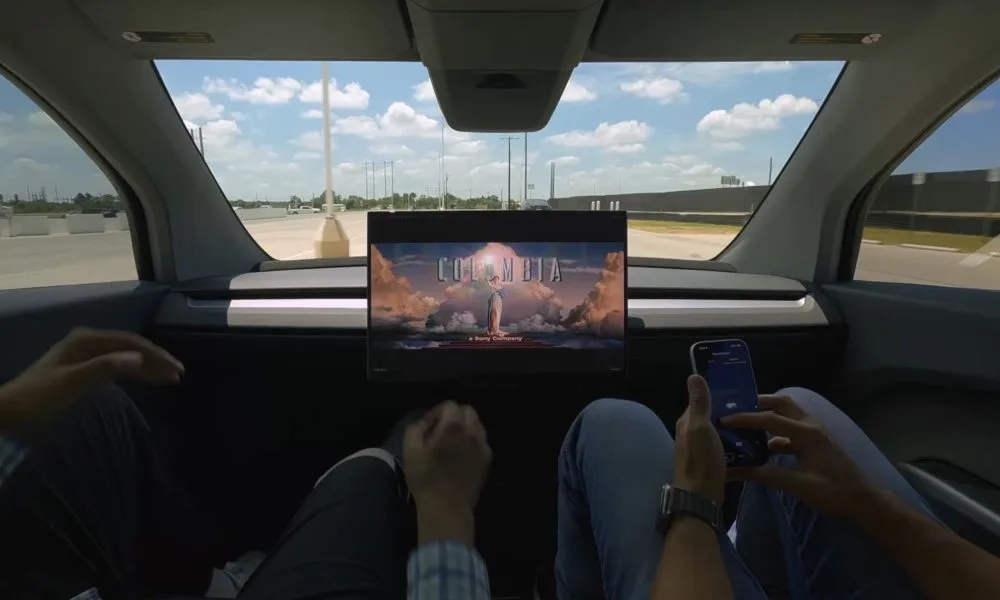
Tesla is officially transforming its robotaxi fleet into mobile entertainment hubs by shipping Cybercabs from Giga Texas with standard Starlink hardware. This integration pushes high-bandwidth satellite connectivity directly to the vehicles, enabling 4K streaming and gaming on the go. The move ensures that the steering-wheel-free robotaxis maintain constant communication for both autonomous telemetry and premium passenger experiences.
Starlink Integration and the Miami Cybercab Fleet
Elon Musk is pushing satellite connectivity across the robotaxi fleet to guarantee uninterrupted bandwidth. The Cybercabs recently began public road testing in Austin and are currently staging for commercial service in other major cities. However, the Miami rollout recently faced an unexpected proximity scare involving a major aviation accident.
On September 3, 2026, an Amazon Prime Air Boeing 767 cargo jet overran the runway at Miami International Airport. The aircraft, operated by carrier 21 Air as Flight 7598, touched down at 170 knots - well above the typical 135 to 140-knot range for the jet. The crash killed five people and injured five more after the plane plowed across NW 67th Avenue.
Photos from the scene show the aircraft’s nose stopped just meters away from a fenced staging lot holding dozens of gold-painted Tesla Cybercabs. While Miami-Dade Fire Rescue confirmed the plane struck multiple vehicles, Tesla has not issued a statement regarding whether any of the unreleased Cybercabs were damaged in the incident.
How to Control Your Tesla with the Grok AI Update
Alongside hardware deployments, Tesla’s 2026 Summer Update (versions including FSD v14.3.8 and 2026.26.6.5) transforms the Grok AI from a conversational assistant into a comprehensive in-car controller. Drivers can now issue multiple simultaneous hardware and software commands using natural speech, significantly reducing the need to navigate touchscreen menus.
To utilize the new capabilities, drivers can speak a single sentence to execute combined actions. Supported commands include:
- Folding the exterior mirrors.
- Turning on the wipers to the fastest setting.
- Changing the cabin temperature to a specific degree, such as 65 degrees.
- Opening the self-driving application and the glovebox simultaneously.
- Placing phone calls, queuing streaming music, and searching the Controls panel.
The Falcon 1 Legacy That Built Starlink
The high-bandwidth Starlink connectivity powering the Cybercabs traces its existence back to a critical SpaceX milestone. Elon Musk recently reflected on the company's near-collapse in 2008, noting that a fourth consecutive launch failure would have bankrupted the firm and erased the possibility of low Earth orbit broadband.
If the 4th launch had failed, SpaceX would not exist.
- Elon Musk, SpaceX
The journey to orbit was fraught with precise mechanical failures. The first flight on March 24, 2006, ended after 33 seconds when a corroded fitting leaked kerosene, destroying the DARPA FalconSAT-2 payload. Flight 2 on March 21, 2007, reached 289 kilometers before propellant slosh shut down the engine, while Flight 3 on August 2, 2008, reached 217 kilometers before residual thrust of just 10 pounds per square inch caused the stages to collide.
Finally, on September 28, 2008, at 23:15 UTC, Flight 4 successfully placed the 165-kilogram Ratsat mass simulator into a 621-by-643-kilometer orbit at a 9.35-degree inclination. This flawless execution secured NASA's Commercial Resupply Services contract, ultimately funding the Falcon 9 program and paving the way for the Starlink constellation.
The Satellite-Driven Ecosystem
The decision to make Starlink hardware standard on the Cybercab highlights a massive strategic advantage that traditional automakers simply cannot replicate. By bypassing terrestrial 5G cellular networks, Tesla guarantees that its autonomous fleet maintains a persistent, high-bandwidth connection regardless of local cell tower congestion or dead zones.
This integration is not just about enabling 4K streaming for passengers; it is a critical infrastructure play for unsupervised Full Self-Driving telemetry. As the Grok AI handles complex in-cabin requests and Starlink manages the massive data pipeline required for autonomous navigation, Tesla is effectively operating a closed-loop technological ecosystem that relies entirely on Musk-owned infrastructure from orbit to the pavement.
