Malaysia is preparing to test Starlink Direct-to-Cell technology, a satellite-based solution designed to eliminate mobile dead zones without requiring users to purchase dedicated satellite phones. Communications Minister Fahmi Fadzil confirmed that Starlink representatives intend to conduct local trials, prompting the Malaysian Communications and Multimedia Commission (MCMC) to invite local mobile network operators to participate. If successful, this initiative could instantly provide mobile connectivity to remote areas where building traditional telecommunications towers is economically unviable.
Deploying conventional infrastructure typically takes between 18 and 24 months to complete. In contrast, the satellite-based approach extends an operator's existing network directly from space, drastically reducing both deployment time and capital expenditure for rural coverage.
How 4G LTE Connects to Space
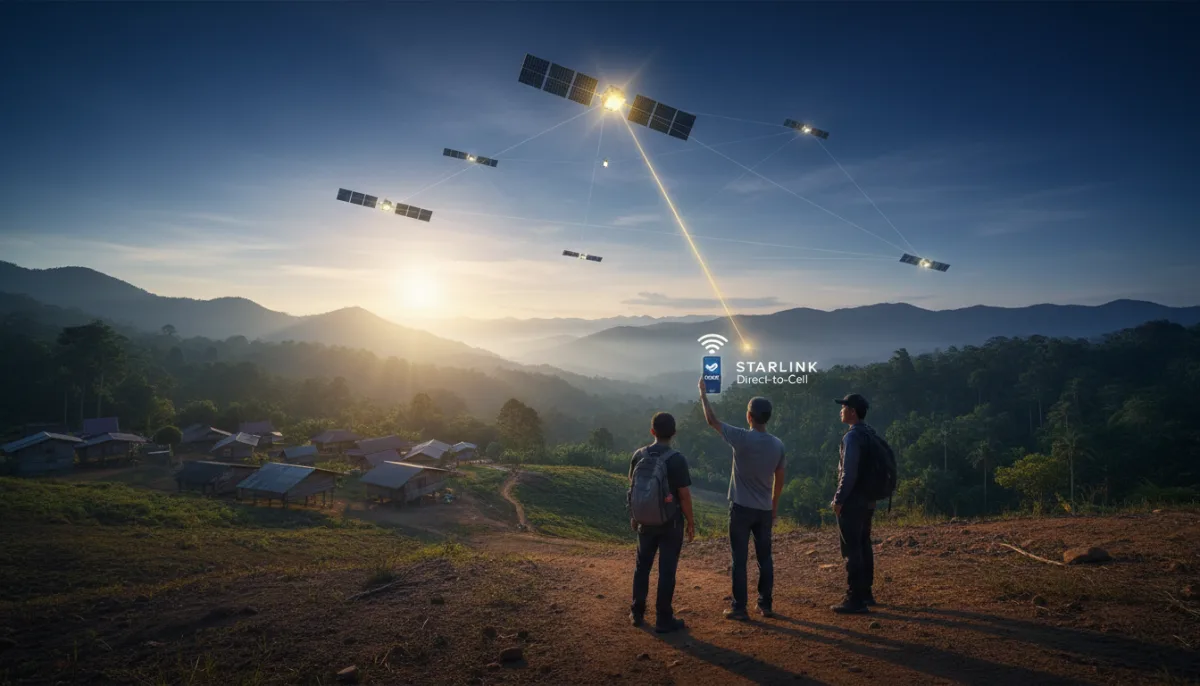
Unlike standard Starlink broadband that requires a dedicated dish, the Direct-to-Cell service works seamlessly with existing 4G LTE smartphones. When a user steps outside their local telco's coverage area, their phone connects directly to a Starlink satellite in Low Earth Orbit, positioned roughly 500 to 600km above Earth. The satellite effectively acts as a 4G LTE base station in space, routing the connection back to the mobile operator's core network using licensed spectrum.
In Malaysia, this system is expected to utilize lower-band frequencies, such as 900MHz or 1800MHz, to ensure better reception over the vast distance between the device and the satellite. Users retain their current SIM cards and phone numbers, while the local telco maintains full control over the network routing.
V2 Satellites and Hardware Limitations
SpaceX has already deployed over 650 first-generation Direct-to-Cell satellites to build this space-based network. The upcoming second-generation (V2) satellites will feature custom SpaceX-designed silicon and phased array antennas. These upgrades will support thousands of spatial beams, delivering approximately 20x the throughput of the current generation.
However, the technology is designed as a complementary layer, not a replacement for terrestrial 5G or 4G networks. Because it relies on a clear line of sight to the sky, it cannot provide indoor coverage. Speeds and latency will also be lower than standard cellular networks, making the service strictly intended for essential communications like messaging, voice calls, and emergency SOS when users are completely off the grid.
The Southeast Asian Precedent
Malaysia is not the first regional market to explore this capability. In the Philippines, Globe Telecom became the first Southeast Asian operator to roll out Starlink Direct-to-Cell services. Globe offers the feature on both prepaid and postpaid tiers, starting at PHP99 (RM6.60) for a 30-day plan that includes 2GB of data and 100 satellite texts to all networks.
According to a recent Q2 2026 analysis by Ookla, the Philippines currently accounts for the largest share of detected Starlink Direct-to-Cell users in the Asia-Pacific region. Similar partnerships are already underway in the United States, Australia, New Zealand, Canada, and Japan.
The Economics of Space-Based Cell Towers
The transition to Direct-to-Cell fundamentally rewrites the capital expenditure playbook for national telcos. For decades, carriers have struggled to justify the ROI of building expensive terrestrial towers in sparsely populated rural corridors or offshore zones. By leveraging Starlink's orbital infrastructure, telcos can instantly achieve 100% geographical coverage without pouring millions into concrete, steel, and fiber backhaul.
This shift transforms rural connectivity from a heavy infrastructure burden into a lightweight operational expense. Furthermore, the aggressive pricing seen in the Philippines - just RM6.60 for a basic satellite add-on - proves that space-based roaming can be commoditized for everyday consumers, rather than reserved for enterprise maritime or aviation clients. As V2 satellites increase bandwidth capacity, the line between terrestrial and satellite mobile networks will effectively disappear for the end user.