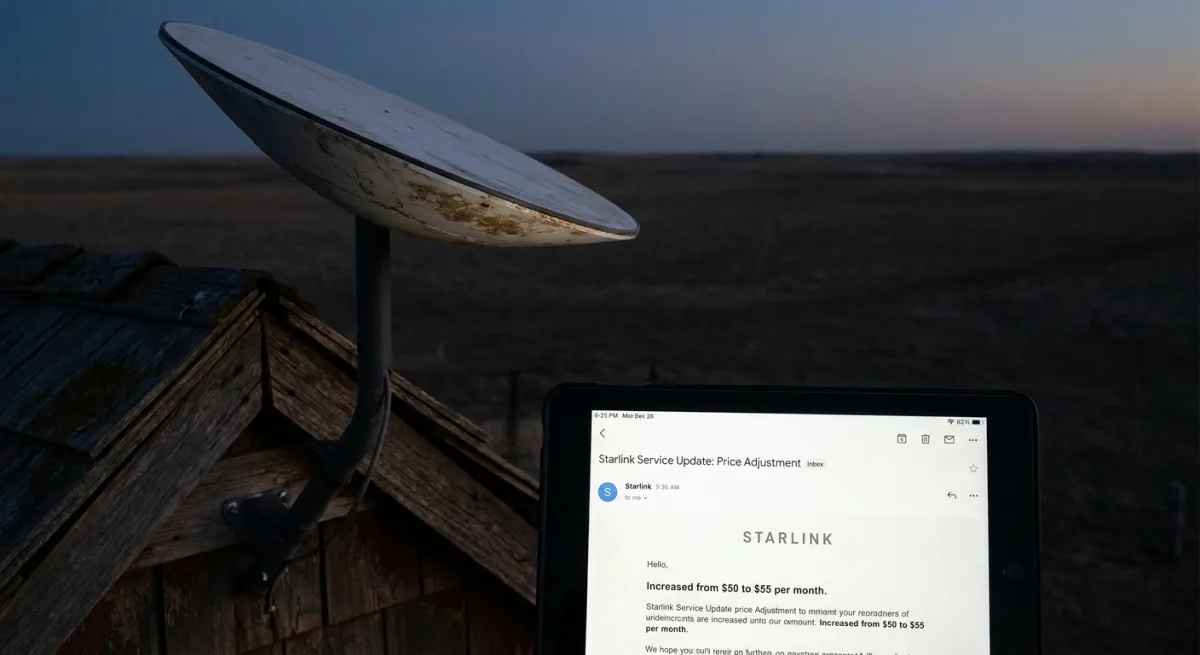
Starlink is quietly rolling out a price increase across nearly all its satellite internet tiers in the US, impacting both residential users and digital nomads. The price hikes, which push the cheapest 100Mbps Residential plan from $50 to $55 per month, arrive just as SpaceX lobbies the government to cut billions in rural broadband subsidies.
The adjustments affect a wide range of service tiers, forcing subscribers to pay more for the same speeds. According to a message sent to customers, the increases are necessary to fund rapid network capacity expansion and reliability improvements. The updated pricing structure includes:
- 100Mbps Residential: Increased from $50 to $55 per month.
- 200Mbps Residential: Increased from $80 to $85 per month.
- Residential Max: Increased from $120 to $130 per month.
- Standby Mode: Doubled from $5 to $10 per month.
- 100GB Roam: Increased from $50 to $55 per month.
- Unlimited Roam: Increased from $165 to $175 per month.
The 300GB Roam plan is the only tier that remains unchanged, holding steady at $80 per month. Standby Mode, which saw a 100 percent price jump, is a feature that allows subscribers to pause their main Starlink service while retaining access to unlimited low-speed data.
While Starlink has become a vital lifeline for rural communities lacking traditional ISP options, the price hikes raise questions about long-term affordability and market competition. Just last week, SpaceX submitted a letter to the Federal Communications Commission (FCC) urging the agency to terminate $4.5 billion in rural internet subsidies. The company argued that satellite internet has effectively "solved" the high-speed broadband access problem, making government funding for competing infrastructure unnecessary.
In a message to customers, Starlink justified the higher fees by stating the service is "rapidly increasing network capacity, expanding coverage, and improving reliability to deliver faster, more consistent connectivity." This shift follows aggressive promotional tactics from last year, where Starlink offered a 12-month residential contract that reduced the upfront hardware cost of the dish and router to $0 in select markets.
The Monopoly Playbook in Low Earth Orbit
SpaceX’s dual strategy of raising prices while simultaneously lobbying the FCC to kill $4.5 billion in rural broadband subsidies reveals a classic market consolidation play. By arguing that satellite internet has "solved" the rural connectivity gap, Starlink is attempting to pull the ladder up behind it, starving potential fiber or fixed-wireless competitors of crucial government funding.
If the FCC agrees to cut those subsidies, rural customers will be left with fewer alternatives, giving Starlink the unchecked leverage to continue raising prices without fear of subscriber churn. The 100 percent hike on Standby Mode is a clear indicator that SpaceX knows its rural and nomadic user base is effectively locked in. As the company transitions from aggressive customer acquisition - like last year's $0 hardware promotions - to maximizing revenue, rural America may soon find that the "solution" to their internet problem comes with an ever-increasing monthly toll.
This article was written by AI from reporting by theverge.com.