

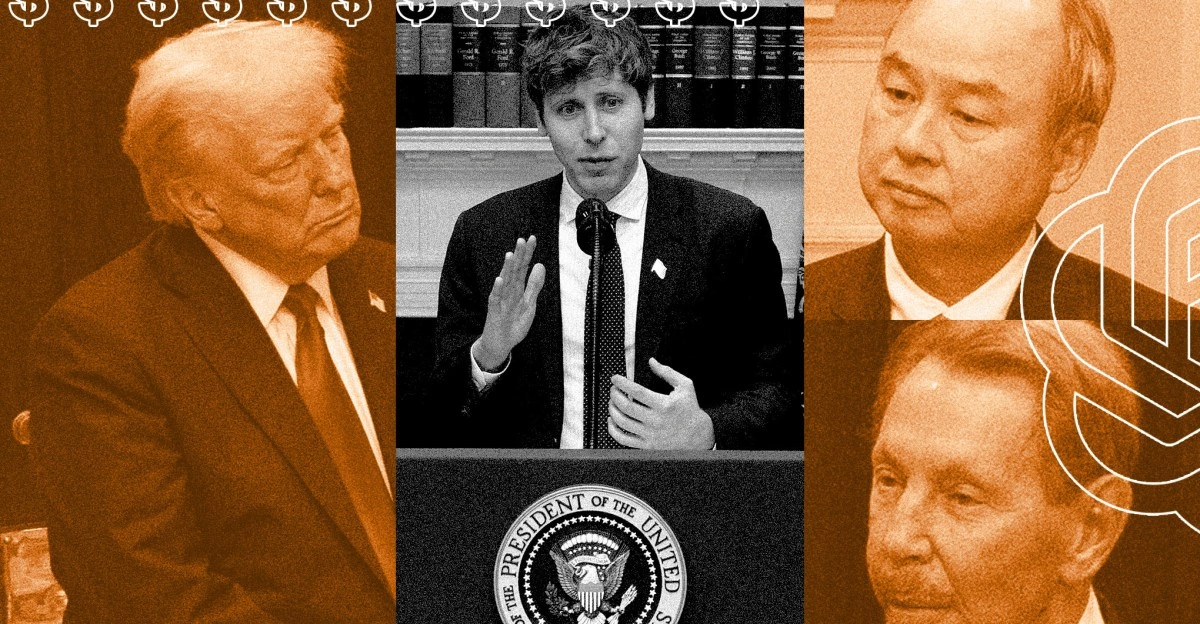
Stargate Ignites the AI Infrastructure Arms Race
Picture this: a $500 billion bet on silicon and steel to power the next era of AI. That's Project Stargate, the audacious joint venture from OpenAI, SoftBank, Oracle, and MGX, formally announced in January 2025. Kicking off with $100 billion immediately, it's not just fundingit's a full-scale reindustrialization of American AI compute, promising 7 gigawatts of capacity across new U.S. sites from Texas to Ohio.
SoftBank's Masayoshi Son chairs the effort, with OpenAI handling operations. NVIDIA supplies the GPUs, Oracle drops $40 billion on 400,000 GB200 chips, and partners like Arm, Microsoft, and others build the backbone. The goal? Secure U.S. leadership in AGI, create 25,000 jobs, and fuel breakthroughs in drug discovery, climate modeling, and beyond.
Key Players and Their Massive Commitments
Stargate LLC isn't flying solo in this supercycle. As of early 2026, the 'Big Six' AI spendersthink hyperscalers like Microsoft, Amazon, Meta, and Alphabetare projected to pour over $500 billion into infrastructure this year alone, potentially hitting $650 billion. NVIDIA remains the undisputed king, gobbling up capex for Blackwell and Rubin GPUs.
Recent expansions added five U.S. sites, pushing total investment past $400 billion over three years and capacity to nearly 7GWon track for 10GW by year-end. Oracle and OpenAI's Abilene work, plus SoftBank-powered Texas facilities scalable to 1.5GW in 18 months, anchor the buildout.
CEO Reactions: Nadella's Calm vs. Meta's Skepticism
The Verge spotlighted illuminating responses to Stargate's splash. Microsoft CEO Satya Nadella views the frenzy as 'just getting started,' aligning with his firm's deepened Azure tiesOpenAI will ramp up consumption there alongside Stargate compute. No panic, just pragmatic scaling.
Meta, however, pushes a contrarian line. Mark Zuckerberg's team emphasizes custom silicon over raw NVIDIA hauls, pivoting capex to 'Superintelligence Labs.' It's a witty jab at the 'Maginot Line' of mega-spendingimpressive walls of GPUs that might not outpace efficiency gains elsewhere.
Power Hungry: The Gigawatt Supercycle
AI's thirst for electricity is the real plot twist. Stargate's 10GW target rivals small nations' grids. The OBBBA legislation in July 2025 unlocked fiscal certainty, shifting narratives from AI hype to 'how much power can we secure?' Sites like Patagonia’s 500MW Stargate Argentina hint at global ripple effects.
Here's a quick comparison of the infrastructure boom:
| Player | Investment | Focus | Key Tech |
|---|---|---|---|
| OpenAI/SoftBank/Oracle (Stargate) | $500B over 4 years | U.S. campuses, 10GW | NVIDIA GB200, Arm |
| Amazon (AWS) | $200B multi-year | Custom silicon, sovereign clouds | Trainium |
| Meta | Full capex pivot | Superintelligence Labs | Custom chips |
| Alphabet | Doubled down | Integrated services | TPU clusters |
This table underscores Stargate's scaleno one matches the sheer gigawatt ambition.
Risks and Roadblocks
Not all smooth circuits. Bloomberg noted delays in August 2025no funds raised yet amid market uncertainty, trade policies, and chip valuations. Banks face 'tail risks' from AI IT spending exploding to $1T by 2029. Power sourcing remains a chokepoint, with SP Energy and others racing to deliver.
My Take: Visionary Gamble or Overhyped Power Grab?
As Coreiten's Senior Editor, I see Stargate as the Manhattan Project for AIbold, necessary, and a bit terrifying. Nadella's right: the frenzy is ramping up, but Meta's efficiency play might steal the show long-term. Prediction: By 2027, we'll hit AGI milestones powered by this grid, but only if power innovators keep pace. Startups get cheaper access, economies boom locally, and the U.S. cements dominance. Witty upside? Son's trillion-dollar TSMC pitch shows the stakes. Buckle upthis supercycle redefines winners.
