

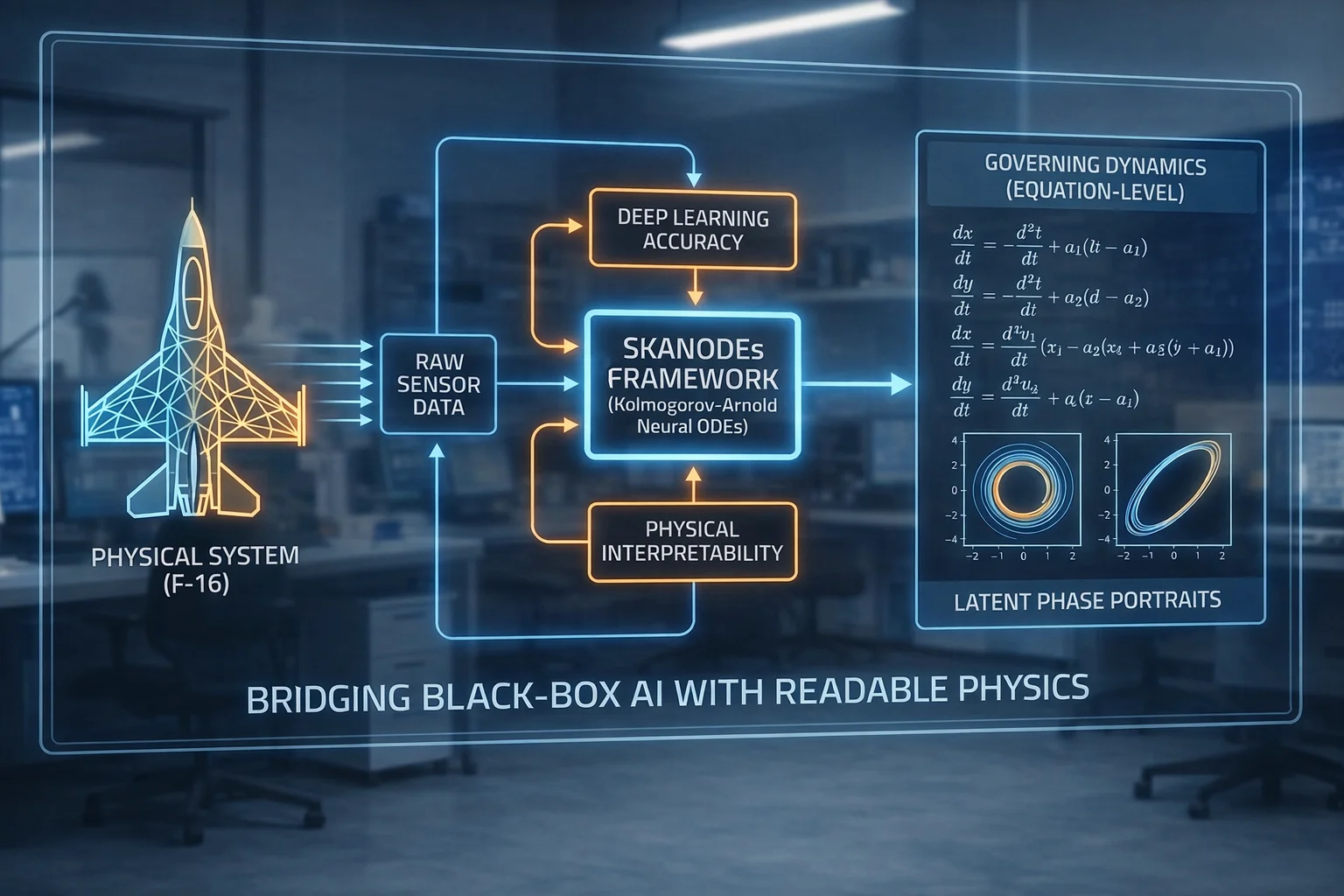
The newly proposed Structured Kolmogorov-Arnold Neural ODEs (SKANODEs) framework is set to transform how researchers model complex physical systems by bridging the gap between deep learning accuracy and physical interpretability. Developed by researchers Wei Liu, Kiran Bacsa, Loon Ching Tang, and Eleni Chatzi, this architecture integrates structured state-space modeling with Kolmogorov-Arnold Networks to decode nonlinear dynamical systems. The research, recently updated on March 5, 2026, addresses a fundamental challenge across science and engineering: achieving models that are both highly accurate and physically transparent.
This development is crucial for engineers, physicists, and data scientists working on structural health monitoring and aerospace engineering. By utilizing this framework, professionals can move beyond black-box predictions to extract readable, equation-level descriptions of physical dynamics, enabling safer and more predictable engineering designs. Traditionally, deep learning models excel at capturing complex system behaviors but fail to explain the underlying physics, leaving engineers with uninterpretable results. SKANODEs solve this by employing a fully trainable Kolmogorov-Arnold Network as a universal function approximator to perform virtual sensing.
Decoding Nonlinear Dynamics with SKANODEs
Within a Neural ODE architecture, the SKANODE system recovers latent states that correspond directly to interpretable physical quantities, such as displacements and velocities. Leveraging the symbolic regression capability of Kolmogorov-Arnold Networks, the framework then extracts compact, interpretable expressions for the governing dynamics of the system. This allows researchers to see exactly how the neural network is interpreting the physical laws governing the data, rather than just receiving a final predictive output.
The research team validated the framework through rigorous experiments on two canonical nonlinear oscillators and a real-world F-16 ground vibration dataset. In the Duffing oscillator test, the system successfully identified the correct cubic stiffness. For the Van der Pol oscillator, it accurately mapped the nonlinear damping structure. Furthermore, when applied to the F-16 dataset, the framework revealed hysteretic signatures in the interface dynamics through structured latent phase portraits and an interpretable symbolic model. Across all three scenarios, the architecture provided more accurate and robust predictions than black-box NODE baselines and classical ARX and NARX identification methods. Researchers can explore the citation metrics for this study via Google Scholar.
Frequently Asked Questions
What is the SKANODEs framework?
It is a novel architecture that integrates structured state-space modeling with Kolmogorov-Arnold Networks within a Neural ODE framework to model nonlinear dynamical systems interpretably.
How does it improve upon existing models?
Unlike traditional black-box deep learning models, SKANODEs use symbolic regression to extract readable, equation-level descriptions of physical dynamics, outperforming classical ARX and NARX identification methods.
What real-world data was used to test it?
The framework was rigorously tested using a real-world F-16 ground vibration dataset, where it successfully identified hysteretic signatures in the interface dynamics.
My Take
The introduction of the SKANODEs framework marks a critical pivot in scientific machine learning, shifting the focus from mere predictive accuracy to true physical interpretability. The fact that this model outperformed established classical ARX and NARX identification methods on a complex, real-world F-16 ground vibration dataset proves that symbolic regression combined with Neural ODEs is not just a theoretical exercise. It is a highly practical tool for aerospace and mechanical engineering. As industries demand more transparent AI systems for safety-critical applications, frameworks that can output equation-level descriptions of learned dynamics will become the new gold standard for structural health monitoring and predictive maintenance.
