

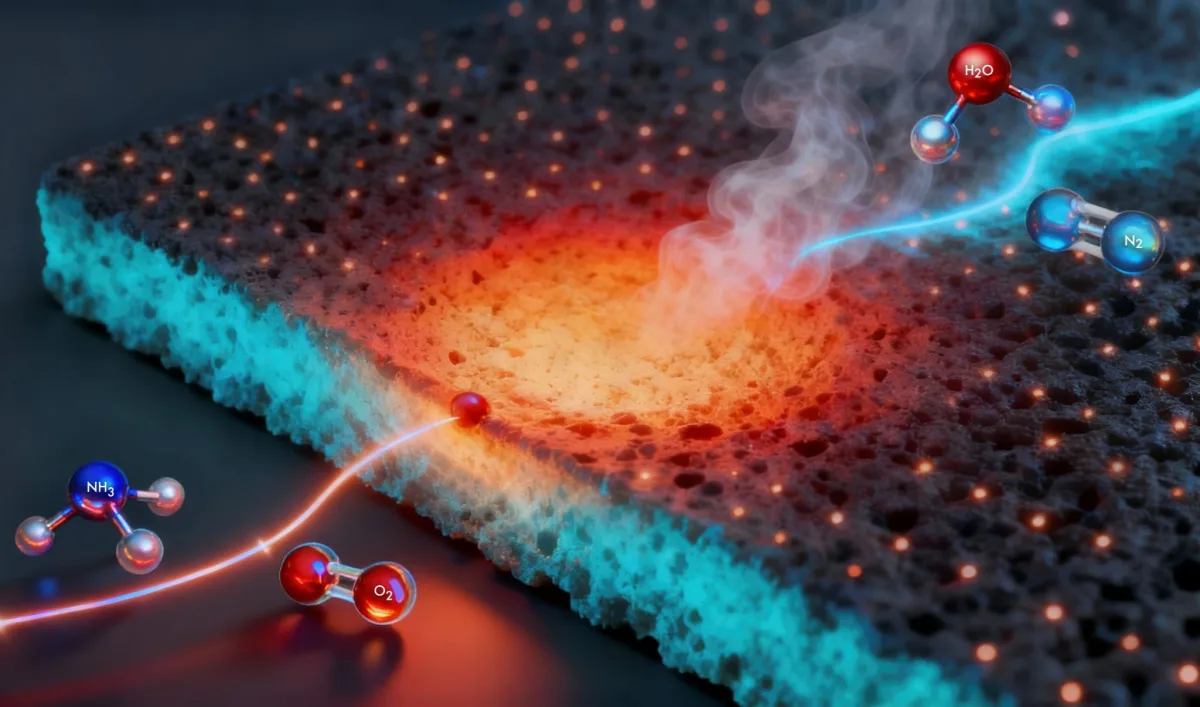
Heavy industries like steel and cement manufacturing have a massive carbon footprint, but replacing fossil fuels with clean-burning ammonia has historically hit a toxic roadblock. Ammonia is notoriously difficult to ignite, typically requiring temperatures of 500°C (932°F) or higher, and releases dangerous nitrogen oxides (NOx) when burned at the extreme temperatures required for industrial processes.
Researchers at the National University of Singapore (NUS) have engineered a single-atom platinum catalyst that eliminates these hurdles. The newly developed material ignites ammonia at roughly 215°C (419°F) - just above the 200°C (392°F) baseline targeted by the team - and sustains stable, clean combustion at a blistering 1,100°C (2,012°F).
Atomic-Scale Engineering for Clean Heat
The research team, led by Professor Yan Ning and Assistant Professor He Qian, dispersed individual platinum atoms across a durable alumina support reinforced with zirconia. This atomic-scale design prevents the platinum from clustering under intense heat, preserving the catalyst's stability at temperatures well above 1,000°C (1,832°F). At lower temperatures, the isolated atoms efficiently break apart ammonia molecules.
As the heat scales up, the catalyst's structure forces the chemical reaction to produce harmless nitrogen and water, generating almost zero NOx emissions. Laboratory imaging confirmed that the platinum atoms remained active and evenly dispersed even after 80 hours of continuous high-temperature operation. Furthermore, the catalyst's efficiency actually improved after its initial use, fully converting all ammonia molecules with no unburned fuel left behind.
"Heavy industry needs high-quality heat, not just a clean exhaust," Assistant Professor He Qian explained. "We set out to kill two birds with one stone: make ammonia easier to ignite and keep NOx low when you run it hot."
Ammonia has always held promise as a low-carbon fuel, but making it truly usable required solving a long-standing chemistry problem. Our catalyst shows that it is possible to unlock ammonia’s energy cleanly and reliably.
- Du Yankun, Lead Author, National University of Singapore
Supported by the NUS Centre for Hydrogen Innovations, the team is preparing for pilot-scale trials to test the catalyst in industrial burners, high-temperature reactors, and gas turbines.
The Missing Link for Heavy Industry Decarbonization
While electric vehicles and solar grids dominate the clean energy conversation, heavy manufacturing requires intense, on-demand thermal energy that batteries simply cannot provide. This single-atom platinum catalyst is a massive leap forward because it allows existing plants to retrofit their infrastructure with minimal changes rather than rebuilding from scratch.
By lowering the ignition threshold to 215°C and neutralizing NOx at 1,100°C, this breakthrough transforms ammonia from a theoretical green alternative into a highly practical, deployable industrial fuel. If the upcoming pilot trials succeed, this could rapidly accelerate the decarbonization of the steel and cement sectors, which are currently responsible for a massive share of global emissions.
