The world's first room-temperature quantum material has just been engineered by physicists at LSU, effectively eliminating the need for massive, energy-hungry cryogenic refrigerators. For decades, the fragile nature of quantum mechanics has kept revolutionary technologies locked inside deep-freeze laboratories, but this breakthrough shatters that absolute-zero barrier.
The research, published in Nature, introduces a fundamentally new class of material that operates without extreme cooling. At ordinary temperatures, atomic vibrations typically destroy the delicate quantum effects required for advanced computing and sensing. By engineering a material from the ground up, the team bypassed nature's limitations entirely.
Building the Plasmonic Metacrystal
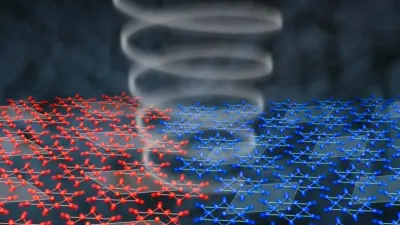
Instead of hunting for naturally occurring substances, the researchers constructed an artificial quantum crystal. They deposited a microscopic layer of gold onto a glass chip and used focused ion beams to carve hundreds of nanoscale slits into the metal. Each slit acts as an artificial atom, or meta-atom, creating a structure thinner than a human hair.
When light travels across this gold surface, it interacts with the engineered meta-atoms. By precisely tuning the size, shape, and spacing of these structures, the material acts as a statistical filter. It detects subtle quantum distinctions in incoming photons and directs different quantum states along separate, stable routes.
"These quantum states carry information," explained Associate Professor Omar S. Magaña-Loaiza, who led the study. "Our crystal can distinguish them and move them from one point to another in a robust way without requiring cryogenic cooling. That's what opens the door to practical quantum technologies."
Quantum Statistical Bands and Solar Energy
The team coined a new term for their invention: the quantum statistical plasmonic metacrystal. Much like electronic band structures dictate how electricity flows through semiconductors, this new material features "quantum statistical bands" that govern the movement of light's quantum states. This allows certain states to pass through unaltered while others undergo statistical changes, preserving the highly fragile quantum coherence of many-body systems.
Beyond quantum computing and secure communication networks, this room-temperature quantum material holds surprising potential for renewable energy. Modern solar cells lose significant amounts of energy when trapped light converts into heat rather than electricity. By guiding light along highly stable pathways with minimal loss, this metacrystal could drastically increase the efficiency of next-generation solar panels.
The Commercial Quantum Leap
The transition from cryogenic dependency to room-temperature operation is the exact catalyst the quantum industry has been waiting for. Currently, the infrastructure required to maintain absolute-zero environments makes quantum computers prohibitively expensive and physically massive. By proving that quantum states of light can be robustly transported at room temperature, this LSU research shifts quantum tech from a laboratory novelty to a deployable commercial asset. Furthermore, the pivot toward solar energy applications demonstrates that quantum materials will not just revolutionize data processing, but could fundamentally alter how we capture and convert physical energy in the real world.