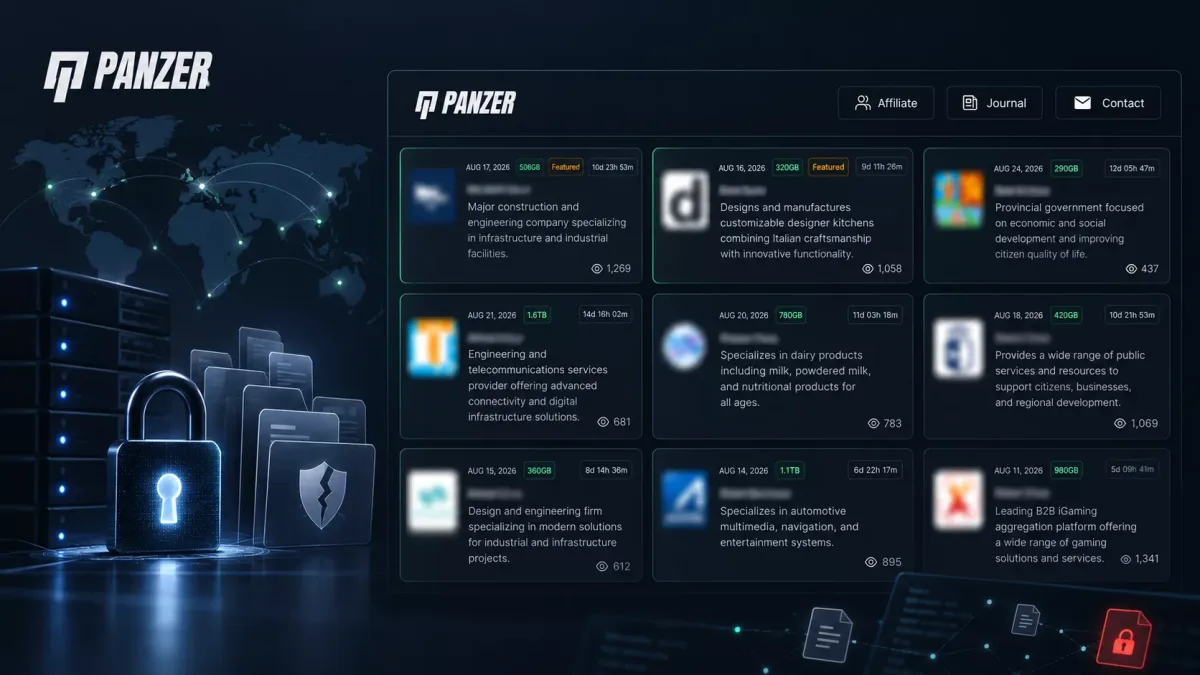
A highly organized Ransomware-as-a-Service (RaaS) operation known as Panzer Ransomware has compromised 16 organizations across 11 countries within its first month of activity. Utilizing a double-extortion model, the group is actively targeting enterprise environments with cross-platform payloads designed to cripple mixed server fleets. The operation's dedicated leak site, first observed on August 5, 2026, reveals a broad, opportunistic targeting strategy rather than a narrow geographic focus.
The initial victim list spans multiple critical sectors, with technology organizations representing the largest share at four victims, followed closely by manufacturing with three. Other compromised entities operate in government, agriculture, energy, education, and retail. Geographically, the attacks are widely distributed, hitting organizations in Thailand, Italy, Indonesia, Serbia, Curaçao, South Korea, Spain, the Czech Republic, Germany, Nigeria, and Switzerland.
The Panzer Affiliate Model and Technical Arsenal
Panzer operates a semi-open affiliate program that functions much like a modern software business. Prospective partners are recruited through a Tox-based application process and must pass a screening before gaining access to the platform's dashboard. The group incentivizes attackers with an 80/20 revenue model, allowing affiliates to retain 80% of the ransom payments while Panzer collects a 20% platform fee.
The technical capabilities of Panzer Ransomware pose a severe threat to modern IT infrastructure. The service advertises dedicated ransomware builds for Windows, Linux, VMware ESXi, and FreeBSD. The inclusion of VMware ESXi support is particularly dangerous, as a successful hypervisor compromise allows attackers to simultaneously encrypt multiple virtual machines and instantly halt critical business services.
The affiliate dashboard is engineered for scalable criminal operations. It features balance tracking, build management, support tickets, and team sub-accounts. Furthermore, it includes a strict leak-publication workflow that requires administrative approval before any stolen victim data is posted publicly.
How to Defend Against Panzer's Double-Extortion Tactics
While no independently verified initial-access technique has been definitively attributed to Panzer, security researchers assess with medium-to-low confidence that the group relies on OS credential dumping, brute-force attacks, and network service discovery. To mitigate the risk of this double-extortion threat, organizations must implement the following defensive measures:
- Patch Internet-Facing Systems: Immediately apply security updates to all external-facing infrastructure to close known vulnerabilities.
- Enforce Phishing-Resistant MFA: Require multi-factor authentication across all valid accounts to block unauthorized access via stolen credentials.
- Segment Critical Infrastructure: Isolate sensitive network segments to prevent remote service lateral movement if an initial breach occurs.
- Monitor Outbound Transfers: Actively scan for unusual data exfiltration patterns, as Panzer steals corporate files before initiating encryption.
- Maintain Immutable Backups: Keep offline, immutable backups to ensure data recovery without paying the ransom, even if hypervisors are compromised.
The SaaS-ification of Cyber Extortion
The most alarming aspect of Panzer Ransomware is not its cross-platform malware, but its aggressive human resource management. By actively monitoring newly onboarded affiliates during their first month to detect law enforcement or security researchers, Panzer is operating with the paranoia and precision of a high-stakes intelligence ring. Their policy of automatically deactivating accounts that show no activity within the first week proves they are not interested in casual hackers; they demand consistent, high-volume attacks.
This strict vetting process, combined with the 80/20 revenue split and enterprise-grade dashboard, highlights a maturing Ransomware-as-a-Service economy. Threat actors are no longer just selling malware; they are providing a fully managed extortion platform. For enterprise defenders, this means the volume of attacks against mixed environments - especially those relying heavily on VMware ESXi - will likely accelerate as Panzer forces its affiliates to maintain high operational tempos to keep their accounts active.
This article was written by AI from reporting by gbhackers.com.