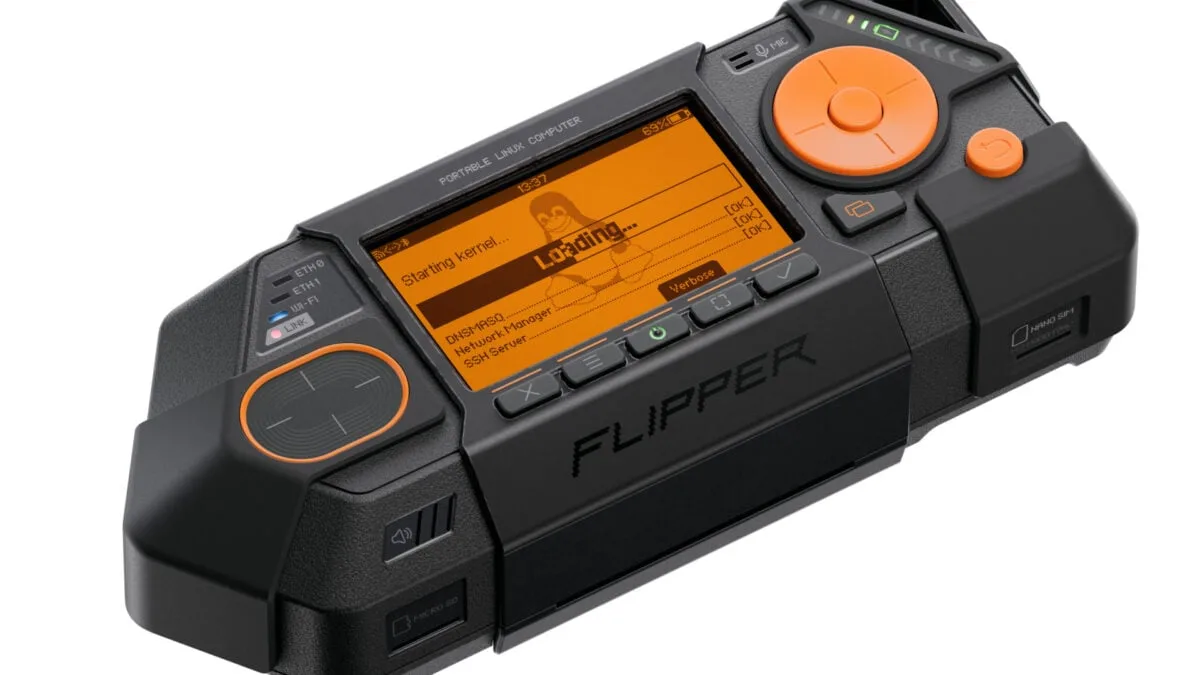
The creators of the controversial Flipper Zero hacking tool are developing a new pocket-sized computer designed to make the PC personal again. Dubbed the Flipper One, this upcoming network multitool and cyberdeck aims to solve the usability nightmares of traditional Raspberry Pi builds by offering a fully customizable, Linux-based system with a built-in D-pad interface. Aimed at cybersecurity enthusiasts, network engineers, and DIY tinkerers, the device provides a portable environment for network diagnostics, travel routing, and hardware expansion without the vendor lock-in of modern laptops.
Unlike the Flipper Zero, which gained notoriety as a low-level radio frequency and NFC multi-tool, the Flipper One is a full-fledged computer. Flipper CEO Pavel Zhovner explained that the new gadget was built to address his personal frustrations with DIY computers, specifically the reliance on single-cable power connections and the need for a mouse to navigate tiny screens on Linux-based operating systems. To bypass this, the Flipper One utilizes a D-pad and programmable buttons, with plans to support its own Flipper OS and a dedicated app store.
Under the hood, the Flipper One is powered by a Rockchip RK3576 processor. Zhovner noted that this chip outperforms the Raspberry Pi 5 in multi-core CPU performance, though it trails slightly in single-core tasks. The miniaturized computer is heavily focused on connectivity, aiming to support Wi-Fi 6E, Ethernet, and 5G through an M.2 module, eSIM, or physical SIM card. For users requiring specialized hardware, the device even includes an extra PCIe expansion slot in the rear.
Back when I was a kid, you could just buy the PC and learn how computers work. From the very beginning - I could understand how the boot system worked. Today, all the manufacturers create their own logic that is absolutely vendor locked.
- Pavel Zhovner, CEO, Flipper
One of the most ambitious software goals for the Flipper One is seamless profile switching. Zhovner wants users to be able to transition the device between distinct use cases - such as a travel router, a home TV box, or an emergency desktop environment - without needing to completely reconfigure the underlying Linux system. Physically, the device retains the aesthetic spirit of the Flipper Zero but is nearly twice as large to accommodate the upgraded internals.
The company is currently sharing its development process online and soliciting community feedback to finalize the UI layout. While the device is not yet available for purchase, Flipper plans to launch a Kickstarter campaign later this year. Depending on component costs and backer volume, the company is targeting a retail price of around $350.
The Antidote to Cloud-Locked Hardware
The transition from the Flipper Zero to the Flipper One represents a fascinating pivot from offensive security testing to sovereign computing. The Flipper Zero faced intense regulatory scrutiny - including bans in Canada - due to its use in RFID skimming and Bluetooth spamming attacks. By shifting focus to a general-purpose cyberdeck, Flipper is distancing itself from the "hacker tool" stigma while retaining its core audience of hardware enthusiasts who resent the locked-down nature of modern cloud-dependent devices.
At a projected $350, the Flipper One enters a competitive price bracket currently dominated by entry-level Chromebooks and refurbished enterprise laptops. However, its unique combination of built-in 5G, native Ethernet, and a PCIe expansion slot gives it a distinct tactical advantage for field engineers and IT professionals. If Flipper can successfully deliver on its promise of seamless Linux profile switching - a notoriously difficult software challenge - the Flipper One could become the definitive everyday carry device for network administrators.