NASA's Perseverance rover has detected chromium-bearing corundum - the crystalline mineral responsible for rubies and sapphires on Earth - hidden within pale rocks scattered across the Martian surface. This unprecedented discovery in Jezero Crater challenges existing models of Martian geology, as the conditions required to form these gemstone precursors are notoriously difficult to achieve on the Red Planet.
For planetary scientists and space enthusiasts, this finding provides a critical new puzzle piece regarding Mars's violent geological past. The presence of corundum on Mars indicates extreme heat and pressure events, likely tied to ancient asteroid impacts rather than standard volcanic activity.
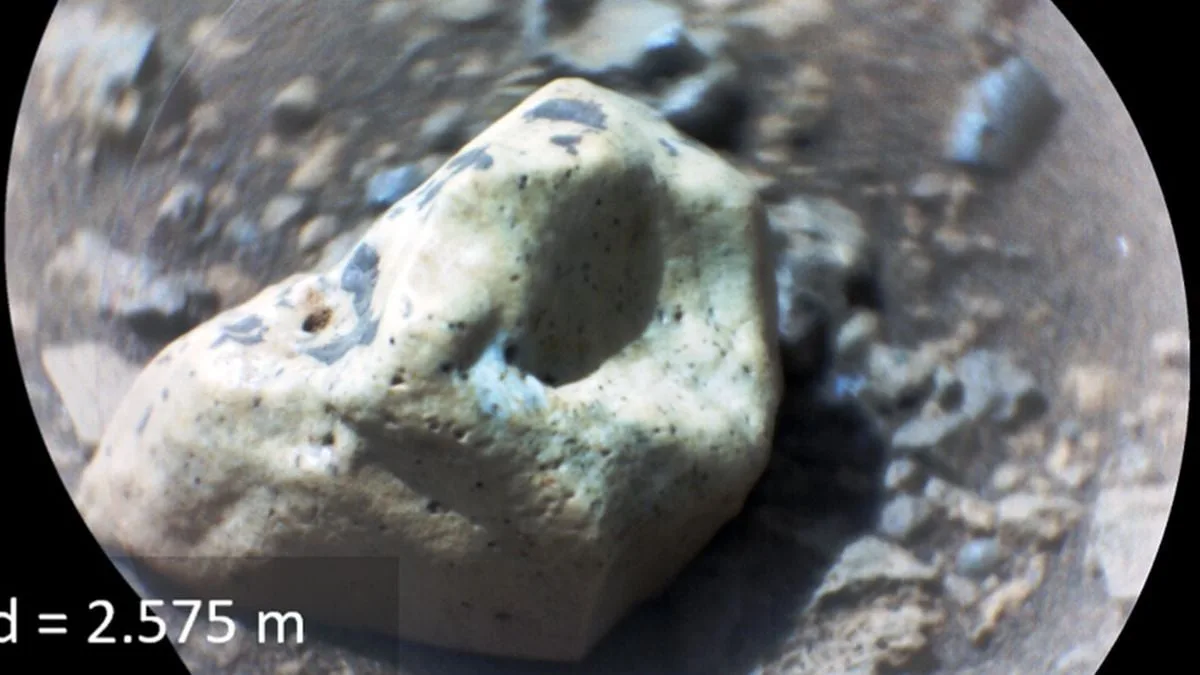
In 2025, Perseverance used its SuperCam to perform time-resolved luminescence (TRL) spectroscopy on three plagioclase-rich "float rocks" named Hampden River, Coffee Cove, and Smiths Harbour. These rocks, found along the crater rim, are detached from their original bedrock, meaning they were likely transported from elsewhere.
Very unexpectedly, SuperCam's TRL analysis of three plagioclase-rich float rocks in the crater rim were found to exhibit clear signatures of chromium-bearing corundum.
- Ann Ollila, Los Alamos National Laboratory
The analysis revealed two prominent luminescence peaks at wavelengths of 692.7 and 694.1 nanometers. In the Smiths Harbour sample, the glow lingered for about 3 milliseconds, squarely in the range measured for terrestrial corundum.
The scientific conundrum lies in the chemistry. Corundum is aluminum oxide, requiring high aluminum and low silicon to form. However, the rocks were dominated by plagioclase feldspar, a silicate mineral that typically absorbs available aluminum. Finding both coexisting on Mars is highly unusual.
Researchers published their findings in Geophysical Research Letters, proposing that the colossal impact that created Jezero Crater billions of years ago generated the immense heat and pressure necessary to forge these minerals. The team argues this discovery strengthens the case for reviving the Mars sample return mission, which has faced recent uncertainties.
The Hidden Value of Martian "Rubies"
While the public might fixate on the idea of gemstones on Mars, the true value of this corundum discovery lies in its role as a geological time capsule. The specific 3-millisecond luminescence glow matching terrestrial rubies confirms that Jezero Crater's impact history was violent enough to mimic deep-crust metamorphic processes on Earth.
If NASA can successfully execute the sample return mission, these tiny chromium-bearing grains could definitively prove whether hydrothermal fluids actively circulated post-impact. Confirming this fluid interaction would fundamentally alter our timeline for when Mars might have harbored habitable conditions, shifting the focus from volcanic warmth to impact-driven hydrothermal vents.