

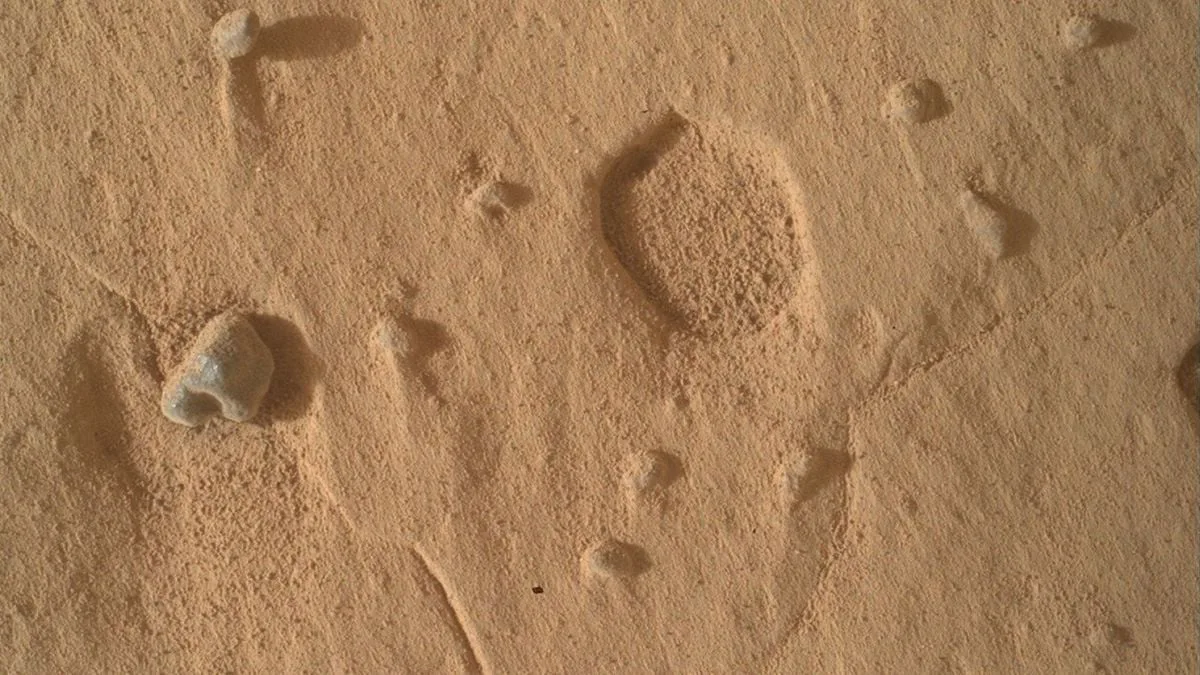
NASA's Curiosity rover has uncovered a new geological puzzle during its 14-year mission on Mars, discovering a series of strange, unexplained holes dotting the surface. The rover found these anomalies while navigating Valle Grande, a broad valley cutting through the sulfate-rich layers of Mount Sharp inside Gale Crater. Measuring roughly 1 centimeter (0.4 inches) across, these tiny, shallow divots defy the usual explanations for Martian surface pitting.
While pitted ground is common on a planet battered by meteorites and wind, these specific formations are unusually broad and shallow. Typically, small pits in Martian bedrock form when embedded pebbles or mineral nodules resist erosion longer than the surrounding rock, eventually weathering out to leave cavities. However, scientists note there are no obvious pebbles or nodules nearby that could account for these new depressions, prompting a deeper investigation.
Deploying the Mars Hand Lens Imager
To solve the mystery, the Curiosity science team is utilizing the rover's advanced optical suite. The Mars Hand Lens Imager (MAHLI) is capturing close-range photographs of the pits, while the Mastcam system takes overlapping stereo images of the surrounding terrain. By combining these visual datasets, researchers can construct precise three-dimensional models of the surface to measure the exact shapes and depths of the holes, hoping to reverse-engineer their formation process.
Climbing Mount Sharp's Sulfate Layers
This discovery occurs as Curiosity traverses relatively fresh territory, having recently left behind the web-like "boxwork" terrain - a landscape of mineralized ridges shaped by ancient groundwater. As it climbs higher through Mount Sharp, the rover is encountering rapid changes in rock textures and chemistry. In late August 2026, the rover marked a major milestone by reaching an elevation gain of 1,000 meters (3,280 feet).
The ultimate goal of this ascent is to read the planet's geological history recorded in the sedimentary layers. The peak of Mount Sharp rises 5.5 kilometers (3.4 miles) above the crater floor. By analyzing the changing chemistry and erosion resistance of these rougher gray layers, scientists aim to understand exactly how Mars transitioned from a wet environment to a dry, barren world.
The Micro-Clues of Martian Climate Shift
The discovery of these unexplained 1-centimeter pits might seem like a minor topographical quirk, but it highlights a critical phase in Martian geological research. Curiosity is currently transitioning between distinct environmental eras recorded in the rock - moving from the water-formed boxwork ridges into the drier, sulfate-rich upper layers of Mount Sharp. These shallow divots likely represent an unfamiliar erosion process unique to this specific transitional chemistry.
If these holes are not the result of traditional nodule weathering, they could point to a previously unknown interaction between ancient atmospheric conditions and the sulfate bedrock. As the rover continues its 5.5-kilometer climb, these micro-textures will serve as crucial data points, proving that the red planet's shift from a habitable, wet world to a frozen desert was not a uniform event, but a complex, highly localized chemical evolution.
