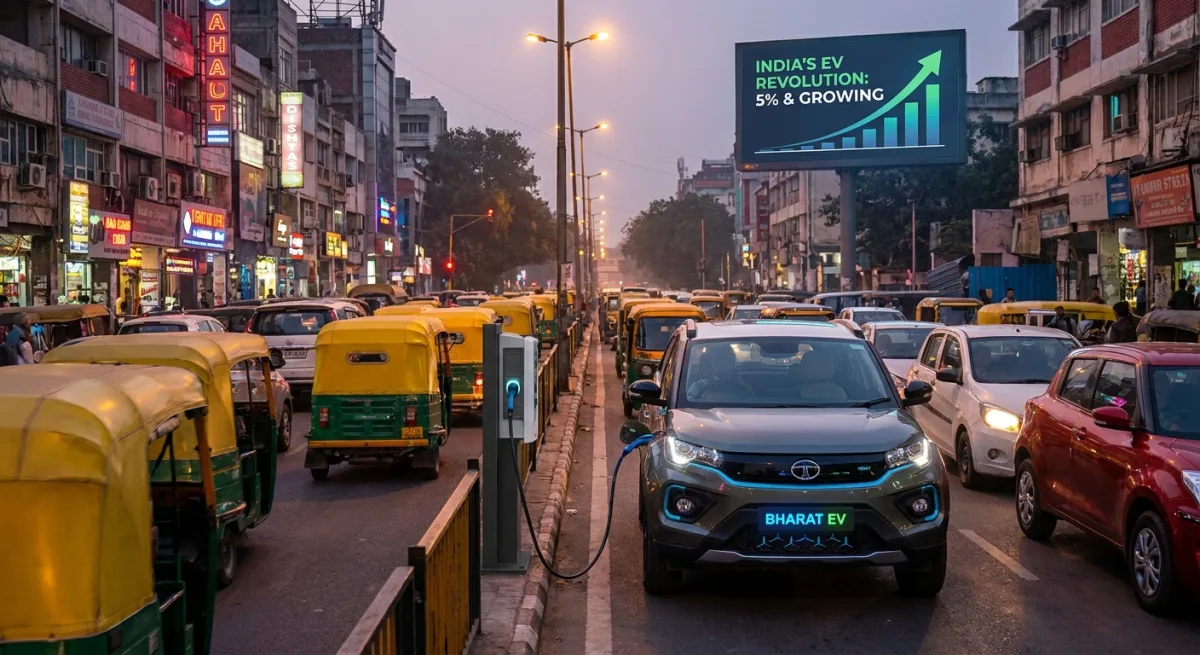
Surging fuel prices and geopolitical instability are rapidly accelerating India EV adoption, pushing the world's third-largest auto market past a critical milestone. With electric vehicles recently crossing the 5% threshold in passenger car sales, the shift from internal combustion engines is transitioning from a slow trend to a mass-market reality.
The EV market expanded by 25% in the year ending March 2026. Adoption is particularly strong in vehicles priced above one million rupees ($10,481), where EVs now account for one in ten sales. In the two- and three-wheeler segments, electric models already capture 15% and 30% of the market, respectively.
India imports nearly 90% of its oil, making it highly vulnerable to global market shocks. A 50% jump in crude prices, exacerbated by Middle East conflicts, has forced state-run retailers to hike pump prices, driving consumers directly toward electric alternatives.
The CAFE-3 Regulatory Push
Upcoming CAFE-3 norms, set to run from April next year until March 2032, aim to reduce carbon emissions from 113 to 76g/km - a 33% drop. Analysts at Bernstein note that unlike previous regulations where billion-dollar fines across eight original equipment manufacturers (OEMs) were ignored, CAFE-3 penalties are expected to be strictly enforced.
Localized efforts are also intensifying to force the transition. City-states like Delhi, which ranks among the country's most polluted hotspots, have proposed halting registrations of new ICE two- and three-wheelers entirely by 2027.
In the absence of regulatory clarity, manufacturers defer investment decisions, supply chains evolve more slowly, and the broader ecosystem remains uncertain.
- Amitabh Kant, Niti Aayog
Infrastructure and Supply Chain Bottlenecks
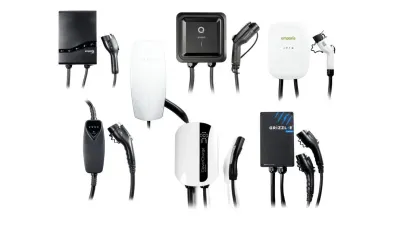
Despite the recent growth, India's EV penetration lags far behind China's 53.3%, the EU's 20%, and the US's 8%. Public charging stations have grown from 2,000 to over 10,000, but they remain heavily concentrated in just four of India's 28 states.
This infrastructure deficit pales in comparison to China's 20 million public charging points, leaving range anxiety (Range anxiety) as a primary deterrent for Indian buyers. Furthermore, India remains heavily dependent on global supply chains for rare earths and battery materials.
According to KPMG, China currently controls 70% to 80% of lithium and cobalt refining, and nearly 90% of rare earth separation. This underscores severe geopolitical risks that could delay India's EV rollout and severely impact cost competitiveness.
The True Cost of the EV Transition
The acceleration of India EV adoption is undeniable, but the underlying vulnerabilities are stark. While high fuel prices provide an immediate catalyst for consumers, the long-term success of this transition hinges entirely on the strict enforcement of CAFE-3 and massive infrastructure scaling.
If the government fails to collect emissions penalties as it did in the past, OEMs will simply absorb the regulatory pressure rather than innovate. The staggering gap in charging infrastructure - 10,000 stations versus China's 20 million - highlights a critical failure in planning.
Until domestic battery manufacturing and localized charging networks mature, India's EV boom will remain heavily constrained by geopolitical risks and supply chain monopolies. The real battleground isn't just selling cars; it's breaking the reliance on foreign refining to secure the future of mobility.
This article was written by AI from reporting by bbc.co.uk.