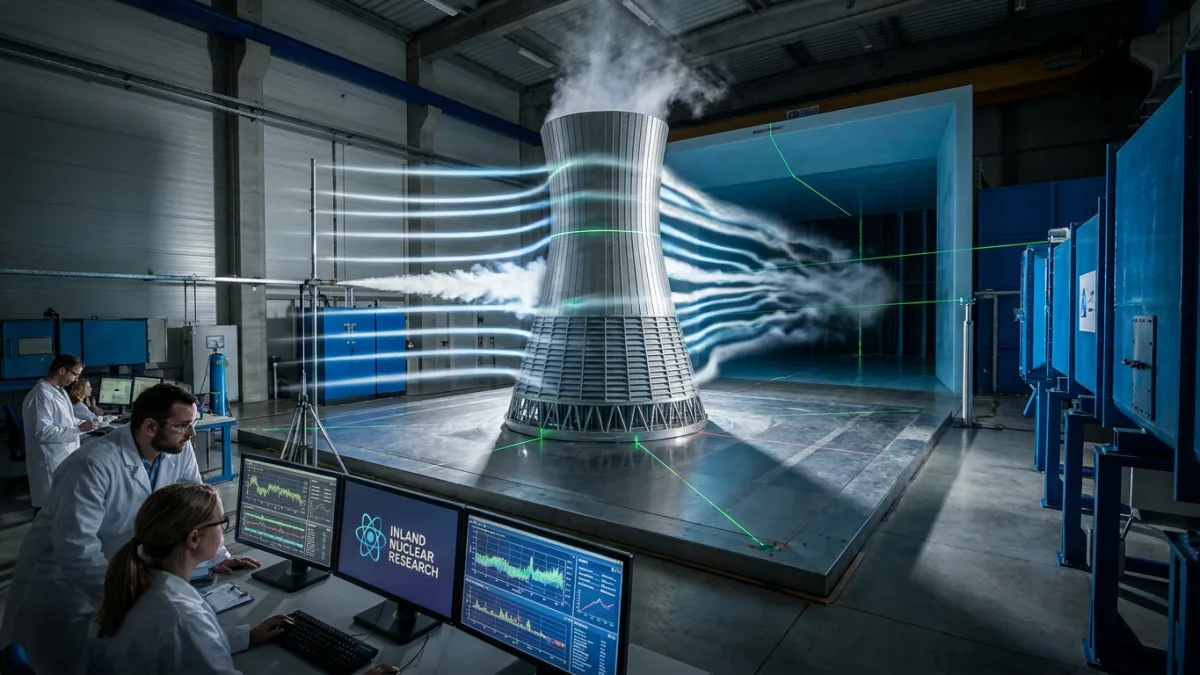
As coastal sites for nuclear power plants reach saturation, the energy sector is increasingly looking inland to meet growing demands. To make this shift viable, researchers are testing water-saving indirect dry cooling towers using advanced wind tunnel and scaled model tests.
A new study published in Scientific Reports on September 19, 2026, outlines the resistance characteristics of these critical cooling structures. The research was conducted collaboratively by scholars from Shanghai Jiao Tong University, the China Institute of Water Resources and Hydropower Research, and the State Nuclear Electric Power Planning Design & Research Institute Co., Ltd.
Because inland nuclear deployment cannot rely on the massive water bodies available on the coast, the indirect dry cooling tower (IDCT) offers a necessary water-saving alternative. To understand how these towers perform under various aerodynamic conditions, the research team utilized scaled models inside wind tunnels to measure airflow efficiency.
Key Measurement Parameters
The study focused on calculating specific resistance coefficients and pressure errors across the tower's structure. Key variables analyzed include:
- Pressure Differentials: Measurements of total pressure difference, static pressure, and atmospheric pressure across characteristic cross-sections.
- Louver Resistance: The resistance coefficients of both flat and corrugated louvers, alongside the impact of the louver closing angle.
- Environmental Factors: Variations in ambient air density, ambient air temperature, and flow velocity at the tower inlet.
- Structural Ratios: The area ratio comparing the air inlet area of the IDCT to the bottom area of the tower shell.
The Strategic Shift Inland
The push for inland nuclear power represents a fundamental shift in how nations plan their energy grids. By decoupling nuclear reactors from coastal waters, energy planners can place high-capacity baseload power closer to landlocked industrial centers. This reduces transmission losses and mitigates the risks associated with rising sea levels at coastal facilities.
However, the success of this inland strategy hinges entirely on efficient thermal management. The precise aerodynamic measurements of indirect dry cooling towers provided by this study are essential for scaling these water-saving designs. If engineers can minimize airflow resistance and optimize cooling triangles based on these wind tunnel tests, inland nuclear plants could become a standard, drought-resistant pillar of the future energy mix.