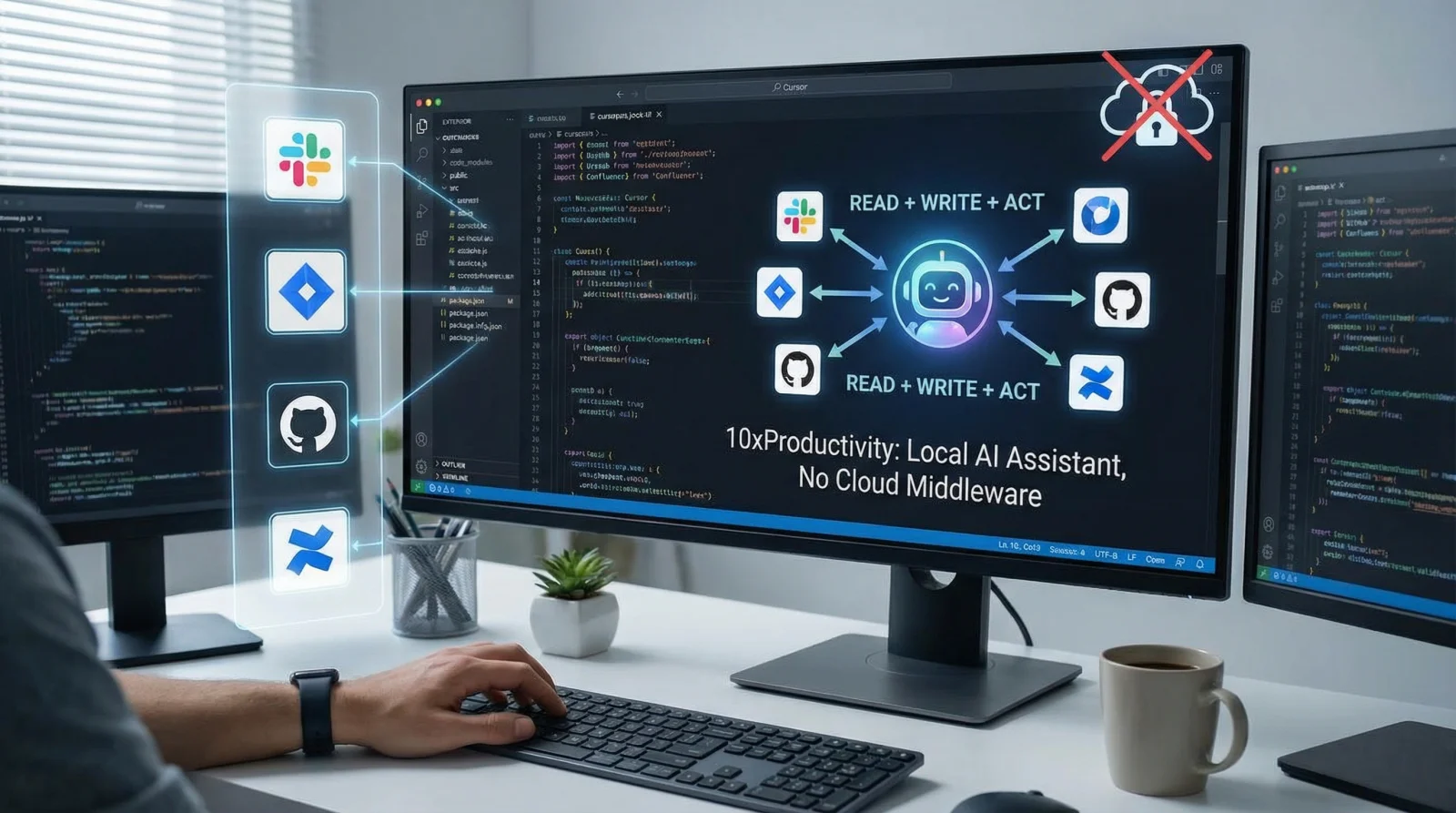
Struggling with clunky cloud middleware, endless IT approval tickets, and complex Zapier integrations just to automate your daily workflows? The newly released 10xProductivity GitHub repository by ZhixiangLuo eliminates these bottlenecks by transforming your existing local coding agents into universal, cross-platform personal assistants. Designed for everyone from developers to top executives, this framework allows tools like Cursor, Claude Code, and GitHub Copilot to securely interact with your enterprise apps directly from your machine. By bypassing third-party cloud services, you gain a powerful assistant capable of reading, writing, and acting across your entire software stack without exposing new attack surfaces.
Most enterprise AI tools are strictly read-only, functioning as glorified search engines that force you to manually execute the final tasks. 10xProductivity introduces a "read + write + act" paradigm. For example, instead of just finding a bug report, the agent can locate the Jira ticket, open a GitHub pull request to fix it, and post a summary in the relevant Slack thread. This local-first approach means the agent uses your existing browser sessions, CLIs, and REST APIs. Your identity remains the accountability layer, ensuring that every action taken by the AI is logged under your personal token, maintaining strict enterprise audit trails without requiring new service accounts.
How to Set Up the 10xProductivity AI Agent
Deploying this framework requires zero staging environments or OAuth app approvals. If you can log into your tools, your local agent can act on them. Follow these steps to connect your workspace:
- A local AI coding agent installed on your machine (e.g., Cursor, Claude Code, Codex, or Copilot).
- Active logins for your daily work tools (Slack, Jira, GitHub, Confluence, Linear, Notion).
- Basic terminal access to clone the repository.
- Clone the official repository to your local machine using your terminal. This downloads the pre-built tool recipes and enterprise search workflows directly to your system.
git clone https://github.com/ZhixiangLuo/10xProductivity.git
cd 10xProductivity- Instruct your AI agent to read the primary setup file by pasting a specific prompt into your agent's chat interface. This initiates the automated onboarding process where the agent learns how to interact with your specific environment.
Read /path/to/10xProductivity/setup.md and set up my tool connections.- Authenticate your required tools when prompted by the agent. This ensures the AI securely uses your existing Single Sign-On (SSO) and local credentials without passing them through external middleware.
- Execute cross-tool queries using the built-in enterprise search workflow. This allows you to pull synthesized answers from Slack, Confluence, and Jira simultaneously using a single prompt.
Read /path/to/10xProductivity/workflows/enterprise-search/enterprise-search.mdMy Take
The release of 10xProductivity highlights a massive shift in how we approach enterprise automation. For years, the industry has relied on top-down, IT-managed middleware like Zapier or complex MCP (Model Context Protocol) servers to stitch tools together. By turning the local machine into the universal client, ZhixiangLuo has effectively democratized "read-write-act" capabilities. This completely bypasses the traditional friction of vendor lock-in and security reviews, because the threat model is identical to a human clicking buttons on their own laptop.
What makes this particularly disruptive is the compounding nature of connected knowledge. When an agent can cross-reference a PagerDuty incident with a stale Jira ticket and a Slack debate in seconds, it stops being a generic coding assistant and becomes a contextual institutional memory bank. As more power users build custom skills within their local directories, teams will see a dramatic reduction in context-switching fatigue. Ultimately, tools like 10xProductivity prove that the future of AI isn't about buying more enterprise SaaS platforms; it's about maximizing the leverage of the local agents we already trust.
This article was written by AI from reporting by github.com.