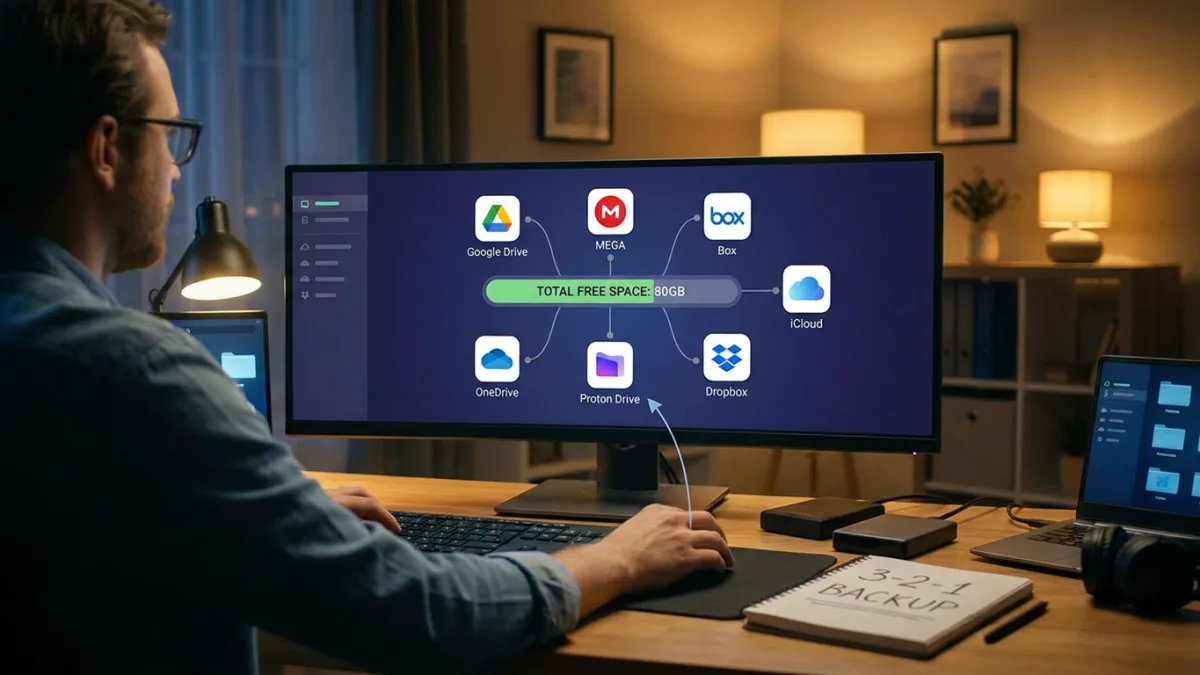
Users tired of paying monthly subscription fees can combine multiple free cloud storage tiers to unlock over 80GB of remote space. Relying on a single provider often leads to inevitable paid upgrades once the initial data cap is reached, but strategically distributing files across different platforms eliminates the need for a premium plan. This approach requires careful organization to ensure files remain accessible and secure across various ecosystems.
Prerequisites for Safe Data Management
- The 3-2-1 backup rule: Maintain three copies of your data, on two different media types, with one stored offsite. Never rely solely on cloud storage to prevent total data loss if an account is locked.
- A reliable password manager to secure multiple account credentials across different cloud providers.
Available Free Cloud Storage Allocations
- Google Drive: Offers 15GB of space, split across Gmail, Google Photos, and Android backups. Note that Google recently introduced a 5GB cap on some new accounts, which can be bypassed by linking a phone number.
- MEGA: Provides a massive 20GB allotment that includes automatic backups and retains 100 file versions.
- Box: Grants 10GB of secure storage on its free plan, featuring a 250GB file upload limit and 5 e-signature requests per month, though it restricts users to a single file version.
- Apple iCloud: Delivers 5GB of space shared across device backups, Photos, Messages, Mail, Contacts, FaceTime, voice memos, and Apple Invites. Users can delete content to reduce the size of their backups. Paid iCloud+ tiers start at $1 per month for 50GB.
- Microsoft OneDrive: Comes with 5GB of space for Microsoft 365 accounts, while Outlook receives a separate 15GB allotment.
- Proton Drive: Offers 5GB of end-to-end encrypted space, ideal for privacy-focused users.
- Dropbox: Limits free users to just 2GB of storage, which can be synced across a maximum of three devices.
- Alternative Providers: Icedrive offers 10GB, pCloud provides up to 10GB, and Sync.com includes 5GB. However, Reddit communities have noted reliability and customer support concerns with these services.
- Password Managers: Bitwarden Premium includes 5GB of encrypted storage, while 1Password, Proton Pass, and Dashlane each provide 1GB.
How to Organize and Maximize Your Free Space
- Allocate large media files and static archives to MEGA for cold storage.
This ensures that massive files that do not require frequent access utilize the generous 20GB limit without clogging up daily workspaces. - Store sensitive legal records and tax returns in Proton Drive or Sync.com.
This enables end-to-end encryption for highly confidential documents. Alternatively, users can encrypt files locally using the free, open-source tool Cryptomator before uploading them to Google Drive or Box. - Dedicate Google Drive, Microsoft OneDrive, and Apple iCloud to active collaboration and device backups.
This ensures seamless daily access to frequently used documents and leverages the native integration these services have with their respective operating systems. - Upload smaller PDF records and receipts to Box.
This maximizes the utility of the 10GB Box tier, which is ideal for documents due to its 250GB file upload limit and single file version restriction.
The Security Trade-Off of Fragmented Data
While cobbling together 80GB of free cloud storage saves money, it introduces significant data governance risks. Managing eight different accounts means monitoring eight separate attack vectors, increasing the likelihood of a compromised password or a missed security update. Furthermore, relying on smaller alternative providers carries the risk of sudden service closures, which is why adhering to the 3-2-1 backup rule is non-negotiable.
For users managing critical business data, paying $1 per month for 50GB of iCloud+ or a similar entry-level paid tier is often cheaper than the time spent manually routing files across different platforms. The fragmented free-tier strategy is best suited for personal archives and redundant backups rather than a primary, fast-paced workflow environment.