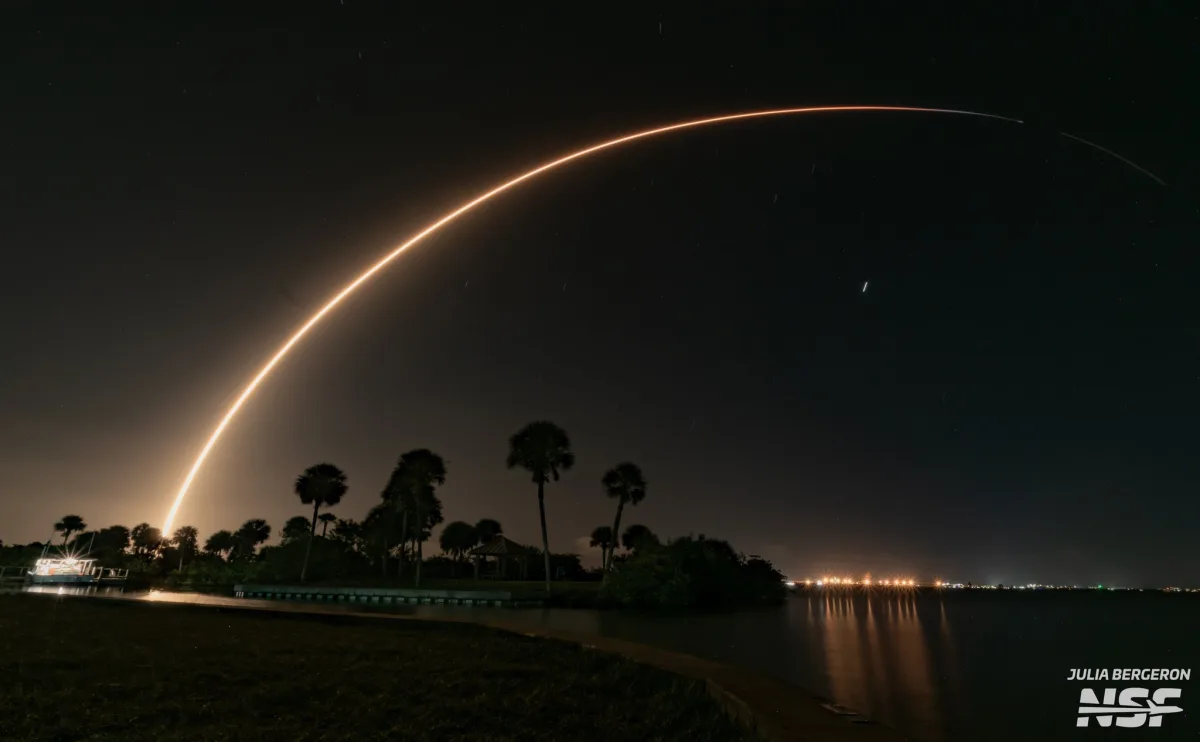
The highly anticipated GPS III SV10 launch established a new benchmark for global navigation systems by introducing high-speed laser communications to medium Earth orbit. For tech enthusiasts and satellite operators tracking the rapid commercialization of space, this packed manifest of seven missions across four countries demonstrated unprecedented orbital infrastructure expansion. The week of April 20, 2026, showcased everything from experimental solid-fuel rockets to routine orbital resupply runs.
With five different launch vehicles taking flight, the aerospace industry proved its capacity for high-cadence operations. Commercial providers stepped in to rescue delayed national science missions, while military agencies tested next-generation hardware.
The Historic GPS III SV10 Launch
SpaceX successfully executed the final mission of the first-generation GPS III contract using a Falcon 9 rocket from Space Launch Complex 40 in Florida. The mission utilized booster B1095 on its seventh flight, culminating in a successful landing on the droneship Just Read the Instructions. The satellite, nicknamed Hedy Lamarr, concluded a Lockheed Martin procurement program that originally began in 2008.
What makes this deployment technically significant is the inclusion of a Tesat-Spacecom SCOT80 optical communications terminal. This marked the first laser communications test from a GPS satellite at medium Earth orbit. The terminal is capable of data rates up to 100 Gbps, paving the way for optical crosslinks that will eventually allow the entire GPS constellation to be updated simultaneously from a single ground station.
SpaceX's Relentless Starlink Expansion
Maintaining its aggressive operational tempo, SpaceX completed two separate Sun-synchronous orbit (SSO) deployments from Vandenberg Space Force Base in California. The Group 17-14 and Group 17-16 missions each delivered batches of 25 Starlink v2 Mini satellites into orbit. These SSO deployments are critical for providing reliable, high-latitude broadband coverage to polar and near-polar regions.
The first mission flew on booster B1100, marking its fifth flight with a rapid 32-day turnaround. The week concluded with booster B1088 making its 15th flight, reflecting a highly optimized 39-day turnaround. Both boosters successfully landed on the droneship Of Course I Still Love You in the Pacific Ocean.
Rocket Lab's Dual Hemisphere Missions
Rocket Lab pulled double duty with two Electron rocket launches from opposite sides of the globe. The first mission, dubbed Bubbles, launched from NASA's Wallops Flight Facility in Virginia. Flying on a suborbital trajectory, the vehicle carried an undisclosed payload, a standard practice for national security missions originating from this facility.
The second mission, Kakushin Rising, launched from the Māhia Peninsula in New Zealand. This orbital rideshare mission carried eight Japanese university and research satellites for JAXA, replacing the grounded Epsilon-S rocket. As confirmed on April 20, 2026, the payload included WASEDA-SAT-ZERO-II, FSI-SAT2, MAGNARO-II, KOSEN-2R, OrigamiSat-2, Mono-Nikko, ARICA-2, and PRELUDE.
South Korea's Orbital Milestone
In a major step for its domestic space program, South Korea's Agency for Defense Development (ADD) executed the first full-configuration orbital demonstration of its solid-fuel small satellite launch vehicle. Informally known as GYUB, the four-stage rocket launched from an offshore platform near Jeju Island. This sea-based approach provided greater flexibility in azimuth selection while avoiding populated overflight zones.
The mission aimed to deliver a 500 kg payload capacity to low-Earth orbit. Following methodical suborbital tests in 2022 and an incomplete three-stage orbital attempt in 2023, this flight marked the first time the complete four-stage vehicle attempted a full orbital insertion.
Other Notable Global Launches
To round out the busy week, two additional international missions successfully reached orbit:
- Chang Zheng 2D: The Chinese Aerospace Science and Technology Corporation launched an undisclosed payload from the Xichang Satellite Launch Center. The CZ-2D rocket, capable of lofting 3,500 kg to LEO, completed its 102nd historical mission.
- Progress MS-34: Russia's Soyuz 2.1a rocket launched from the Baikonur Cosmodrome, carrying approximately 7,280 kg of cargo to the International Space Station. This marked the 187th flight of the long-running Progress resupply program.
The Shift Toward Optical Infrastructure
The successful deployment of the SCOT80 terminal on the SV10 satellite signals a permanent shift away from legacy radio-frequency architectures. By proving that 100 Gbps laser crosslinks can function reliably in medium Earth orbit, military and commercial operators can now drastically reduce the latency of constellation-wide updates. This reduces the reliance on vulnerable, geographically dispersed ground stations.
Furthermore, JAXA's decision to pivot to Rocket Lab after the Epsilon-S failures highlights the growing indispensability of commercial launch providers. When national programs face hardware delays, agile commercial rockets like the Electron are no longer just secondary options; they are critical fail-safes that keep global scientific research on schedule.