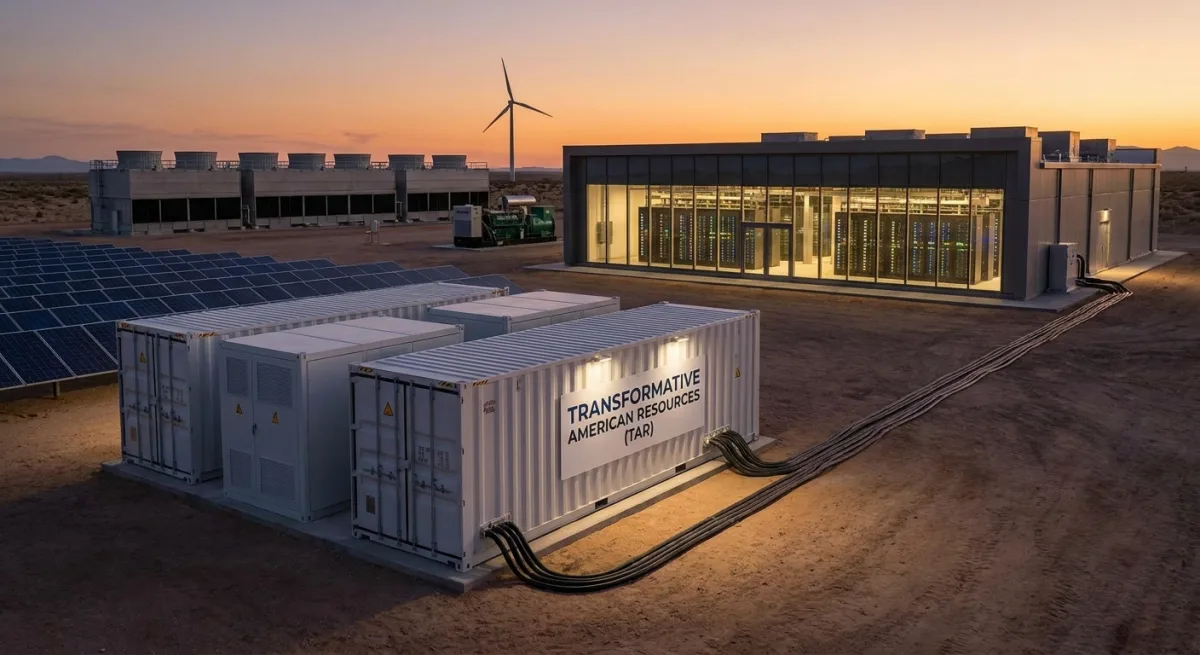
The generative AI boom has hit a physical wall: the electrical grid. Recognizing that compute power is fundamentally constrained by energy availability, Leonhard Soenke and Patrice Becker have executed a massive pivot, leaving the creator economy to launch an AI data center energy startup. Their new venture, Transformative American Resources (TAR), recently secured a $27 million seed round from an undisclosed strategic investor, launching with a staggering $500 million valuation. This transition highlights a critical shift in the tech industry, where the most urgent problems have moved from software scalability to heavy physical infrastructure.
Soenke and Becker originally made their mark in 2021 by founding Throne, a highly successful creator economy startup that allowed influencers to curate wishlists for their fans. Over the years, Throne secured major vendor partnerships and worked closely with companies like Amazon, growing into a large and stable organization. However, as the creator economy matured and became increasingly crowded, the founders felt the urge to tackle a more foundational challenge. They realized that the incremental movements within social platforms paled in comparison to the massive bottlenecks emerging in the AI infrastructure stack.
To execute this transition, the founders embarked on a deliberate, six-month handover process, passing Throne's daily operations to trusted, long-term team members. While Soenke admits that letting go of his first major success was difficult for a self-described control freak, the move allowed the duo to relocate from New York to San Francisco. There, they spent extensive time with AI labs and major compute providers to pinpoint exactly where the industry's friction points lay, ultimately leading them to the energy sector.
Solving the "Time-to-Token" Bottleneck
The core mission of this new AI data center energy startup is to drastically reduce what the industry calls "time-to-token" - the duration it takes to get AI models powered up and generating outputs. As AI models become more advanced and deeply integrated into society, the demand for specialized chips and the power to run them has become an acute crisis. Traditional grid infrastructure simply cannot keep pace with the deployment speed required by modern AI data centers, forcing companies to look for alternative, decentralized power solutions.
TAR is addressing this by building modular, scalable, behind-the-meter energy systems. Instead of waiting years for grid interconnection approvals, TAR deploys localized power generation directly at the data center site. These systems utilize a pragmatic mix of generation sources, primarily consisting of solar, battery storage, wind energy, and natural gas. The startup is not attempting to invent a novel physics-based energy source; rather, their innovation lies in the rapid deployment and integration of existing technologies to bypass grid delays.
"We are focused on innovating the way we deploy these existing technologies faster," Soenke explained, noting that the market pull for energy solutions mirrors the intense early demand they saw when launching Throne. By combining renewable sources with the reliability of natural gas and battery storage, TAR aims to provide the uninterrupted, high-density power that AI training and inference workloads demand.
The Capex Reality of Building Data Centers
Transitioning from a software-as-a-service model to physical energy infrastructure requires a fundamental shift in business operations. Building an AI data center energy startup is vastly more capital-intensive than writing code. The founders are now dealing with heavy equipment procurement, warehouse construction, and complex land development deals. This reality prompted TAR to expand its footprint beyond its San Francisco engineering hub, recently opening operations in Austin, Texas - a strategic move to be closer to the epicenter of American energy and data center development.
The biggest difference is working with more legacy players in the energy space. Obviously, you come from a slightly different world if you're in software and you're just sitting in your New York or San Francisco office.
- Leonhard Soenke, TAR
This shift also demands a new type of founder empathy. In the software world, user research often involves A/B testing and digital feedback loops. In the energy sector, it requires getting on-site, wearing hard hats, and negotiating directly with blue-collar construction crews, legacy utility companies, and local contractors. Soenke emphasized that understanding the perspectives of these new partners is just as critical as understanding software users, proving that problem-solving skills are highly transferable across vastly different industries.
The Infrastructure Premium in Tech Monetization
The $500 million valuation for a seed-stage company like TAR signals a profound strategic shift in how venture capital is monetizing the AI boom. Investors are realizing that funding another foundational Large Language Model (LLM) is highly risky, but funding the physical power required to run those models is a guaranteed necessity. The bottleneck is no longer algorithmic; it is strictly electrical. By pivoting to energy, Soenke and Becker are positioning themselves at the most lucrative chokepoint of the AI revolution.
This move also highlights the changing nature of tech moats. In the creator economy, moats are built on network effects and brand partnerships, which can be fragile and subject to platform algorithm changes. In the data center energy space, moats are built on land rights, heavy equipment procurement, and regulatory navigation. These are capital-intensive, high-friction barriers to entry that software-only founders typically avoid.
Ultimately, TAR's massive early valuation proves that the market is willing to pay a massive premium for execution speed in the physical world. Reducing the "time-to-token" by even a few months can save AI labs millions of dollars in delayed compute capabilities. As the AI arms race continues, the most valuable startups won't just be the ones writing the smartest code, but the ones pouring the concrete and laying the high-voltage cables to keep the servers running.