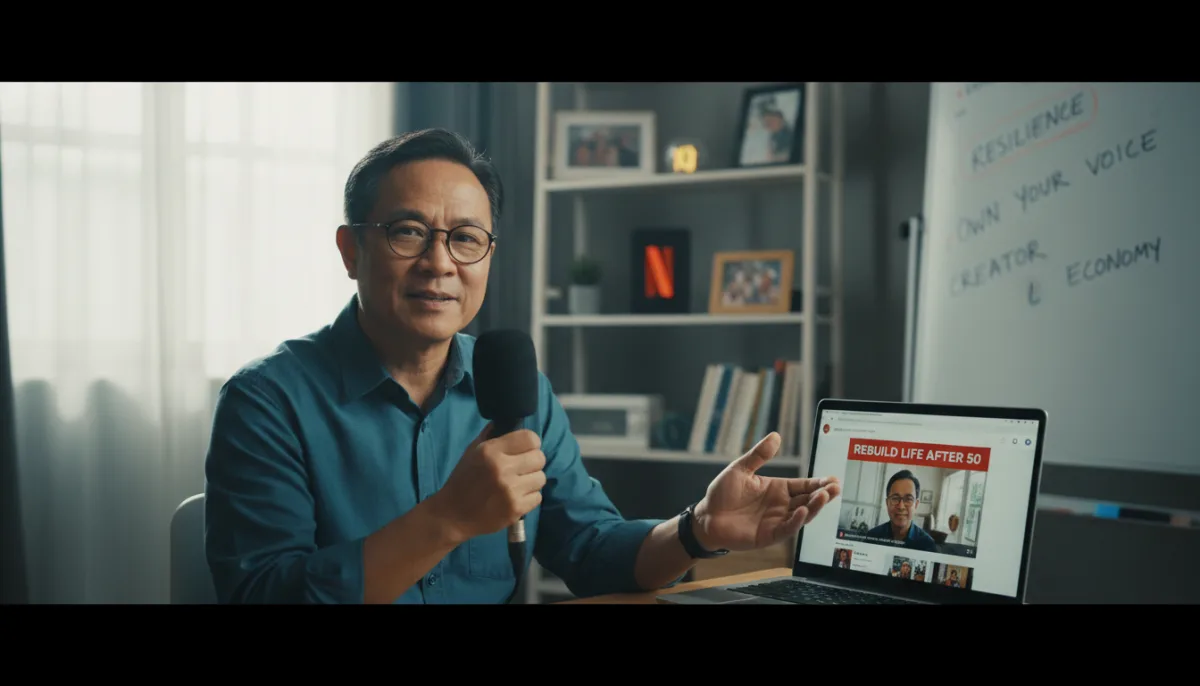
When Edgar Tang lost his role as a video editor at Netflix at age 50, he did not immediately update his resume to chase another corporate position. Instead, he recognized a fundamental shift in the modern digital economy: corporate security is increasingly an illusion, but a personal brand built on genuine lived experience is an asset no algorithm can replace. Facing a major career crossroads, Tang chose to pivot entirely, entering the creator economy to build a digital business centered around rebuilding life after 50.
The transition from a structured corporate environment to the unpredictable world of content creation requires a significant mindset shift. For Tang, the preparation for this leap began decades earlier. Diagnosed with stage three Hodgkin's lymphoma at age 32 while working abroad, he was forced to confront the fragility of life's supposed guarantees. Surviving the illness, and later navigating the tragic loss of a friend, fundamentally altered his risk tolerance and approach to career planning.
These traumatic life events instilled a philosophy of taking incremental steps toward his fears. Whether it was moving to New York to combat loneliness, relocating to Los Angeles to build confidence, or eventually returning to Singapore to care for his elderly parents, Tang learned to adapt to constant disruption. This resilience became the foundational strategy for his eventual entry into digital monetization.
The Illusion of Corporate Safety
Despite working at what he described as the best job he ever had - praising the culture, the people, and the product fit at Netflix - the reality of corporate restructuring still caught up with him. The layoff was not a reflection of his individual performance, but rather a consequence of shifting business strategies within the streaming giant. This realization was a critical turning point in his professional outlook.
When you look at how disruption has been happening in almost every industry, you realize that no real corporate job is safe.
- Edgar Tang, Former Video Editor, Netflix
This stark realization highlights a growing sentiment among veteran tech and media professionals. The traditional contract of exchanging loyalty for long-term security is fracturing. Tang recognized that internalizing a layoff as a personal failure is a trap; instead, it should be viewed as a signal to diversify one's income streams and professional identity.
"Your voice is something you own," Tang explained regarding his decision to pivot. "I'm going to own it by sharing it and seeing how it can be both valuable and viable, versus jumping to the next corporate job." This shift from renting out his skills to a corporation to owning his platform represents the core ethos of the modern creator economy.
Monetizing Lived Experience in the Creator Economy
Entering the content creation space requires more than just a willingness to share; it demands a strategic approach to audience building and monetization. Tang initially considered creating "faceless" content - a popular strategy for those seeking anonymity while generating ad revenue. However, he quickly realized that the true value of his brand lay in authenticity and vulnerability.
By choosing to be the face of his channel, Tang leveraged his unique narrative: surviving cancer, navigating global relocations, acting as a caregiver, and facing a late-career layoff. These are not just personal anecdotes; they are highly relatable pain points for a massive, underserved demographic. In the digital business landscape, a highly engaged, niche audience is far more valuable than a broad, disconnected one.
To professionalize his new venture, Tang enrolled in a content-creator course just a month after his layoff. This step underscores the importance of treating content creation as a legitimate business endeavor, requiring education in platform algorithms, audience retention, and digital marketing strategies. He transitioned from telling stories for a corporation's products to architecting his own narrative.
Actionable Steps: How to Pivot to Content Creation After a Layoff
For professionals facing sudden unemployment or industry disruption, Tang's journey offers a blueprint for transitioning into the creator economy. Building a sustainable digital presence requires deliberate, strategic actions rather than random posting.
- Audit Your Unique Value Proposition: Identify the specific "lived experiences" that differentiate you. Skills can be commoditized, but your unique perspective on overcoming industry challenges, personal setbacks, or career transitions cannot be replicated.
- Take Incremental Steps Toward Exposure: If the idea of public content creation is intimidating, start small. Enroll in a digital marketing or content strategy course to build technical confidence before launching your primary platform.
- Choose Authenticity Over Anonymity: While faceless channels can generate revenue, personal brands build deeper trust. Being vulnerable about your failures and transitions fosters a stronger connection with your target audience, which is crucial for long-term monetization.
- Reframe Your Professional Identity: Stop viewing yourself solely through the lens of your previous job title. Shift your mindset from being an employee who executes tasks to a media entity that owns its voice and distribution channels.
The Premium on Human Vulnerability in an AI Era
The timing of Tang's pivot from video editing to on-camera storytelling is strategically brilliant, even if driven by necessity. We are entering an era where generative AI is rapidly commoditizing technical production skills. The mechanics of video editing, copywriting, and basic graphic design are increasingly being outsourced to algorithms. However, what an AI cannot generate is genuine human vulnerability and the weight of lived experience.
By stepping in front of the camera and sharing the raw reality of rebuilding life at 50, Tang has built a competitive moat that technology cannot cross. His story proves that the creator economy is no longer just a playground for Gen Z lifestyle influencers; it is becoming a vital safety net and a lucrative second act for seasoned professionals. When corporate structures fail to provide stability, owning your audience and your narrative is the most secure business strategy available.