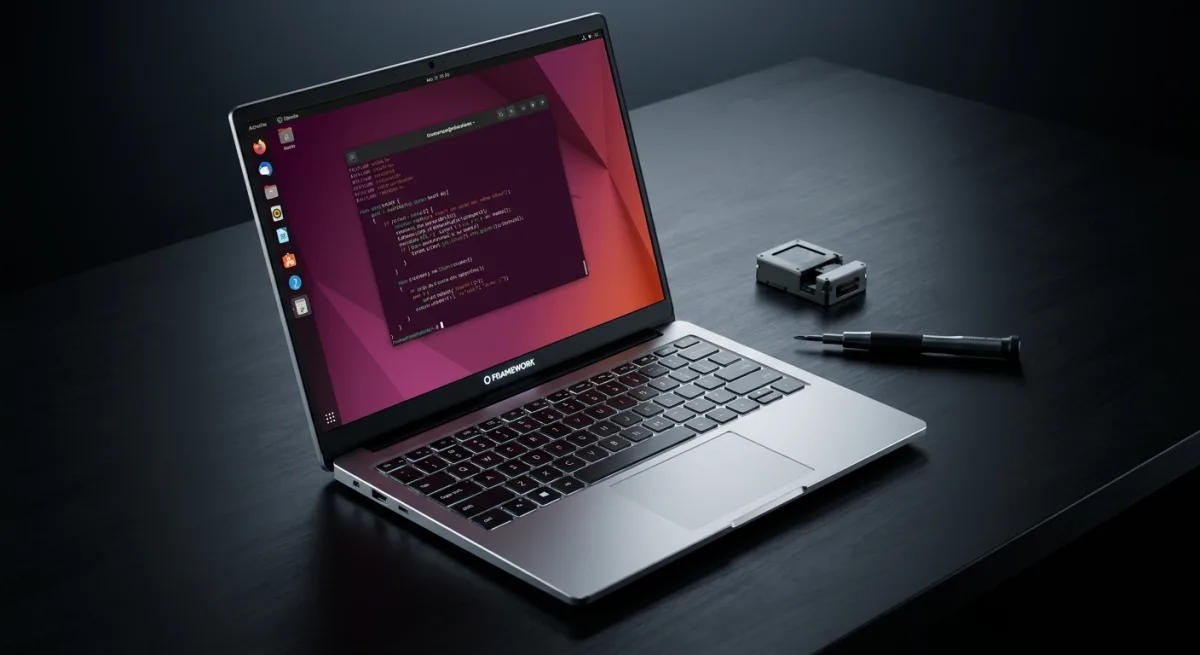
The new Framework Laptop 13 Pro finally bridges the gap between modular repairability and premium build quality, directly targeting developers who want a MacBook-caliber experience on Linux. For years, users have compromised on battery life and chassis flex to support the repairable laptop movement, but this latest iteration eliminates those pain points with a fully machined CNC aluminum body and a massive 74Wh battery.
Designed specifically with coders and power users in mind, the machine can be preloaded with Ubuntu out of the box. Framework CEO Nirav Patel explicitly positioned the device as the ultimate developer laptop, aiming to rival the 14-inch M5 MacBook Pro in both aesthetics and endurance.
A Premium Chassis and Custom Display
Moving away from piecemeal designs, the Laptop 13 Pro is carved from blocks of 6000-series aluminum, resulting in a rigid, flex-free chassis that weighs 1.4kg and measures 15.85mm thick. It features a properly tensioned hinge for one-finger opening and introduces a haptic trackpad for smoother navigation.
The visual experience receives a massive overhaul with Framework's first fully custom display. The 13.5-inch, 3:2, 2.8K IPS screen now supports a variable refresh rate of 30-120Hz and hits 700 nits of brightness. While the color gamut is capped at 100 percent sRGB to maximize battery efficiency, the new anti-glare coating and in-cell touch capabilities make it highly practical for daily coding. Audio is also upgraded with Dolby Atmos-certified side-firing speakers.
Panther Lake Performance and LPCAMM2 Memory
Under the hood, the system is powered by Intel Core Ultra Series 3 "Panther Lake" processors, paired with cutting-edge LPCAMM2 compression-mounted memory. This combination, alongside the 22 percent larger 74Wh battery, allows the laptop to stream 4K Netflix for up to 20 hours, theoretically edging out the M5 MacBook Pro.
Storage is equally robust, featuring PCIe 5.0 support for up to 8TB of 14,000MB/s SSD speeds. During hands-on testing, a higher-end chip managed to run Cyberpunk 2077 at around 70fps with adaptive upscaling. For those avoiding the current RAM pricing crisis, Framework is transparently stocking LPCAMM2 LPDDR5X modules: 16GB for $239, 32GB for $439, and 64GB for $849.
Pricing, Upgrades, and Backward Compatibility
True to its modular roots, the Laptop 13 Pro does not break compatibility with older models. Existing Framework 13 owners can simply buy the new Intel Core Ultra Series 3 mainboard ($449 for the Ultra 5 325, or $799 for the Ultra X7 358H), the new display, or just the 74Wh battery and bottom cover. Alternatively, buyers can configure the system with last year's AMD Ryzen AI 300 boards.
For full system purchases, pre-orders are open now with shipments starting in June. The pricing structure scales aggressively based on performance needs:
- DIY Edition: Starts at $1,199.
- Pre-built Base Model: $1,499 (Includes Intel Core Ultra 5 325, 16GB RAM, 512GB storage, and a 100W GaN charger).
- High-End Configuration: $2,099 (Includes Core Ultra X7 358H, 32GB RAM, 1TB storage, and triple the integrated graphics cores).
- Flagship Intel X9: Initial small batches sold out immediately.
The Cost of Modular Perfection
Framework’s decision to cap the display at 100 percent sRGB is a calculated risk that perfectly illustrates the company's laser focus on its target audience. By sacrificing wider color gamuts like DCI-P3 - which visual designers demand - Framework is explicitly prioritizing the battery life that developers and Linux power users actually care about. This isn't a machine for video editors; it is a purpose-built coding powerhouse.
However, the $1,499 starting price for the pre-built model represents a steep $400 premium over previous Ryzen-based iterations. While the CNC aluminum chassis, haptic trackpad, and LPCAMM2 memory justify the cost on paper, Framework is now competing directly in MacBook Pro pricing territory. The true value lies in the backward compatibility; the ability to drop a $449 Panther Lake mainboard into a three-year-old chassis remains an unmatched advantage in the modern PC hardware landscape.