Elon Musk has achieved a historic financial milestone, reaching an estimated net worth of $1.3 trillion to become more than four times richer than the world's second-wealthiest individual. This unprecedented wealth gap, driven by massive market projections in artificial intelligence and space exploration, surpasses the financial dominance previously held by tech pioneers like Bill Gates.
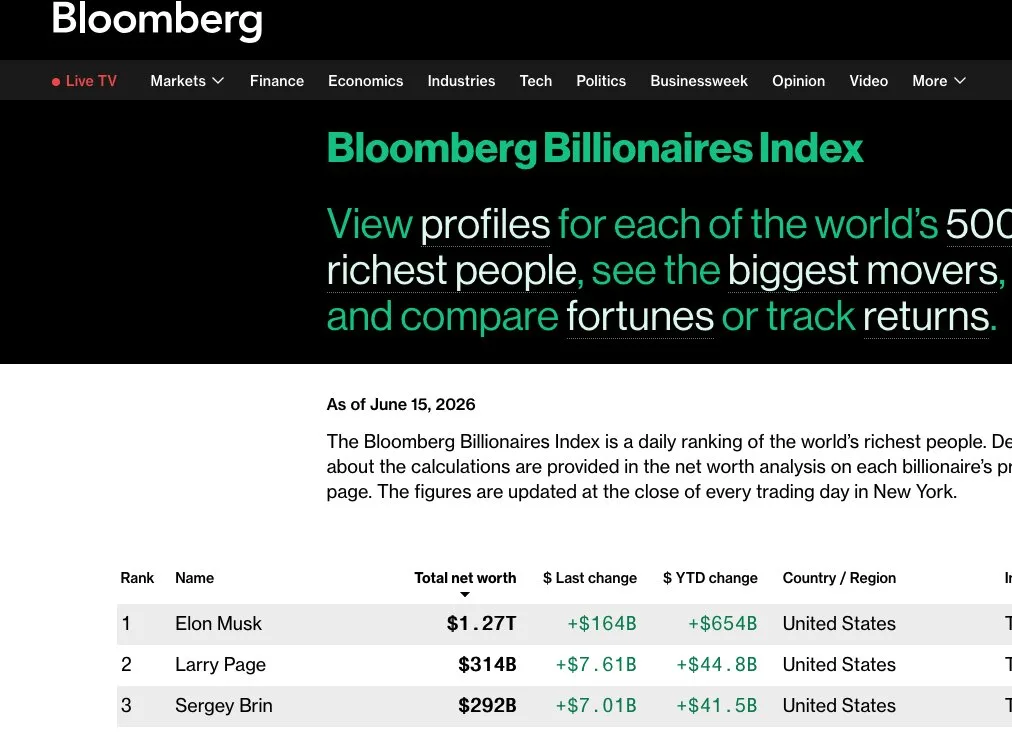
According to real-time billionaire trackers from Forbes and Bloomberg, Musk's valuation currently sits between $1.27 trillion and $1.3 trillion. This places him at a staggering 4.04X multiple over Alphabet co-founder Larry Page, who holds the second-place position with approximately $314 billion. To put this into historical context, Musk's current wealth represents roughly 4% of the United States Gross Domestic Product (GDP).
This wealth ratio eclipses the peak dominance of Microsoft co-founder Bill Gates. Although Gates held the top spot for roughly 13 consecutive years from 1995 to 2007, his wealth gap never reached the 4X mark. During his most dominant period in 1999, Gates was 2.5X richer than Warren Buffett, with his ratio generally fluctuating between 1.5X and 2.5X. The only comparable historical figure is oil magnate John D. Rockefeller, who became America's first billionaire around 1916. His $900 million net worth in 1913 represented nearly 3% of the U.S. GDP. During his peak era from the 1900s to the 1930s, Rockefeller likely maintained a 3X to 5X lead over contemporaries like Andrew Carnegie.
The foundation of this massive valuation is heavily tied to SpaceX and its network of high-profile tech investors. Charles Ergen, CEO of EchoStar, holds an indirect 1.1% stake in SpaceX (owning 51% of a 2.2% share). Peter Thiel maintains roughly 1.1% (owning 30% of Founders Fund's 3.5% stake), while Antonio Gracias holds about 1% via Valor. Larry Ellison currently owns 1.5% of Tesla, which could translate to a 0.5% to 0.7% stake in a combined SpaceX-Tesla scenario. Even Larry Page holds an indirect 0.18% interest (owning 3% of Google's 6% stake in the aerospace company).
The Trillion-Dollar AI and Space Premium
If current projections for artificial intelligence and commercial spaceflight materialize, Musk's financial lead could theoretically expand to 10X the wealth of the second-place billionaire. This 4.04X ratio is not just a personal milestone; it reflects how the market is pricing the monopolistic potential of SpaceX's orbital infrastructure and Tesla's AI ambitions.
Unlike Gates' software dominance or Rockefeller's oil empire, Musk's valuation is uniquely leveraged on future multi-planetary and autonomous technologies. The fractional ownership data reveals that even the world's other top billionaires are relying on minor stakes in Musk's ventures to capture this upside, creating a concentration of wealth that modern markets have never previously priced in.