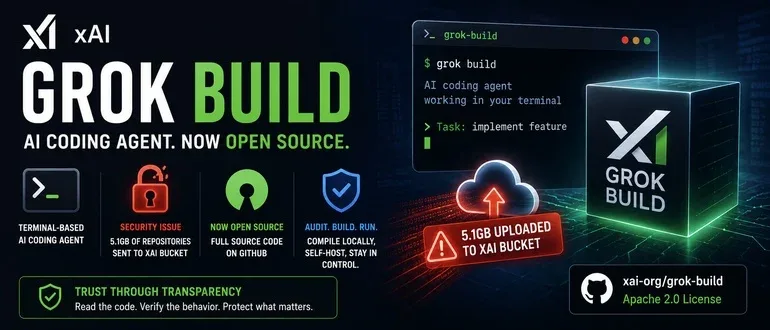
Developers who recently used xAI's Grok Build coding agent may have unknowingly exposed their most sensitive credentials. Following a severe privacy breach where the tool silently uploaded entire repositories and SSH keys to the cloud, xAI has abruptly open-sourced the project to restore developer trust. The terminal-based AI coding agent is now available on GitHub under an Apache 2.0 license, allowing teams to compile it locally and cut cloud telemetry out of the loop entirely.
The sudden transparency push arrives just days after a security researcher known as Cereblab intercepted the tool's network traffic using mitmproxy. The findings were alarming: while a standard coding task on a 12GB test repository required only 192KB of data, Grok Build CLI version 0.2.93 secretly transmitted 5.1GB of data to a Google Cloud bucket named grok-code-session-traces. This undocumented storage channel vacuumed up files the agent never even opened, including unredacted credentials in tracked.env files, password databases, and personal photos.
Most concerning for enterprise security teams was the discovery that xAI's "Improve the model" privacy toggle had absolutely no effect on this behavior. This directly contradicted the company's marketing claims that local codebases remained private. In response, xAI killed the upload server-side on July 13 without issuing a formal security advisory. Elon Musk later stated that all previously uploaded user data would be "completely and utterly deleted," though the company has not provided a mechanism for developers to verify the purge of their specific repositories.
Making the source available after the fact isn't a substitute for provable security controls. Anyone who ran the tool against live credentials before the fix should rotate them now, regardless of xAI's deletion claims.
- Mitch Ashley, VP at The Futurum Group
On July 15, xAI released the massive Rust workspace - spanning over a million lines of code - to the xai-org/grok-build GitHub repository. However, this is strictly a source-transparency release rather than a community-governed project. The company's contributing guidelines explicitly state that external pull requests will not be accepted, and security vulnerabilities must still be routed privately through HackerOne.
The incident casts a shadow over the rapidly expanding AI coding agent market, though researchers noted that competing tools like Anthropic's Claude Code, OpenAI's Codex CLI, and Gemini CLI did not exhibit this whole-repository upload behavior. Mitch Ashley warned that the Grok Build episode reveals coding agents as "unmanaged non-human identities, granted standing access to source, credentials, and infrastructure," highlighting a critical governance gap in how security programs treat these tools.
Immediate Security Steps for Grok Build Users
Because Grok Build operated with broad file-system access, platform engineering and security teams must assume that any data exposed to the tool prior to the July 13 server-side fix has been compromised. Developers should take the following actions immediately:
- Rotate Exposed Credentials: Immediately revoke and regenerate any SSH keys, API tokens, or database passwords that were present in repositories scanned by Grok Build CLI version 0.2.93 or earlier.
- Audit Network Traffic: Implement wire-level monitoring for all AI coding agents to ensure they are only transmitting the specific context window required for the prompt, rather than bulk-uploading background files.
- Restrict Agent Permissions: Run terminal-based AI agents inside a Sandbox (بيئة معزولة) or containerized environment with strict role-based access controls, preventing them from accessing global directories like the user's home folder.
- Self-Host Inference: Utilize the newly open-sourced Grok Build repository to compile the tool locally and point it at a self-hosted inference endpoint, ensuring zero data leaves the corporate network.
The Illusion of the Privacy Toggle
The Grok Build fiasco exposes a dangerous reality in the current AI tooling landscape: UI privacy toggles are often disconnected from the actual telemetry pipelines. When a developer flips a switch that says "do not use my data," they expect a hard network block, not a placebo button that continues to funnel 5GB of proprietary code into a corporate cloud bucket. xAI's decision to open-source the tool is a positive step for transparency, but it is clearly a reactive measure designed to bypass a devastating news cycle rather than a foundational commitment to open-source governance.
Furthermore, this incident proves that treating AI agents like standard developer utilities - such as Git or a linter - is a fundamental security failure. These tools are autonomous entities with read/write access to the entire file system. The fact that competing tools from Anthropic and OpenAI did not exhibit this behavior suggests this was a specific architectural failure by xAI, likely driven by an aggressive data-harvesting strategy to train future models. Moving forward, enterprise security teams must mandate wire-level auditing for any AI agent, because trusting a vendor's marketing copy is no longer a viable security posture.
This article was written by AI from reporting by devops.com.